Blog Archives
Q: How do you feel about the fact that more people view an artist’s work online than ever see it in person?

A: This has been a dilemma for decades. Don’t get me wrong. Artists are indeed fortunate to have alternative ways to share our art, such as on the internet, but there is just no substitute for seeing art in person! I remember friends telling me about a review of a Nan Goldin exhibition that said, “All of the pleasure circuits are fired in looking.” That rarely happens when you view art online. Yet this is how most people experience our work – at a remove and on a small screen.
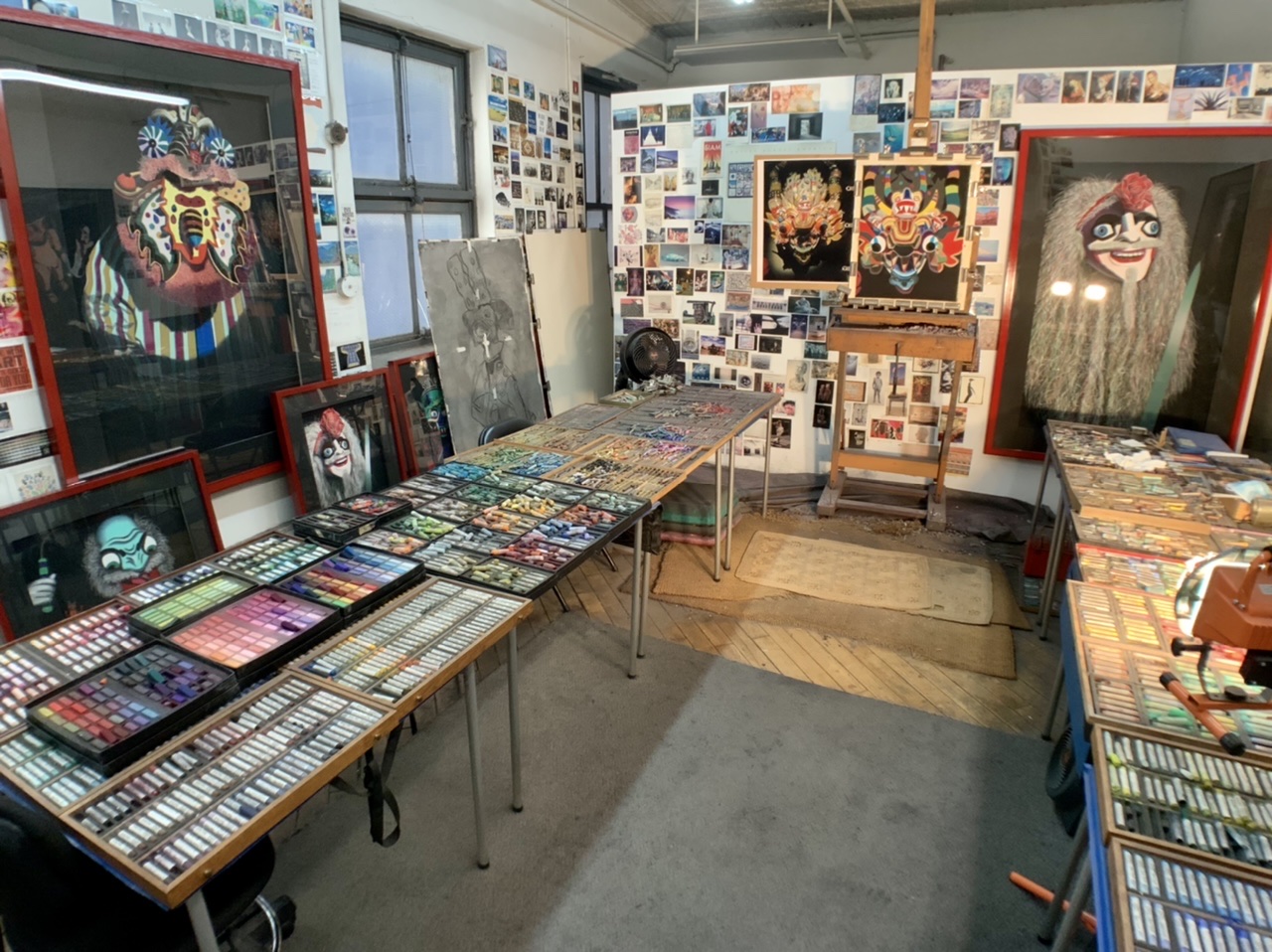
Nowadays, a global audience will see art on their phones instead of in our studios or in a gallery or museum. My pastel paintings are quite large and very detailed so when people finally see them in person, they are often surprised. They had gotten used to seeing them in a much smaller scale online, where very few of the meticulous and subtle details I incorporate into them are visible.
Comments are welcome!
Q: When you’re not creating art what’s your next favorite creative activity?

Hudson Yards, NYC iPad Photo
A: I love taking photographs with my iPad Pro! It has a 12.9″ screen so I can see every detail of the image. It is equivalent to using an 8 x 10 view camera with the advantages of being relatively lightweight and portable; does not require a tripod, a hood, or other special equipment like individual film holders; and the image appears right side up on the screen. It’s a perfect camera!
I have owned and used many film and digital cameras, but my iPad Pro has been my favorite for several years now. It’s great for my specific needs. I take it all over the world!
Comments are welcome!
Pearls from artists* # 521

*an ongoing series of quotations – mostly from artists, to artists – that offers wisdom, inspiration, and advice for the sometimes lonely road we are on.
But on the whole, I’m taking into consideration, at the point of the cut, where the audience’s eye is and what direction it’s moving, and with what speed. The editor has to imagine the audience’s point of attention when the film is projected, and has to be able to predict where ninety-nine percent of the audience is looking at any moment… I have to be able to say with some certainty that at such-and-such a moment ninety-nine percent of the audience will be looking at this point on the screen, and in the next second they will be looking here. That means that their eye is travelling, say, left to right, to the upper corner of the frame, at a certain speed. If I choose to cut at this point – at frame 17 – I know that at that moment their eye is right here, in the Cartesian grid of the screen.
That’s a very valuable piece of information. When I select the next shot, I choose a frame that has an interesting visual at exactly that point, where the audience’s eye is at the moment of the cut, to catch and redirect their attention somewhere else. Every shot has its own dynamic. One of the editor’s obligations is to carry, like a sacred vessel, the focus of attention of the audience and move it in interesting ways around the surface of the screen.
This is exactly what I do as I work to compose my pastel paintings! – BR
In The Conversations: Walter Murch and the Art of Editing Film by Michael Ondaatje
Comments are welcome!
Pearls from artists* # 483

*an ongoing series of quotations – mostly from artists, to artists – that offers wisdom, inspiration, and advice for the sometimes lonely road we are on.
The editor has a unique relationship with the actors. I never try to go on to the set to see the actors out of costume or out of character – and also just not to see the set. I only want to see what there is on screen. Ultimately, that’s all the audience is ever going to see. Everyone else working on the film at that stage is party to everything going on around the filmed scene: how cold it was when that scene was shot; who was mad at whom; who is in love with whom; how quickly something was done; what was standing just to the left of the frame. An editor particularly has to be careful that those things don’t exert a hidden influence on the way the film is constructed, can (and should in my view) remain ignorant of all that stuff – in order to find value where others might not see value, and on the other hand, to diminish the value of certain things that other people see as too important. It’s one o the crucial functions of the editor. To take, as far as it is possible, the view of the audience, who is seeing the film without any knowledge of all the things that went into its construction.
On Editing Actors, by Walter Murch in The Conversations: Walter Murch and the Art of Editing Film, by Michael Ondaatje
Comments are welcome!
Pearls from artists* # 472
*an ongoing series of quotations – mostly from artists, to artists – that offers wisdom, inspiration, and advice for the sometimes lonely road we are on.
A remark by Kurt Anderson suggests how the Internet discourages patient gazing: “Waiting a while to get everything you want… was a definition of maturity. Demanding satisfaction right this instant, on the other hand, is a defining behavior of seven-year-olds. The powerful appeal of the Web is not just the ‘community’ it enables but its instantane-ity… as a result… delayed gratification itself came to seem quaint and unnecessary.” A survey commissioned by the Visitor Studies Association reveals the impact of impatience. On average, the survey found, Americans spend between six and ten seconds looking at individual works in museums. (Is it just a coincidence that six to ten seconds is also the average time browsers perch on any given Web page?) Yet how many hours a day do we spend absorbed by one or another electronic screen? For the Los Angeles artist Ed Ruscha (born 1937) brief encounters won’t suffice. When somebody asked, “How can you tell good art from bad?” Ruscha replied, “With a bad work you immediately say, ‘Wow!’ But afterwards, you think, ‘Hum? Maybe not.’ With a good work, the opposite happens.” Time is lodged at the heart of Ruscha’s formula, as the artwork becomes part of our temporal experience. In order to know what is good, we need to take a breather. Even to know what is bad, we need to pause.
Arden Reed in Slow Art: The Experience of Looking, Sacred Images to James Turrell
Comments are welcome!
Pearls from artists* # 43
Boulder, CO
* an ongoing series of quotations – mostly from artists, to artists – that offers wisdom, inspiration, and advice for the sometimes lonely road we are on.
Why would anyone read a book instead of watching big people move on a screen? Because a book can be literature. It is a subtle thing – a poor thing, but our own. In my view, the more literary the book – the more purely verbal, crafted sentence by sentence, the more imaginative, reasoned, and deep – the more likely people are to read it. The people who read are the people who like literature, after all, whatever that might be. They like, or require, what books alone have. If they want to see films that evening, they will find films. If they do no like to read, they will not. People who read are not too lazy to flip on the television; they prefer books. I cannot imagine a sorrier pursuit than struggling for years to write a book that attempts to appeal to people who do not read in the first place.
Annie Dillard in The Writing Life
Comments are welcome!


 barbararachkoscoloreddust.com