Blog Archives
Q: How important is the feedback of your audience? Do you ever think about who will enjoy your Art when you conceive it?

Painting, subject, reference photo
A: I can’t say that I think at all about audience reaction while I’m creating a painting in my studio. Although, of course I want people to respond favorably to the work.
Generally, I’m thinking about technical problems – making something that is exciting to look at, well-composed, vibrant, up to my exacting standards, etc. When I finish a painting, it is the best thing I am capable of making at that moment in time.
I think about a painting and look at it for so long and with such intensity, that it could hardly have turned out any differently. There is an inevitability to the whole lengthy process that goes all the way back to when I first laid eyes on the folk art figures in a dusty shop in a third world country. Looking at a newly-finished painting on my easel I often think, “Of course! I was drawn to this figure so that it could serve this unique function in this painting.”
Comments are welcome!
Q: What does your creative process look like when you are ready to begin a new painting?

Preliminary sketch
A: My working methods have changed dramatically over the years with my current process being a much-simplified version of how I used to work. In other words as I pared down my imagery in the “Black Paintings,” my process quite naturally pared down, too.
One constant is that I have always worked in series with each pastel painting leading quite logically to the next. Another is that I always have set up a scene, lit and photographed it, and worked with a 20″ x 24″ photograph as the primary reference material. In the “Domestic Threats” series I shot with a 4″ x 5″ view camera. Nowadays the first step is to decide which photo I want to make into a painting (currently I have a backlog of images to choose from) and to order a 19 1/2″ x 19 1/2″ image (my Mamiya 6 shoots square images and uses film) printed on 20″ x 24″ paper. I get the print made at Manhattan Photo on West 20th Street in New York. Typically I have in mind the next two or three paintings that I want to create.
Once I have the reference photograph in hand, I make a preliminary tonal charcoal sketch on a piece of white drawing paper. The sketch helps me think about how to proceed and points out potential problem areas ahead. For example, in the photograph above I had originally thought about creating a vertical painting, but changed to horizontal format after discovering spatial problems in my sketch.
Also, I decided to make a small painting now because it has been two years since I last worked in a smaller (than my usual 38″ x 58″) size. I am re-using the photograph on which “Epiphany” is based. Using a photograph a second time lets me see how my working methods have evolved over time.
Comments are welcome!
Pearls from artists* # 30
East Hampton house
* an ongoing series of quotations – mostly from artists, to artists – that offers wisdom, inspiration, and advice for the sometimes lonely road we are on.
And, just as the analysis of a film by a psychoanalyst can tell us about some implications and some sources of a labour that is all the less tightly under our control since the material problems we encounter during it make us insensible to tiredness and leave our unconscious quite free, so the interpretation of one of our works by the mind of an outsider can show it to us from a new, and revealing perspective.
How disturbed we should be, were there some machine that would allow us to follow the thousand brains in a cinema! No doubt, we should stop writing. We should be wrong to do so, but it would be a hard lesson. What Jules de Noailles said (recounted by Liszt) is true: ‘You will see one day that it is hard to speak about anything to anyone.’ Yet it is equally true that each person takes in or rejects the sustenance that we offer, and that the people who absorb it, do so in their own way; and this it is that determines the progress of a work through the centuries, because if a work were to send back only a perfect echo, the result would be a kind of pleonasm, an inert exchange, a dead perfection.
Andre Bernard and Claude Gauteur, editors, Jean Cocteau: The Art of Cinema
Comments are welcome!
Q: What’s on the easel today?
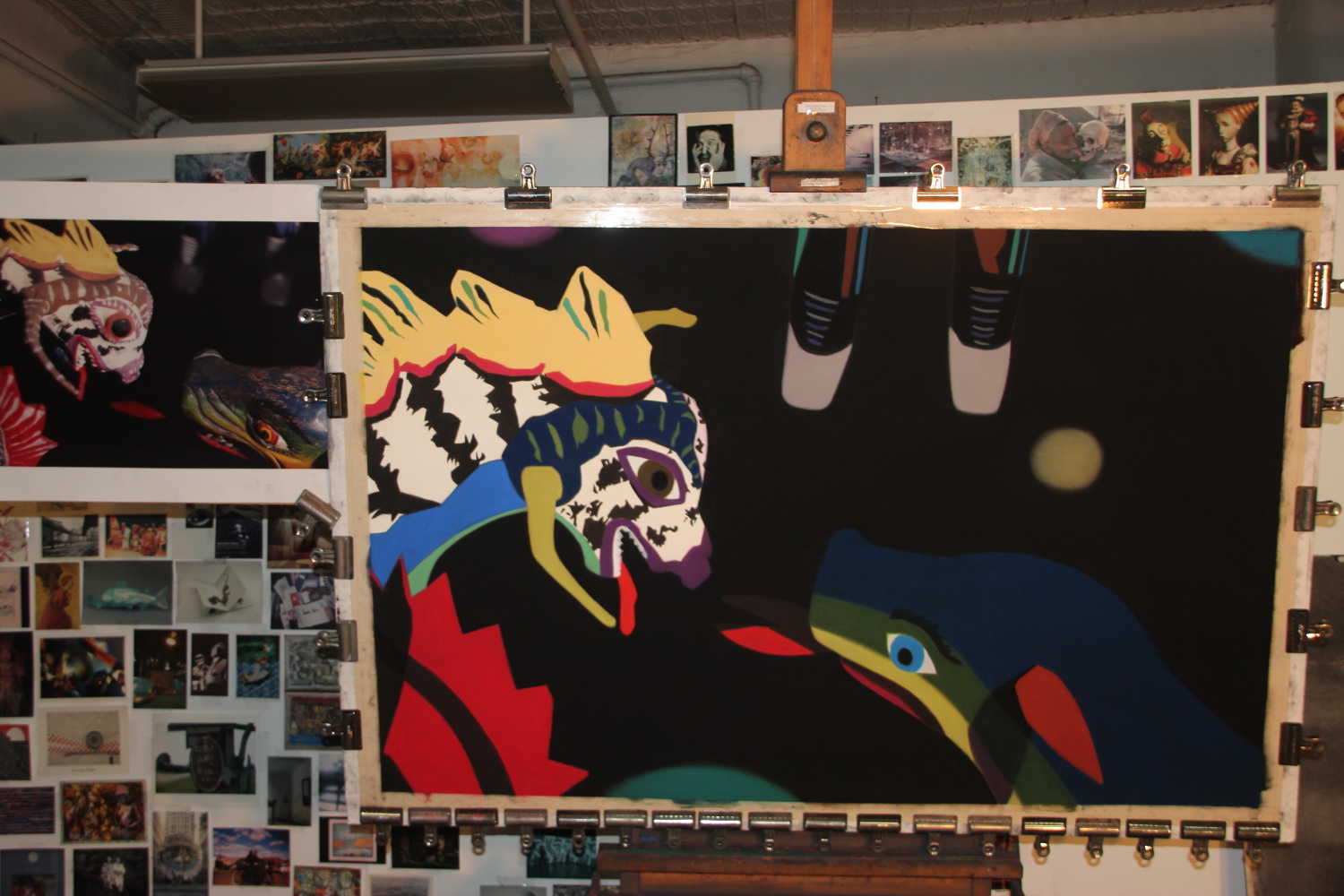
“Stalemate” in progress, soft pastel on sandpaper
A: A large pastel painting with the working title, “Stalemate.” For this one I went back and looked at some of my older 35 mm negatives. I selected one from 2002 and made the photographic print you see above, clipped to the left side of my easel. This piece is unusual because I’m painting the figures much larger than life size. I like what’s happening, but it’s slow going.
The title, “Stalemate,” is one I thought of some twenty-odd years ago, when I worked on a very different pastel painting – a table top still life – by that name. Somehow I couldn’t resolve some problems in the composition so I never finished it. I haven’t seen it in years, but it’s probably sitting in my Alexandria basement someplace.
Comments are welcome!


 barbararachkoscoloreddust.com