Blog Archives
Q: How important is the feedback of your audience? Do you ever think about who will enjoy your Art when you conceive it?

Painting, subject, reference photo
A: I can’t say that I think at all about audience reaction while I’m creating a painting in my studio. Although, of course I want people to respond favorably to the work.
Generally, I’m thinking about technical problems – making something that is exciting to look at, well-composed, vibrant, up to my exacting standards, etc. When I finish a painting, it is the best thing I am capable of making at that moment in time.
I think about a painting and look at it for so long and with such intensity, that it could hardly have turned out any differently. There is an inevitability to the whole lengthy process that goes all the way back to when I first laid eyes on the folk art figures in a dusty shop in a third world country. Looking at a newly-finished painting on my easel I often think, “Of course! I was drawn to this figure so that it could serve this unique function in this painting.”
Comments are welcome!
Q: What is it about soft pastel that you find so intriguing that you use it as your primary fine art medium?

Some of Barbara’s pastels
A: For starters it’s the medium that I fell in love with many years ago. I recently read this article online, “What is Pastel?” by Mike Mahon, and will quote it because it neatly sums up what I love about working with pastel.
Pastel is the most permanent of all media when applied to conservation ground and properly framed. Pastel has no liquid binder that may cause it to oxidize with the passage of time as oftentimes happens with other media.
In this instance, Pastel does not refer to pale colors, as the word is commonly used in cosmetic and fashion terminology. The pure, powdered pigment is ground into a paste with a minimum amount of gum binder, rolled into sticks and dried. The infinite variety of colors in the Pastel palette range from soft and subtle to hard and brilliant.
An artwork is created by stroking the stick of dry pigment across an abrasive ground, embedding the color in the “tooth” of the ground. If the ground is completely covered with Pastel, the work is considered a Pastel painting; whereas, leaving much of the ground exposed produces a Pastel sketch. Techniques vary with individual artists. The Pastel medium is favored by many artists because it allows a spontaneous approach. There is no drying time, therefore, no change in color occurs after drying as it does in other media.
Did you know that a particle of Pastel pigment seen under a microscope looks like a diamond with many facets? It does! Therefore, Pastel paintings reflect light like a prism. No other medium has the same power of color or stability.
Historically, Pastel can be traced back to the 16th century. Its invention is attributed to the German painter, Johann Thiele. A Venetian woman, Rosalba Camera, was the first to make consistent use of Pastel. Chardin did portraits with an open stroke, while La Tour preferred the blended finish. Thereafter, a galaxy of famous artists—Watteau, Copley, Delacroix, Millet, Manet, Renoir, Toulouse Lautrec, Vuillard, Bonnard, Glackens, Whistler, Hassam, William Merritt Chase—used Pastel for a finished work rather than for preliminary sketches.
Pastels from the 16th century exist today, as fresh as the day they were painted. Edgar Degas was the most prolific user of Pastel and its champion. His protégé, Mary Cassat, introduced Pastel to her friends in Philadelphia and Washington, and thus to the United States. In the Spring of 1983, Sotheby Parke Bernet sold at auction, two Degas Pastels for more than $3,000,000 each! Both Pastels were painted about 1880.
Note: Do not confuse Pastel with “colored chalk.” Chalk is a porous, limestone substance impregnated with dyes, whereas, Pastel is pure pigment—the same as is used in other permanent painting media.
Today, Pastel paintings have the stature of oil and watercolor as a major fine art medium. Many of our most renowned, living artists have distinguished themselves in Pastel and have enriched the art world with this beautiful medium.
So knowing all this, I often wonder, why don’t more artists use pastel? Is it because framing is a big issue? Works on paper need to be framed and pastel paintings have unique problems (see my April 27, 2013 blog post). Second only to the cost of maintaining a studio in New York City, frames are my single largest business expense. Sometimes I am grateful that pastel is a very slow medium. I typically finish 4 or 5 paintings in a year, which means I only have to pay for 4 or 5 frames!
Comments are welcome!
Q: The handmade frames on your large pastel-on-sandpaper paintings are quite elaborate. Can you speak more about them?
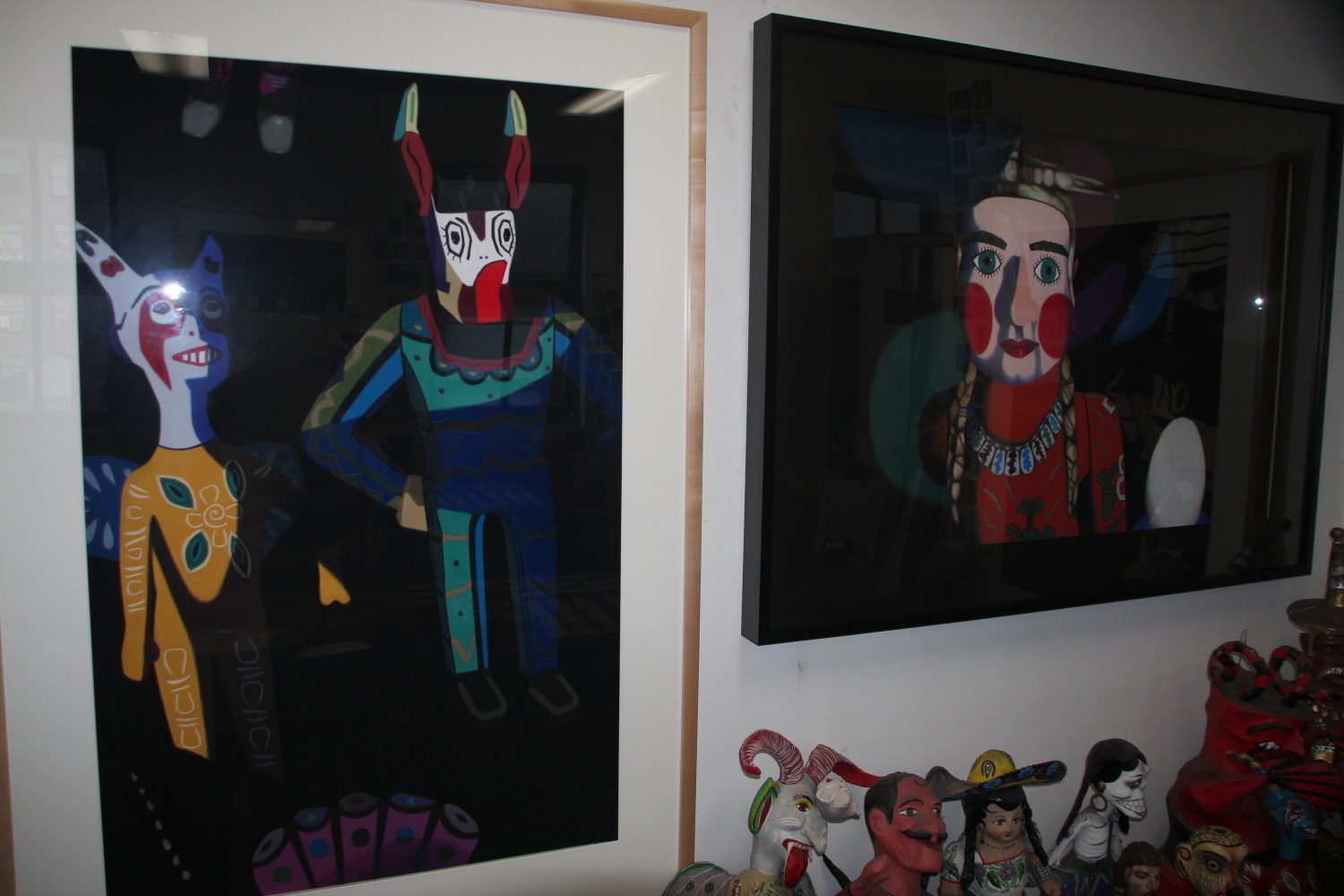
“Quartet” (left) and “Epiphany,” soft pastel on sandpaper
A: I have been working in soft pastel since 1986, I believe, and within six years the sizes of my paintings increased from 11″ x 14″ to 58″ x 38.” (I’d like to work even bigger, but the limiting factors continue to be first, the size of mat board that is available and second, the size of my pick-up truck). My earliest work is framed with pre-cut mats, do-it-yourself Nielsen frames, and glass that was cut-to-order at the local hardware store. With larger-sized paintings DIY framing became impractical. In 1989 an artist told me about Underground Industries, a custom framing business in Fairfax, Virginia, run by Rob Plati, his mother, Del, and until last year, Rob’s late brother, Skip. So Rob and Del have been my framers for 24 years. When I finish a painting in my New York studio, I drive it to Virginia to be framed.
Pastel paintings have unique problems – for example, a smudge from a finger, a stray drop of water, or a sneeze will ruin months of hard work. Once a New York pigeon even pooped on a finished painting! Framing my work is an ongoing learning experience. Currently, my frames are deep, with five layers of acid-free foam core inserted between the painting and the mat to separate them. Plexiglas has a static charge so it needs to be kept as far away from the pastel as possible, especially since I do not spray finished pastel paintings with fixative.
Once they are framed, my paintings cannot be laid face down. There’s a danger that stray pastel could flake off. If that happens, the whole frame needs to be taken apart and the pastel dust removed. It’s a time-consuming, labor-intensive process and an inconvenience, since Rob and Del, the only people I trust with my work, are five hours away from New York by truck.
Comments are welcome!


 barbararachkoscoloreddust.com