Blog Archives
Pearls from artists* # 86

“Broken,” 38″ x 58,” soft pastel on sandpaper
* an ongoing series of quotations – mostly from artists, to artists – that offers wisdom, inspiration, and advice for the sometimes lonely road we are on.
When I’m working from a photograph, a transparency, or direct observation, I am always amazed at how much more I see as the painting progresses. After I think I have completely perceived a particular area, something else reveals itself. As the work continues, the level of awareness deepens. The process takes it’s own time. I have come to accept that time and not fight it. I know that when I begin my work, no matter how hard I try, I’ll never observe as much on the first day as I will on the last. Like life, the development will not be rushed, nor will there be full realization before completion.
Dr. Leopold Caligor, a prominent New York psychiatrist, says that he listens to tapes of recorded sessions with patients, he hears new things and gains deeper insights. Each time he listens, more information is uncovered. This process is repeated until understanding is complete.
Audrey Flack in Art & Soul: Notes on Creating
Comments are welcome!
Q: What’s the point of all of this? Shouldn’t we be discussing how to end poverty or promote world peace? What can art do?
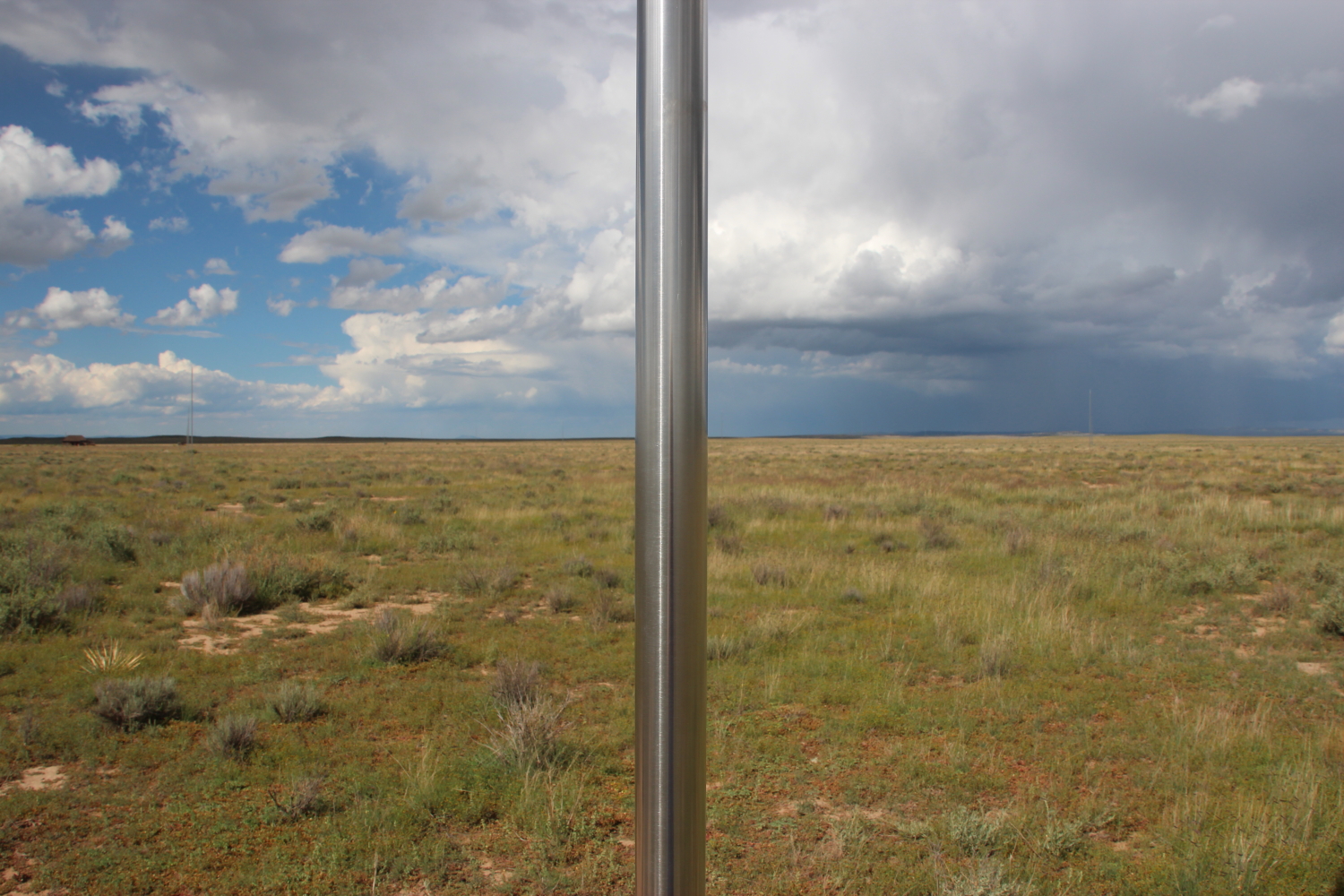
Lightning Field, Quemado, NM
A: I happen to recently have read an inspiring book by Anne Bogart, the theater director. It’s called, “and then you act: making art in an unpredictable world” and she talks about such issues. I’ll quote her wise words below:
“Rather than the experience of life as a shard, art can unite and connect the strands of the universe. When you are in touch with art, borders vanish and the world opens up. Art can expand the definition of what it means to be human. So if we agree to hold ourselves to higher standards and make more rigorous demands on ourselves, then we can say in our work, ‘We have asked ourselves these questions and we are trying to answer them, and that effort earns us the right to ask you, the audience, to face these issues, too.’ Art demands action from the midst of the living and makes a space where growth can happen.
One day, particularly discouraged about the global environment, I asked my friend the playwright Charles L. Mee, Jr., ‘How are we supposed to function in these difficult times? How can we contribute anything useful in this climate?’ ‘Well,’ he answered, ‘You have a choice of two possible directions. Either you convince yourself that these are terrible times and things will never get better and so you decide to give up, or, you choose to believe that there will be a better time in the future. If that is the case, your job in these dark political and social times is to gather together everything you value and become a transport bridge. Pack up what you cherish and carry it on your back to the future.'”
“… In the United States, we are the targets of mass distraction. We are the objects of constant flattery and manufactured desire. I believe that the only possible resistance to a culture of banality is quality. To me, the world often feels unjust, vicious, and even unbearable. And yet, I know that my development as a person is directly proportional to my capacity for discomfort. I see pain, destructive behavior and blindness of the political sphere. I watch wars declared, social injustices that inhabit the streets of my hometown, and a planet in danger of pollution and genocide. I have to do something. My chosen field of action is the theater.”
Comments are welcome!
Q: Can you discuss your process, including how you actually use Mexican and Guatemalan folk art figures in your art?

A corner of Barbara’s studio
A: When I set up the figures to photograph for a painting, I work very intuitively, so how I actually cast them in an artwork is difficult to say. Looks count a lot – I select an object and put it in a particular place, look at it, move it or let it stay, and sometimes develop a storyline. I spend time arranging lights and looking for interesting cast shadows. With my first “Domestic Threats” series, all of this was done so that Bryan, my late husband, or I could shoot a couple of negatives with his Toyo Omega 4″ x 5″ view camera. For my “Black Paintings” series, begun in 2007, I shoot medium format negatives with a Mamiya 6 camera.
I always look at a 20″ x 24″ photograph for reference as I make a pastel-on-sandpaper painting, plus I also work from the ‘live’ objects. The photograph is mainly a catalyst because finished paintings are always quite different from their associated reference photos. Also, since I spend months creating them, the paintings’ interpretative development goes way beyond that of the photo.
I once completed 6 large (58” x 38”) pastel paintings in a single year, but more recently 4 or 5 per year is common. It takes approximately 3 months to make each one. During that time I layer and blend together as many as 25 to 30 layers of pastel. Of course, the colors get more intense as the painting progresses and the pigment accumulates on the sandpaper.
Comments are welcome!
Pearls from artists # 19
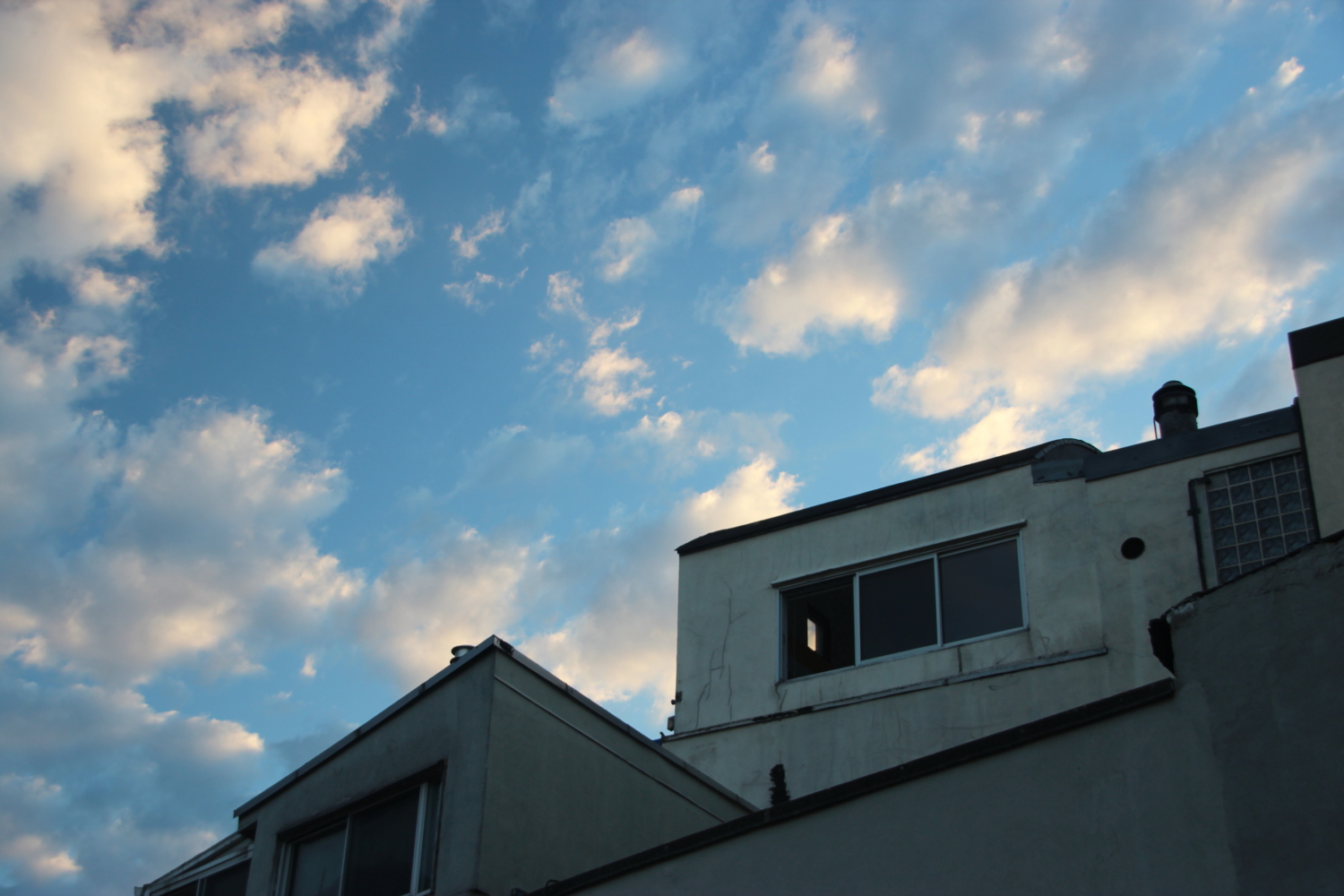
View from the balcony
* an ongoing series of quotations – mostly from artists, to artists – that offers wisdom, inspiration, and advice for the sometimes lonely road we are on.
What one writes at twenty-one is a cry, does one think of a cry that it ought to have been cried differently? The language is still so thin about one in these years, the cry pierces through and just takes along what is left clinging to it. The development will always be this, that one makes one’s language fuller, thicker, firmer (heavier), and of course there is sense in that only for one who is sure that the the cry too is growing in him ceaselessly, irresistibly, so that later, under the pressure of countless atmospheres, it will issue evenly from every pore of the almost impenetrable medium…
Talent, you understand, scarcely has significance any more in our day, since a certain dexterity of expression has become general, where is it not? Hence succeeding still means something only where the highest, utmost is achieved, and then one is again liable to think that just this unsurpassable something, once it appears in person, is in itself successful.
And so there is no real ground for concern, only that we want never to remain behind our heart and never to be in advance of it: that is probably needful. Thus we arrive at everything, each at what is his.
Jane Bannard Greene and M.D. Herter Norton editors, Letters of Rainer Maria Rilke 1910 – 1926
Comments are welcome!
Pearls from artists* # 12

Grand Falls, AZ
* an ongoing series of quotations – mostly from artists, to artists – that offers wisdom, inspiration, and advice for the sometimes lonely road we are on.
People who set their sails into art tend to work very hard. They train themselves in school; they practice and they read and they think and they talk. But for most of them there seems to be a more or less conscious cutoff point. It can be a point in time: “I will work until I am twenty-one (twenty-five, thirty, or forty).” Or a point in effort: “I will work three hours a day (or eight or ten).” Or a point in pleasure: “I will work unless…” and here the “enemies of promise” harry the result. These are personal decisions, more or less of individual will. They depend on the scale of values according to which artists organize their lives. Artists have a modicum of control. Their development is open-ended. As the pressure of their work demands more and more of them. they can stretch to meet it. They can be open to themselves, and as brave as they can be to see who they are, what their work is teaching them. This is never easy. Every step forward is a clearing through a thicket of reluctance and habit and natural indolence. And all the while they are at the mercy of events. They may have a crippling accident, or may find themselves yanked into a lifelong responsibility such as the necessity to support themselves and their families. Or a war may wipe out the cultural context on which they depend. Even the most fortunate have to adjust the demands of a personal obsession to the demands of daily life.
Anne Truitt, Daybook: The Journal of an Artist
Comments are welcome.


 barbararachkoscoloreddust.com