Blog Archives
Q: What kind of art do you create?
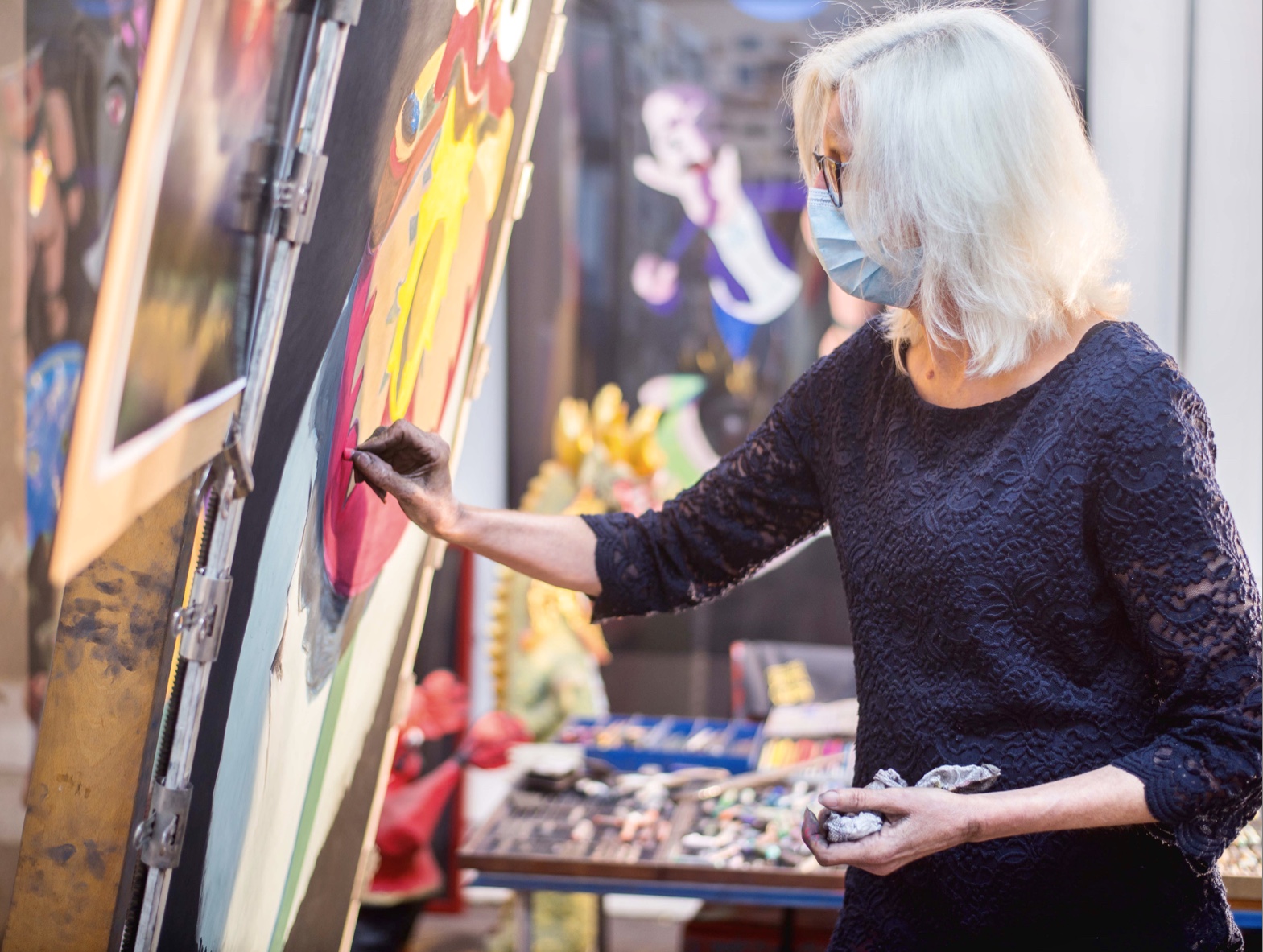
At work
A: I live in the West Village in New York City and have been a working artist for thirty-four years. I create original pastel paintings that use my large collection of Mexican and Guatemalan folk art – masks, carved wooden animals, papier mache figures, and toys – as subject matter. Blending with my fingers, I spend months painstakingly applying dozens of layers of soft pastel onto acid-free sandpaper. My self-invented technique achieves extraordinarily rich, vibrant color and results in paintings that uniquely combine reality, fantasy, and autobiography. Please see https://barbararachko.art/en/
For the last three years I have been working on a series called, “Bolivianos,” based on an exhibition of Carnival masks seen in La Paz. Art critics and others have said that these are my strongest pastel paintings so far. As I write I am working on the fifteenth piece in the series.
Comments are welcome!
Q: What’s on the easel today?

Work in progress
A: I recently started a new 26” x 20” pastel painting that is number 16 in the “Bolivianos” series. More about this work at
https://barbararachko.art/en/paintings/bolivianos
Comments are welcome!
Q: What’s on the easel today?
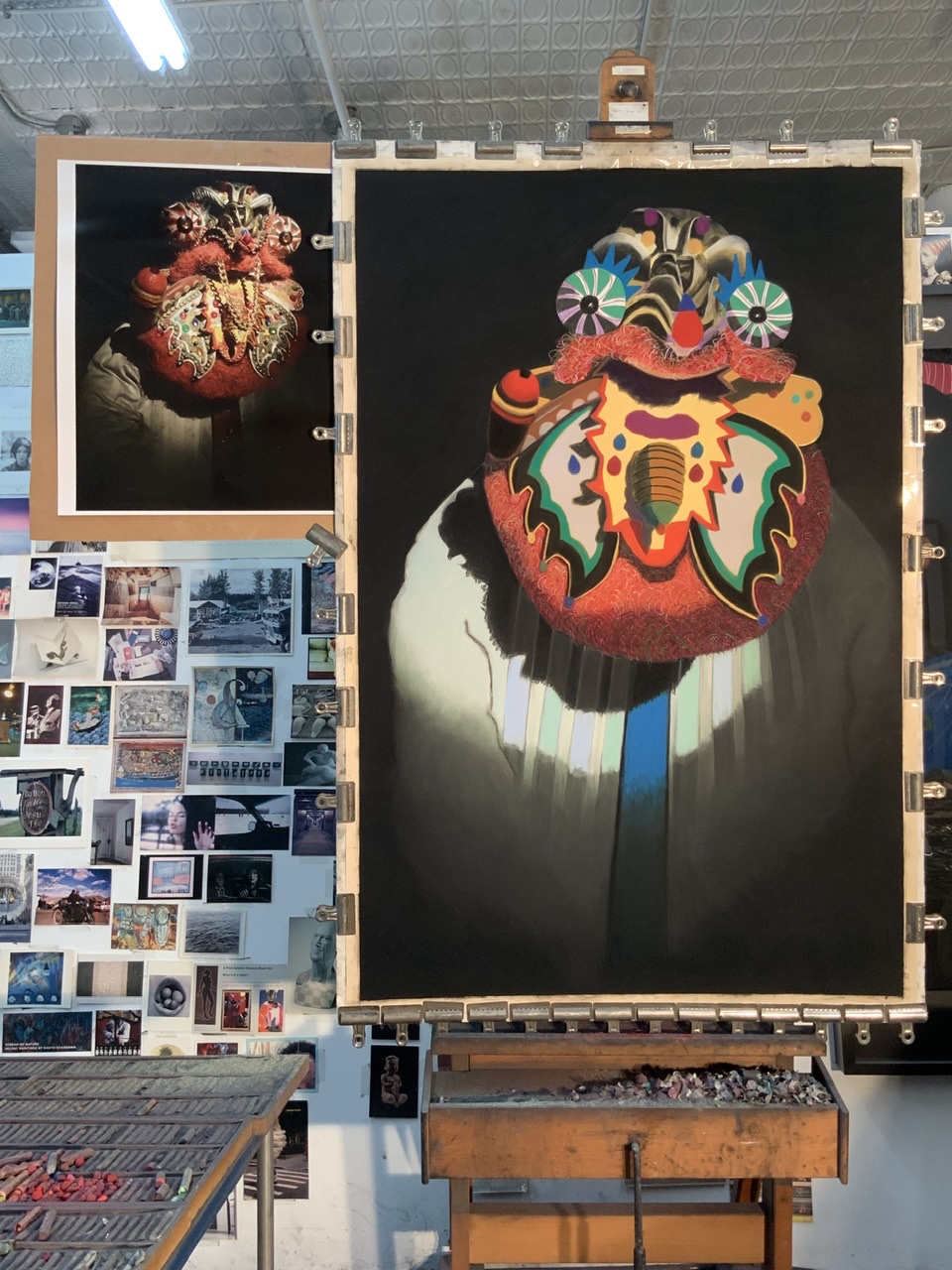
Work in progress
A: Amidst the noisy construction happening next door, I continue slowly working on “Jokester” (tentative title), soft pastel on sandpaper, 58” x 38.” I’ve just begun to add stripes into the shirt.
It is the fifteenth piece in the “Bolivianos” series. Read more about this work at https://barbararachko.art/en/paintings/bolivianos
Comments are welcome!
Q: Can you give us your current elevator pitch?
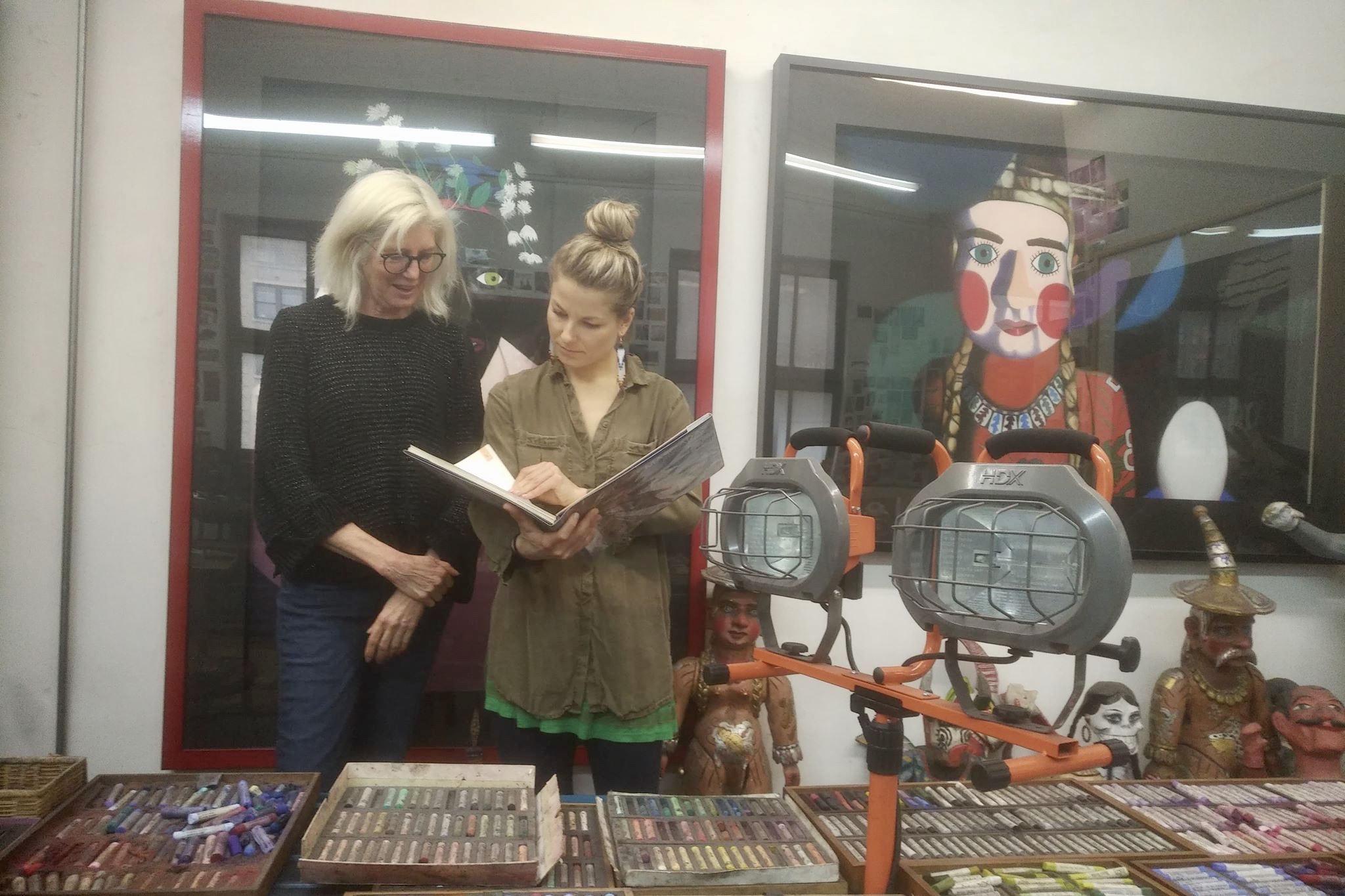
Discussing Bolivian masks with Nika, Photo: David De Hannay
A: Here it is:
I am a New York visual artist, blogger, and author. For thirty-four years I have been creating original pastel-on-sandpaper paintings that depict my large collection of Mexican and Guatemalan folk art – masks, carved wooden animals, papier mache figures, and toys. “Bolivianos,” my current series, is based on a mask exhibition I saw and photographed in La Paz in 2017 at the National Museum of Folklore and Ethnography.
My technique is self-invented and involves applying dozens of layers of soft pastel onto acid-free sandpaper to create new colors directly on the paper. Each pastel painting takes several months to complete. Typically, I make four or five each year. I achieve extraordinarily rich, vibrant color in pastel paintings that are a unique combination of reality, fantasy, and autobiography.
My background is unusual for an artist. I am a pilot, a retired Navy Commander, and a 9/11 widow. Besides making art, I am a published blogger and author best known for my popular blog, “Barbara Rachko’s Colored Dust” (53,000+ subscribers!) and my eBook, “From Pilot to Painter,” on Amazon and iTunes.
Please see images and more at http://barbararachko.art/en/
Comments are welcome!
Q: Travel is an essential aspect of your work. How do you decide where to travel next?
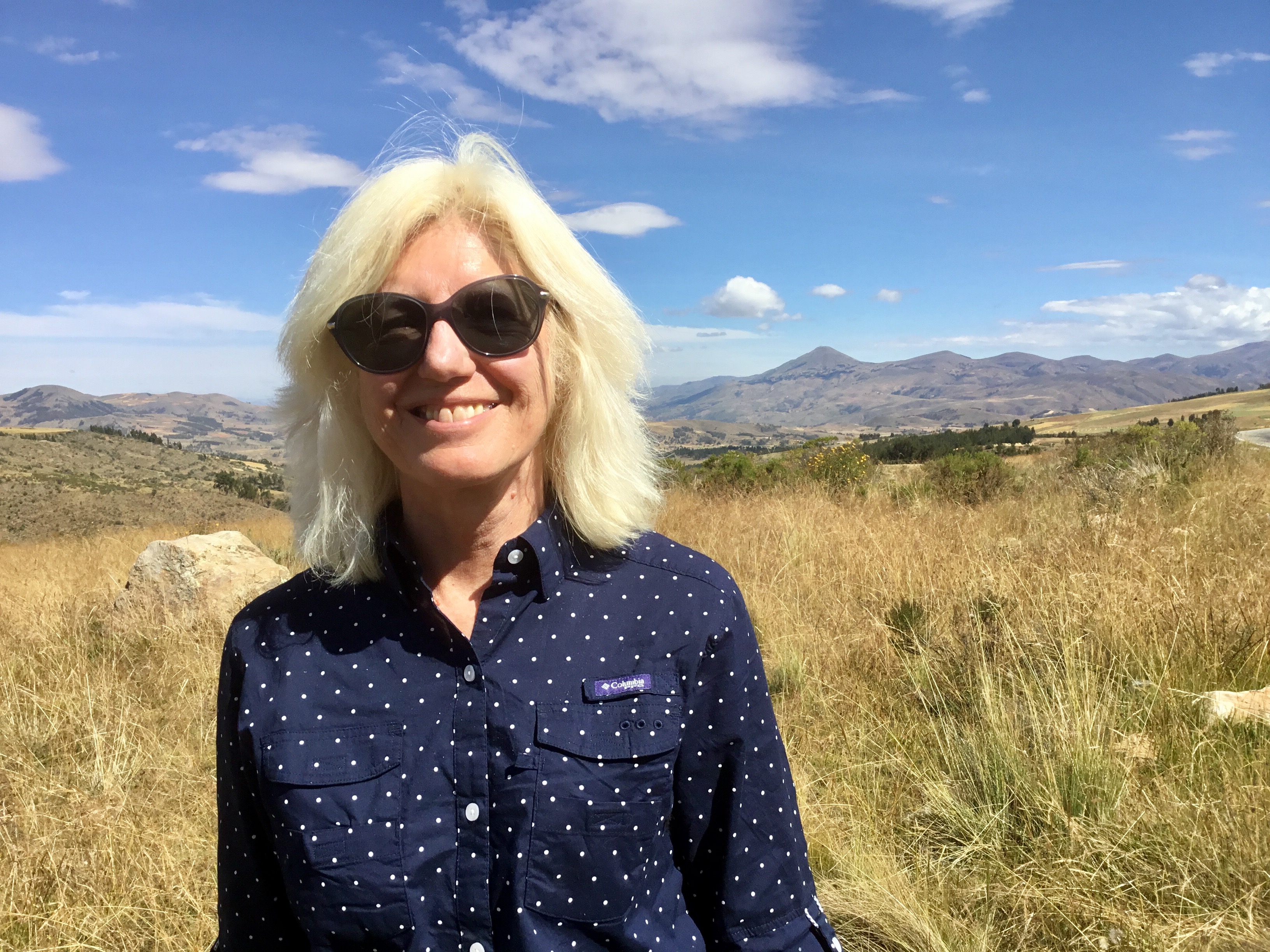
In the Bolivian Andes at about 14,000’
A: Generally, I am most interested in exploring Mexico and destinations in Central and South American because they offer endless inspiration to further my work. I’m not exactly certain why this is the case. I DO know that I cannot get enough of travel to points south!
My 2017 trip to Bolivia proved to be crucial for my current pastel painting series. “Bolivianos” is based on an exhibition of Carnival masks encountered at the National Museum of Ethnology and Folklore in La Paz.
I had high hopes of making a return visit – along with a private tour guide – last February. However, since President Moreno resigned last November, much political instability, violence, and turmoil resulted. I would not have felt safe traveling to Oruro to see Carnival celebrations this year.
In the mean time I look forward to traveling to Chile, the Atacama Desert, and Easter Island next winter!
Comnents are welcome!
Q: What’s on the easel today?
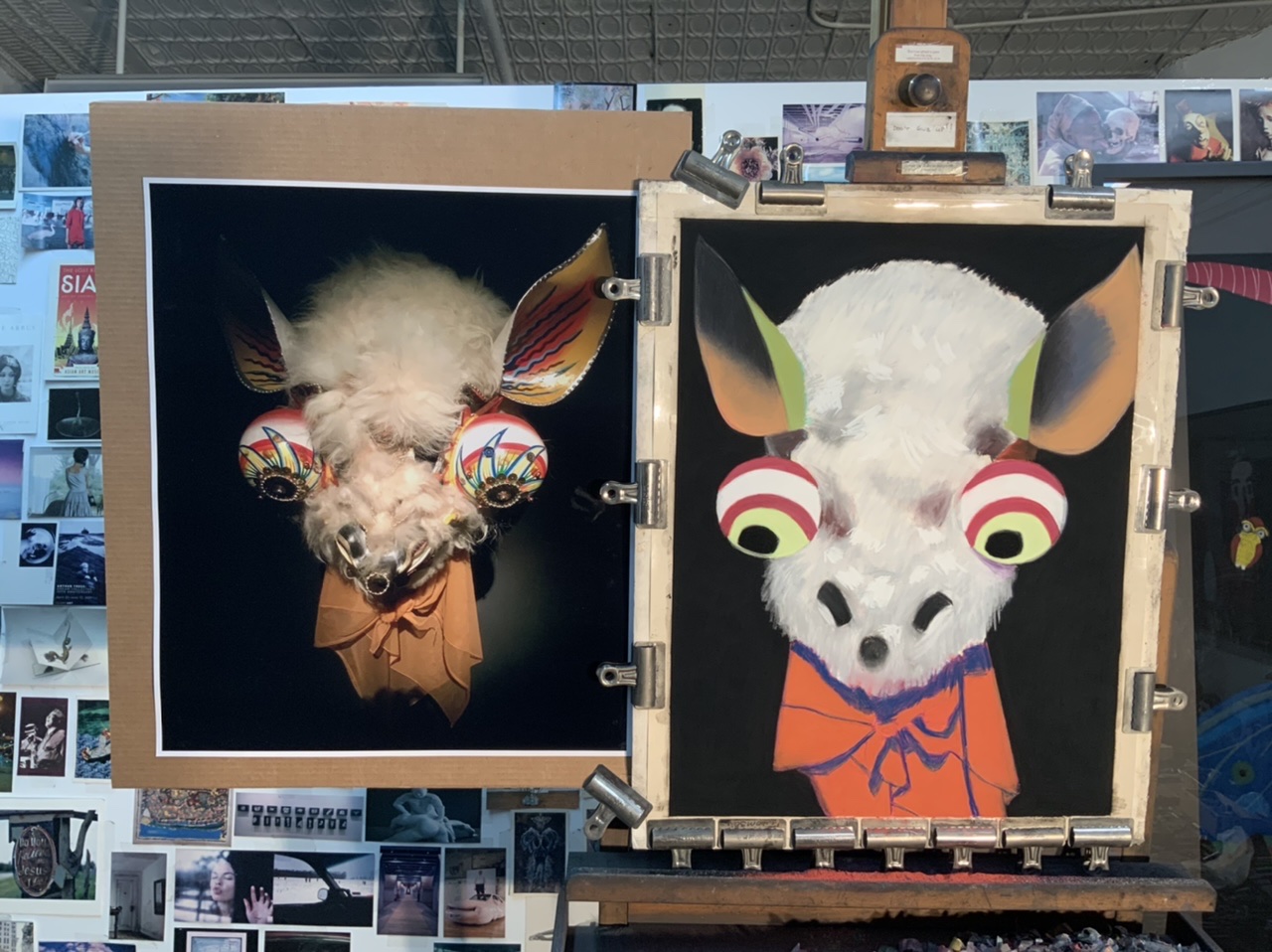
Work in progress
A: I’m working on a 26” x 20” pastel painting that will be number 14 in the “Bolivianos” series. This is very early in the process.
Comments are welcome!
Q: What’s on the easel today?
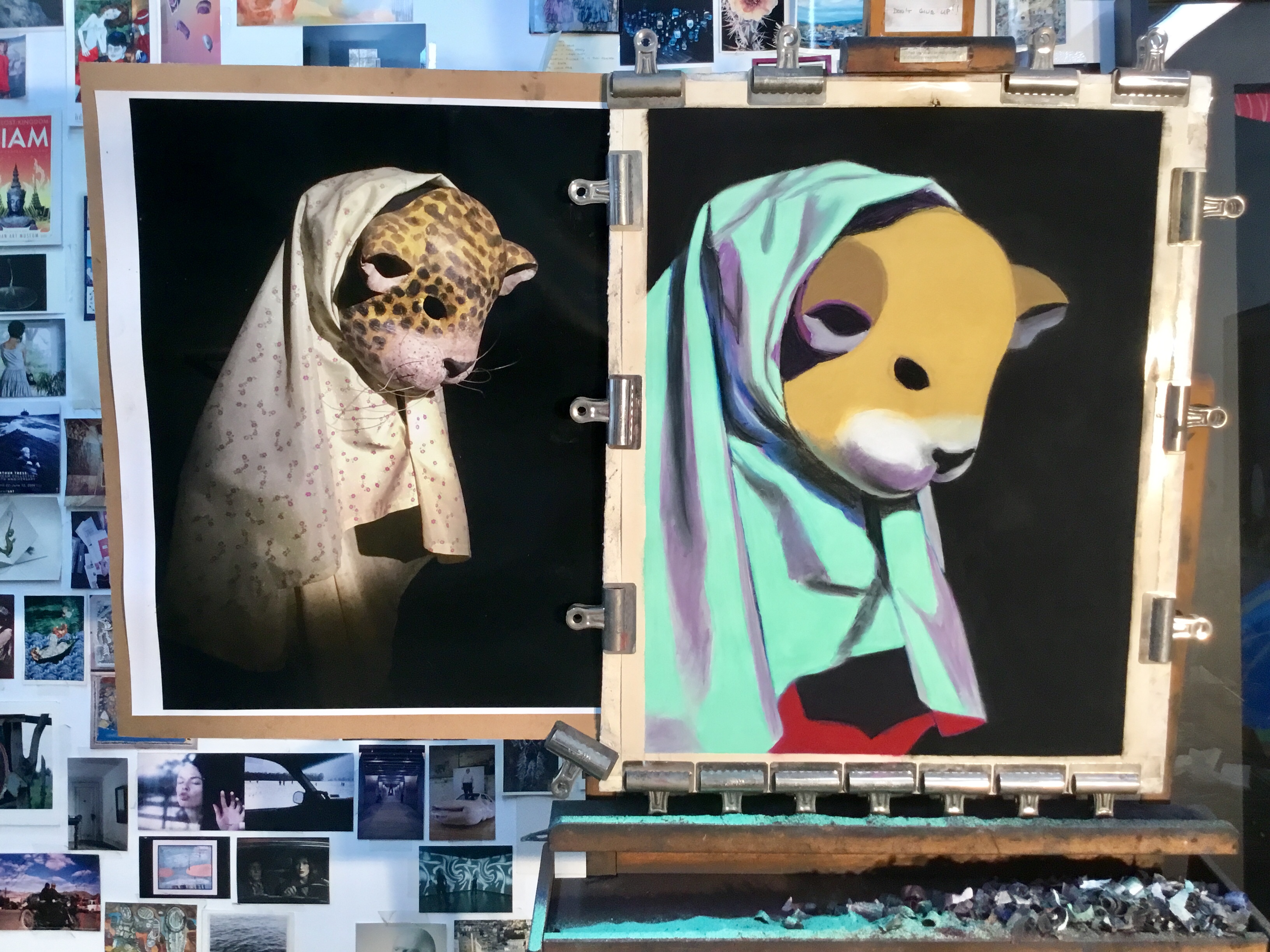
Work in progress
A: I’m at the beginning on a small (26” x 20”) pastel painting. The subject is a jaguar mask I photographed in La Paz. This is painting number eleven in the “Bolivianos” series. Lots of green colored dust now!
Comments are welcome!
Q: During one of the most gripping times of your life, you were personally affected by the 9/11 attack on our country. Your husband was killed on the plane that crashed into the Pentagon. Would you mind telling us about it and how it has shaped your work?
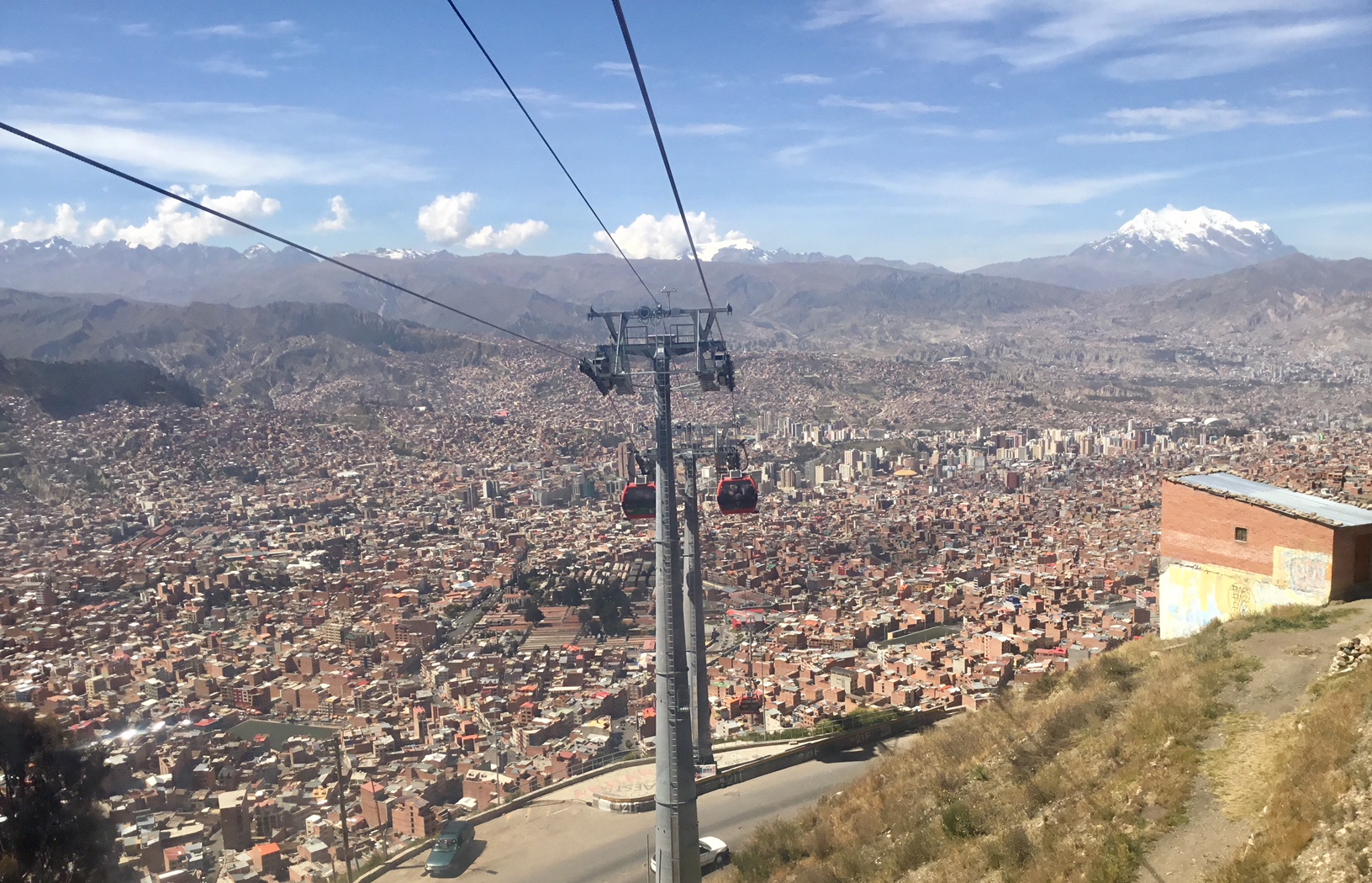
‘Mi Teleferico’ line, La Paz, Bolivia
A: In the summer of 2002 I was ready to – I HAD to – get back to work in my studio. I knew exactly what I must do. More than ever before, learning and painting would become the avenues to my well-being.
Because I use reference photos for my pastel paintings, the first challenge was to learn how to use Bryan’s 4 x 5 view camera. At that time I was not a photographer. Bryan had always taken reference photos for me.
In July 2002 I enrolled in a view camera workshop at New York’s International Center of Photography. Much to my surprise I had already absorbed quite a lot from watching Bryan. After the initial workshop, I continued more formal studies of photography for several years. In 2009, I am proud to say, I was invited to present a solo photography exhibition at a New York gallery!
In 2003 I resumed making my Domestic Threats series of pastel paintings, something that had seemed impossible after Bryan’s death. The first large pastel painting that I created using a reference photograph taken by me confirmed that my life’s work could continue. The title of that painting, “She Embraced It and Grew Stronger,” was autobiographical. “She” is me, and “it” meant continuing on without Bryan and living life for both of us.
Having had a long successful run, the Domestic Threats series finally ended in early 2007. Around that time I was feeling happier and had come to better terms with losing Bryan. While this is a tragedy I will never truly be at peace with, dealing with the loss became easier with time.
Then in 2007 I suddenly became blocked and did not know where to take my work next. I had never experienced creative block and especially for a full-time professional artist, this was a painful time. Still, I continued to go to the studio every day and eventually, thanks to a confluence of favorable circumstances, the block ended.
My next pastel painting series was called Black Paintings. I viewed the black background as literally, the very dark place that I was emerging from, exactly like the figures emerging in these paintings. The figures themselves were wildly colorful and full of life, but that black background – one critic has dubbed it my “blackground” – is always there.
Still the work continues to evolve. In 2017 I began my third pastel painting series called Bolivianos, based on a mask exhibition encountered in La Paz at the The National Museum of Ethnography and Folklore. Many people have proclaimed this to be my most bold, daring, and exciting pastel painting series yet. And I think they may be right! Continuing on the journey I began 30+ years ago, I am looking forward to creating many new, striking pastel paintings!
Comments are welcome!
Q: What’s on the easel today?
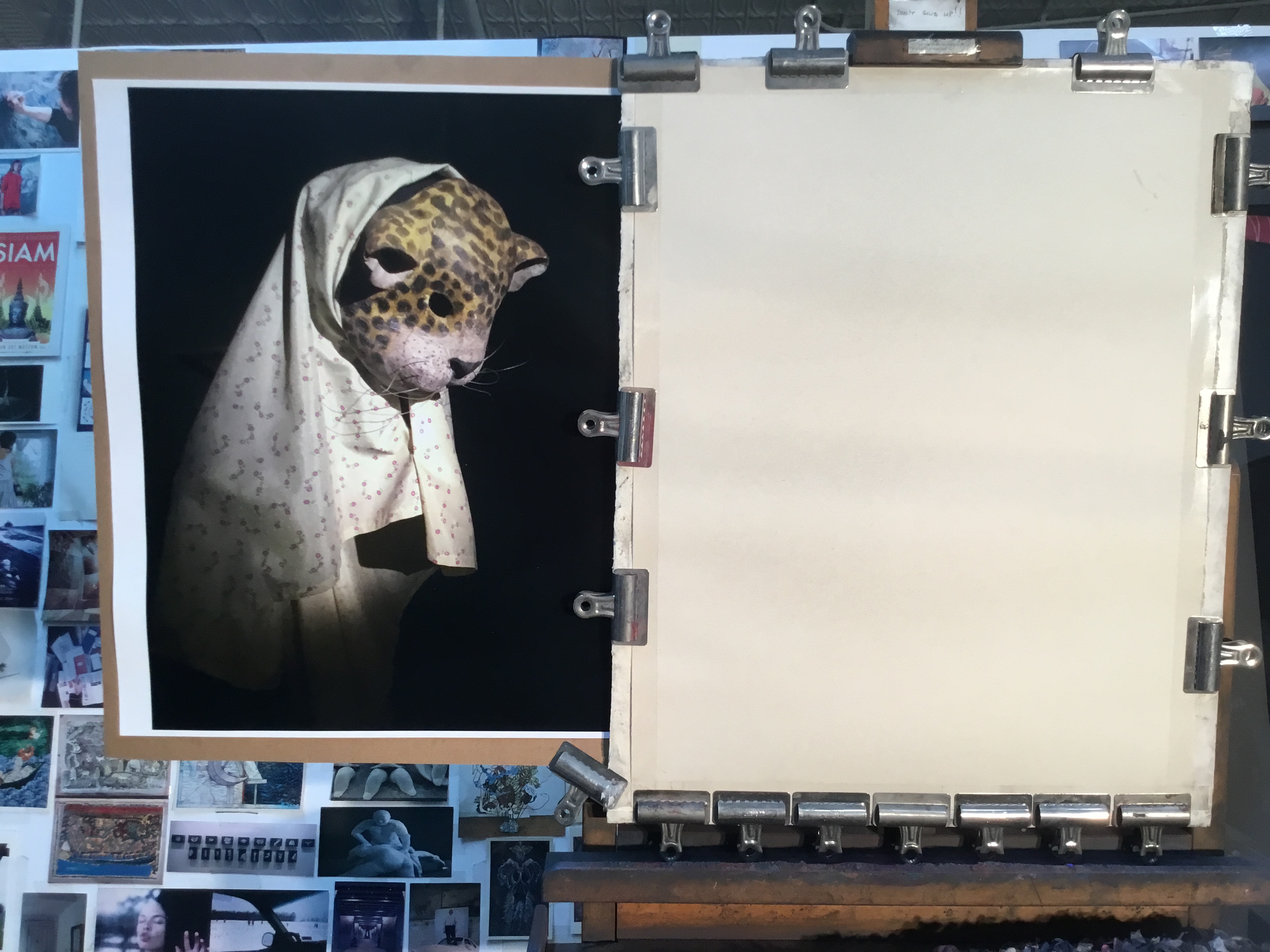
Work in progress
A: I’m beginning a new 26” x 20” pastel painting, which will be number eleven in the “Bolivianos” series.
Comments are welcome!
Q: What’s on the easel today?
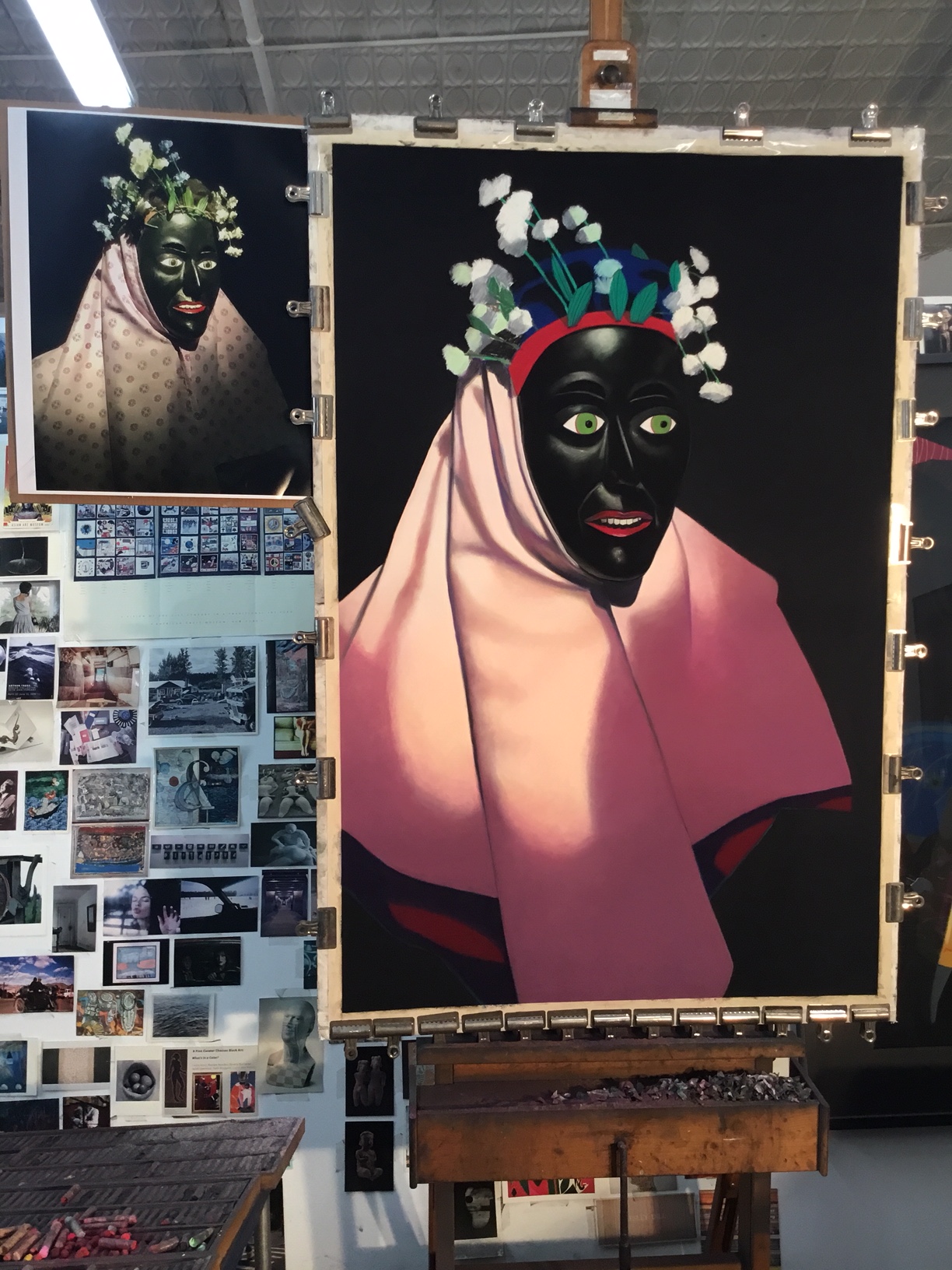
Work in progress
A: I continue working on the latest in the “Bolivianos” series, “Poseur,” Soft Pastel on Sandpaper, 58” x 38.” I haven’t decided yet whether to put a pattern on the fabric.
Comments are welcome!


 barbararachkoscoloreddust.com