Category Archives: Pastel Painting
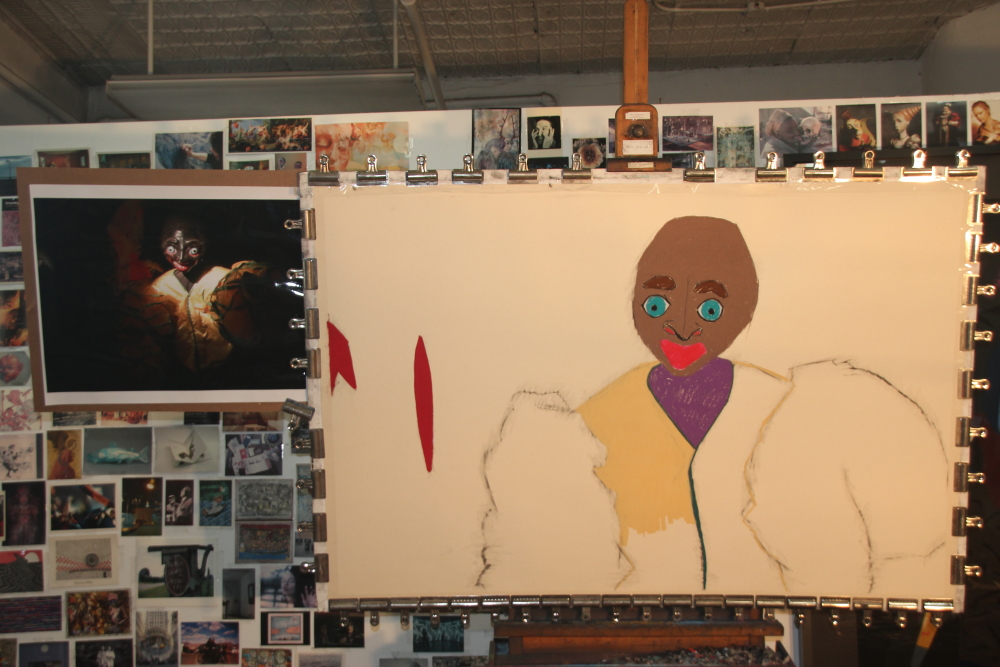
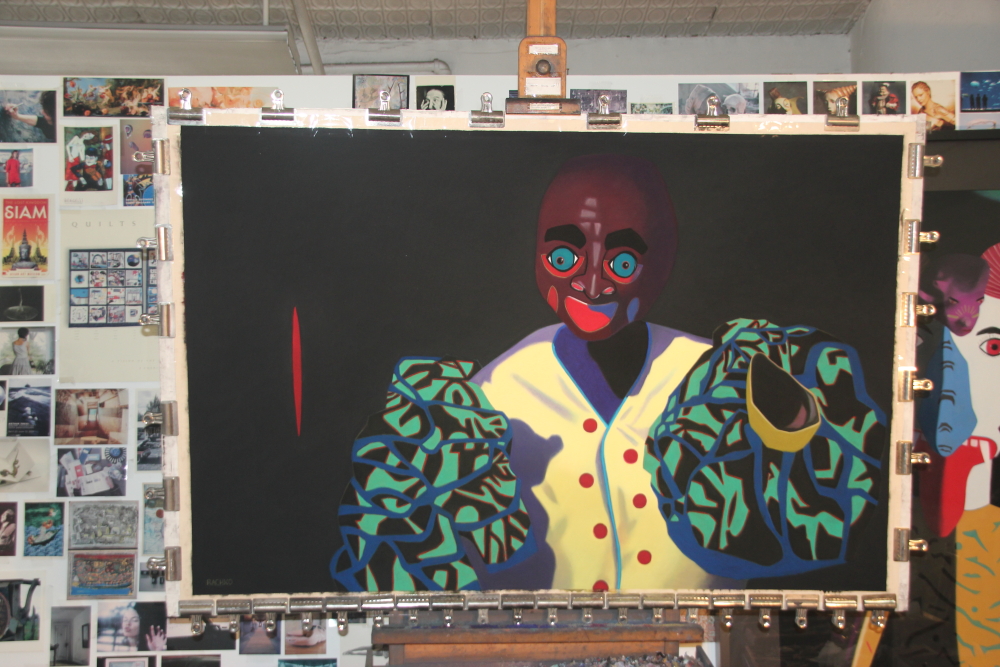
Q: What’s on the easel today?

Ready to begin
A: I’m ready to begin a large – 38” x 58” – pastel-on-sandpaper painting, the sixth in my “Bolivianos” series. I love beginnings because I am looking at something new on my easel and there are so many possibilities!
Comments are welcome!
Q: (Part II) Would you share your story of how creating art enabled you to heal after losing your husband on 9/11?

“The Champ,” soft pastel on sandpaper, 35” x 28.5” framed. The first of my “Bolivianos”.
A: Continued from last Saturday’s post…
Because I use reference photos for my pastel paintings, the first challenge was to learn how to use Bryan’s 4 x 5 view camera. At that time I was not a photographer. Always Bryan had taken reference photos for me.
In July 2002 I enrolled in a view camera workshop at New York’s International Center of Photography. Much to my surprise I had already absorbed quite a lot from watching Bryan. After the initial workshop, I continued more formal studies of photography for a few years. In 2009, I am proud to say, I was invited to present a solo photography exhibition at a New York gallery!
In 2003 I resumed making my “Domestic Threats” series of pastel paintings, something that had seemed impossible after Bryan’s death. The first large pastel painting that I created using a reference photograph taken by me confirmed that my life’s work could continue. The title of that painting, “She Embraced It and Grew Stronger,” was autobiographical. “She” is me, and “it” meant continuing on without Bryan and living life for both of us.
Having had a long successful run, the “Domestic Threats” series finally ended in early 2007. Around that time I was feeling happier and had come to better terms with losing Bryan. While this is a tragedy I will never truly be at peace with, dealing with the loss became easier with time.
Then in 2007 I suddenly became blocked and did not know where to take my work next. I had never experienced creative block and for a full-time professional artist, this was a painful few months. Still, I continued to go to the studio every day and eventually, thanks to a confluence of favorable circumstances, the block ended.
My next pastel painting series was called, “Black Paintings.” I viewed the black background as literally, the very dark place that I was emerging from, exactly like the figures emerging in these paintings. The figures themselves were wildly colorful and full of life, but that black background is always there.
Still the work continues to evolve. Recently I began my third pastel painting series called, “Bolivianos,” based on a mask exhibition encountered in La Paz at the Museum of Ethnography and Folklore. Many people have proclaimed this to be my most bold, daring, and exciting pastel painting series yet. And I think they may be right! Continuing on the journey I began 30+ years ago, I am looking forward to creating many new, striking pastel paintings!
Comments are welcome!
Q: (Part I) Would you share your story of how creating art enabled you to heal after losing your husband on 9/11?

“She Embraced It and Grew Stronger,” 2003, 70” x 50” framed, the first pastel painting I completed after Bryan was killed
A: On June 16, 2001, I married Dr. Bryan Jack, my longtime companion and soulmate, during a very private ceremony in the garden of an historic Alexandria, Virginia residence. In attendance were a justice of the peace, me, and Bryan. He and I were 48 years old and this was the first marriage for us both. Sadly, we never celebrated an anniversary. Exactly 87 days later my new husband was the victim of a terrorist attack.
On September 11, 2001, Bryan, a high-ranking federal government employee, a brilliant economist, and a budget analyst at the Pentagon, was en route to Monterey, CA to give his monthly guest lecture for an economics class at the Naval Postgraduate College. He boarded the American Airlines plane out of Dulles Airport that was high-jacked and crashed into the Pentagon, killing 189 people.
To this day I consider how easily I, too, could have been killed on 9/11, if I had just decided to travel with Bryan to California. Plus, the plane crashed directly into my Navy office on the fifth floor E-ring of the Pentagon. (I am a retired Navy Commander and worked at the Pentagon for many years). But for a twist of fate, we both would have died: Bryan on the plane, me either beside Bryan or inside the building.
In September 2001 Bryan and I had been together for fourteen and a half years. Surprisingly, we were happier than we had ever been. At a time when other couples we knew were settling into a certain boredom and routine, our life together was growing richer and more interesting. So losing Bryan – especially then – was heart-breaking, cruel, and devastating beyond comprehension. It was so unfair. I was numb and in shock.
The next six months passed by in a blur. But I had made a decision and pledged that I would not let the 9/11 attackers claim me as one more victim. My life had been spared for a reason so I began to pick up the pieces and worked to make every day count. Even many years later, wasting time still feels like a crime.
The following summer I was ready to – I HAD to – get back to work in my studio. I knew exactly what I must do. More than ever before, learning and painting would become the avenues to my well-being.
Continued next week…
Comments are welcome!
Q: Please speak about how the three pastel paintings series that you have created interrelate.

“The Orator,” soft pastel on sandpaper, 38″ x 58″
A: The Black Paintings series of pastel-on-sandpaper paintings grew directly from an earlier series, Domestic Threats. While both use cultural objects as surrogates for human beings acting in mysterious, highly-charged narratives, in the Black Paintings I replaced all background details of my actual setup (furniture, rugs, etc.) with lush black pastel. In this work the ‘actors’ are front and center.
While traveling in Bolivia last spring, I visited a mask exhibition at the National Museum of Ethnography and Folklore in La Paz. The masks were presented against black walls, were spot-lit, and looked eerily like 3D versions of my Black Paintings. I immediately knew I had stumbled upon a gift. So far I have completed three pastel paintings in the Bolivianos series. Two more are in progress now.
All of my pastel paintings are an example of a style called “contemporary conceptual realism” in which things are not quite as innocent as they seem. Each painting is a Trojan horse. There is plenty of backstory to my images, although I usually prefer not to over-explain them. Much is to be said for mystery in art.
The world I depict is that of the imagination and this realm owes little debt to the natural world. Recently, at an art talk I was reminded how fascinating it is to learn how others respond to my work. As New York art critic Gerrit Henry once remarked, “What we bring to a Rachko… we get back, bountifully.”
Comments are welcome!

Q: What’s on the easel today?
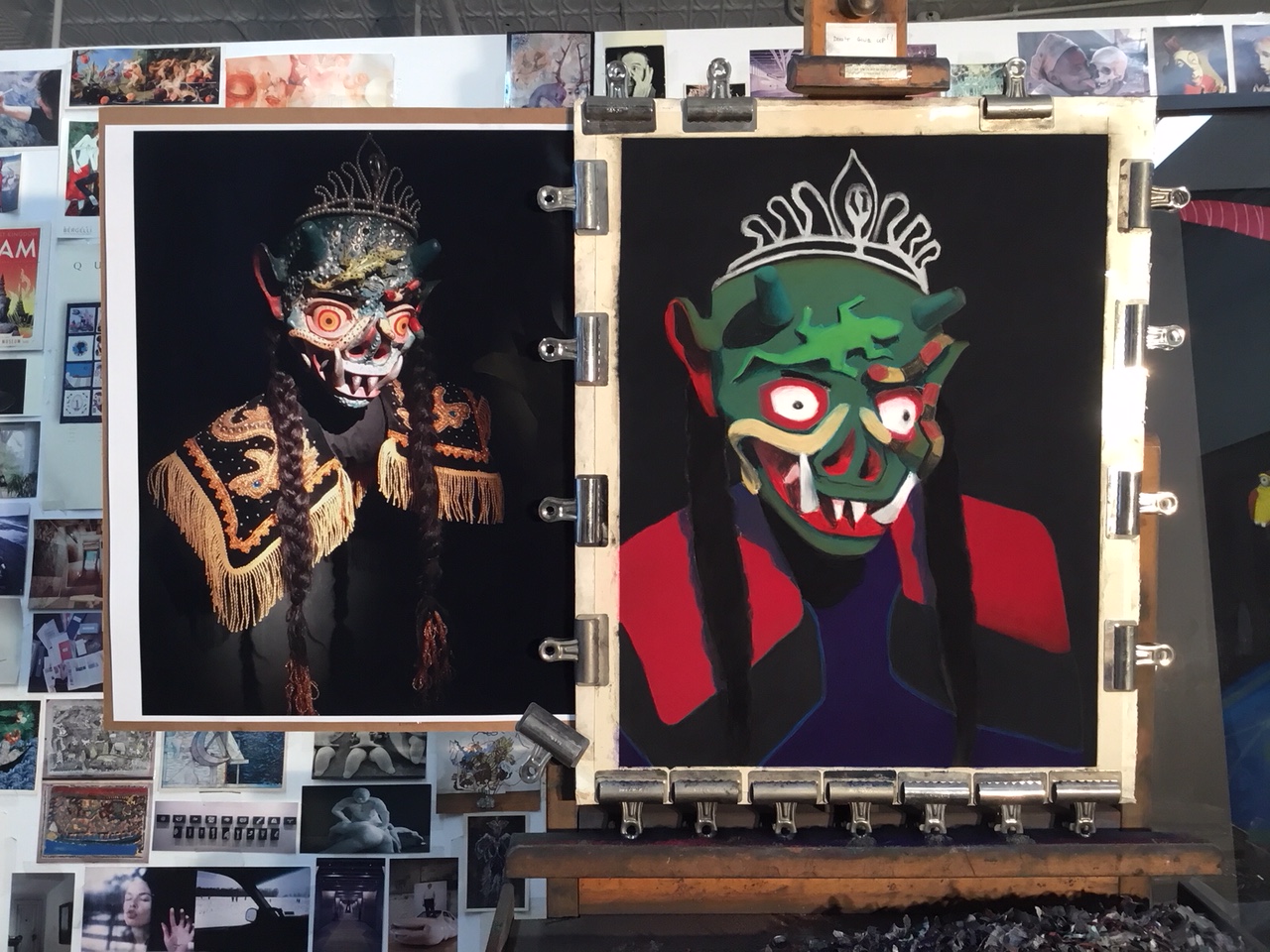
Work in progress
A. I have just started working on a small pastel painting. Although the mask looks Tibetan, surprisingly, it is from Bolivia. It’s one I encountered at a mask exhibition at the Museum of Ethnography and Folklore in La Paz. This is another in my “Bolivianos” series.
Comments are welcome!
Q: Would you share your artist’s statement for the “Bolivianos” series?

Museum of Ethnography and Folklore, La Paz, Bolivia
A: Here it is.
My long-standing fascination with traditional masks took a leap forward in the spring of 2017 when I visited the National Museum of Ethnography and Folklore in La Paz, Bolivia. One particular exhibition on view, with more than fifty festival masks, was completely spell-binding.
The masks were old and had been crafted in Oruro, a former tin-mining center about 140 miles south of La Paz on the cold Altiplano (elevation 12,000’). Depicting important figures from Bolivian folklore traditions, the masks were created for use in Carnival celebrations that happen each year in late February or early March.
Carnival in Oruro revolves around three great dances. The dance of “The Incas” records the conquest and death of Atahualpa, the Inca emperor when the Spanish arrived in 1532. “The Morenada” dance was once assumed to represent black slaves who worked in the mines, but the truth is more complicated (and uncertain) since only mitayo Indians were permitted to do this work. The dance of “The Diablada” depicts Saint Michael fighting against Lucifer and the seven deadly sins. The latter were originally disguised in seven different masks derived from medieval Christian symbols and mostly devoid of pre-Columbian elements (except for totemic animals that became attached to Christianity after the Conquest). Typically, in these dances the cock represents Pride, the dog Envy, the pig Greed, the female devil Lust, etc.
The exhibition in La Paz was stunning and dramatic. Each mask was meticulously installed against a dark black wall and strategically spotlighted so that it became alive. The whole effect was uncanny. The masks looked like 3D versions of my “Black Paintings,” a pastel paintings series I have been creating for ten years. This experience was a gift… I could hardly believe my good fortune!
Knowing I was looking at the birth of a new painting series – I said as much to my companions as I remained behind while they explored other parts of the museum – I spent considerable time composing photographs. Consequently, I have enough reference material to create new pastel paintings in the studio for several years. The series, entitled “Bolivianos,” is arguably my strongest and most striking work to date.
Comments are welcome!
Q: What’s on the easel today?

Finished and signed
A: I have finally finished “Oracle,” soft pastel on sandpaper, 26” x 20.” It’s the third piece in my “Bolivianos” series.
Comments are welcome!
Q: What has been your scariest experience as an artist?

“Between,” soft pastel on sandpaper, 20″ x 26″
A: It was the approximately six months in 2007 when I finished the “Domestic Threats” series and was blocked, certain that a strong body of work was behind me, yet not knowing what in the world to do next! For a professional artist who had been working non-stop for 21 years, this was a profoundly painful, confusing, and disorienting time. I remember continuing to force myself to go to the studio and for lack of anything much to do there, spending long hours reading and thinking about art.
Eventually after all of this reflection, I had an epiphany. “Between,” with drastically simplified imagery, was the first in a new series called, “Black Paintings.” I like to think this series includes work that is considerably richer and more profound than the previous “Domestic Threats.”
Comments are welcome!



