Blog Archives
Q: What is it about soft pastel that you find so intriguing that you use it as your primary fine art medium?

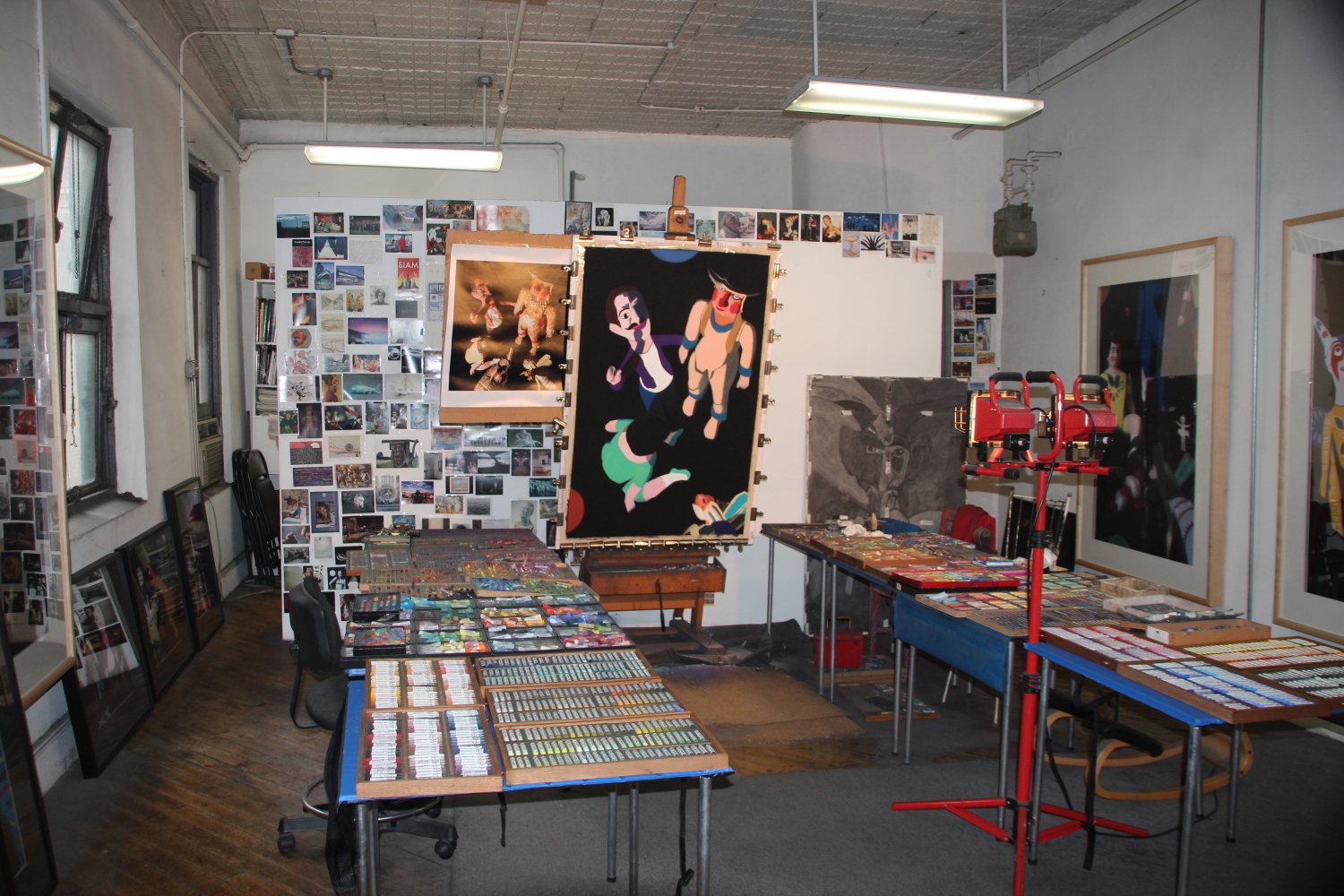
Some of Barbara’s pastels
A: For starters it’s the medium that I fell in love with many years ago. I recently read this article online, “What is Pastel?” by Mike Mahon, and will quote it because it neatly sums up what I love about working with pastel.
Pastel is the most permanent of all media when applied to conservation ground and properly framed. Pastel has no liquid binder that may cause it to oxidize with the passage of time as oftentimes happens with other media.
In this instance, Pastel does not refer to pale colors, as the word is commonly used in cosmetic and fashion terminology. The pure, powdered pigment is ground into a paste with a minimum amount of gum binder, rolled into sticks and dried. The infinite variety of colors in the Pastel palette range from soft and subtle to hard and brilliant.
An artwork is created by stroking the stick of dry pigment across an abrasive ground, embedding the color in the “tooth” of the ground. If the ground is completely covered with Pastel, the work is considered a Pastel painting; whereas, leaving much of the ground exposed produces a Pastel sketch. Techniques vary with individual artists. The Pastel medium is favored by many artists because it allows a spontaneous approach. There is no drying time, therefore, no change in color occurs after drying as it does in other media.
Did you know that a particle of Pastel pigment seen under a microscope looks like a diamond with many facets? It does! Therefore, Pastel paintings reflect light like a prism. No other medium has the same power of color or stability.
Historically, Pastel can be traced back to the 16th century. Its invention is attributed to the German painter, Johann Thiele. A Venetian woman, Rosalba Camera, was the first to make consistent use of Pastel. Chardin did portraits with an open stroke, while La Tour preferred the blended finish. Thereafter, a galaxy of famous artists—Watteau, Copley, Delacroix, Millet, Manet, Renoir, Toulouse Lautrec, Vuillard, Bonnard, Glackens, Whistler, Hassam, William Merritt Chase—used Pastel for a finished work rather than for preliminary sketches.
Pastels from the 16th century exist today, as fresh as the day they were painted. Edgar Degas was the most prolific user of Pastel and its champion. His protégé, Mary Cassat, introduced Pastel to her friends in Philadelphia and Washington, and thus to the United States. In the Spring of 1983, Sotheby Parke Bernet sold at auction, two Degas Pastels for more than $3,000,000 each! Both Pastels were painted about 1880.
Note: Do not confuse Pastel with “colored chalk.” Chalk is a porous, limestone substance impregnated with dyes, whereas, Pastel is pure pigment—the same as is used in other permanent painting media.
Today, Pastel paintings have the stature of oil and watercolor as a major fine art medium. Many of our most renowned, living artists have distinguished themselves in Pastel and have enriched the art world with this beautiful medium.
So knowing all this, I often wonder, why don’t more artists use pastel? Is it because framing is a big issue? Works on paper need to be framed and pastel paintings have unique problems (see my April 27, 2013 blog post). Second only to the cost of maintaining a studio in New York City, frames are my single largest business expense. Sometimes I am grateful that pastel is a very slow medium. I typically finish 4 or 5 paintings in a year, which means I only have to pay for 4 or 5 frames!
Comments are welcome!
Pearls from artists* # 38
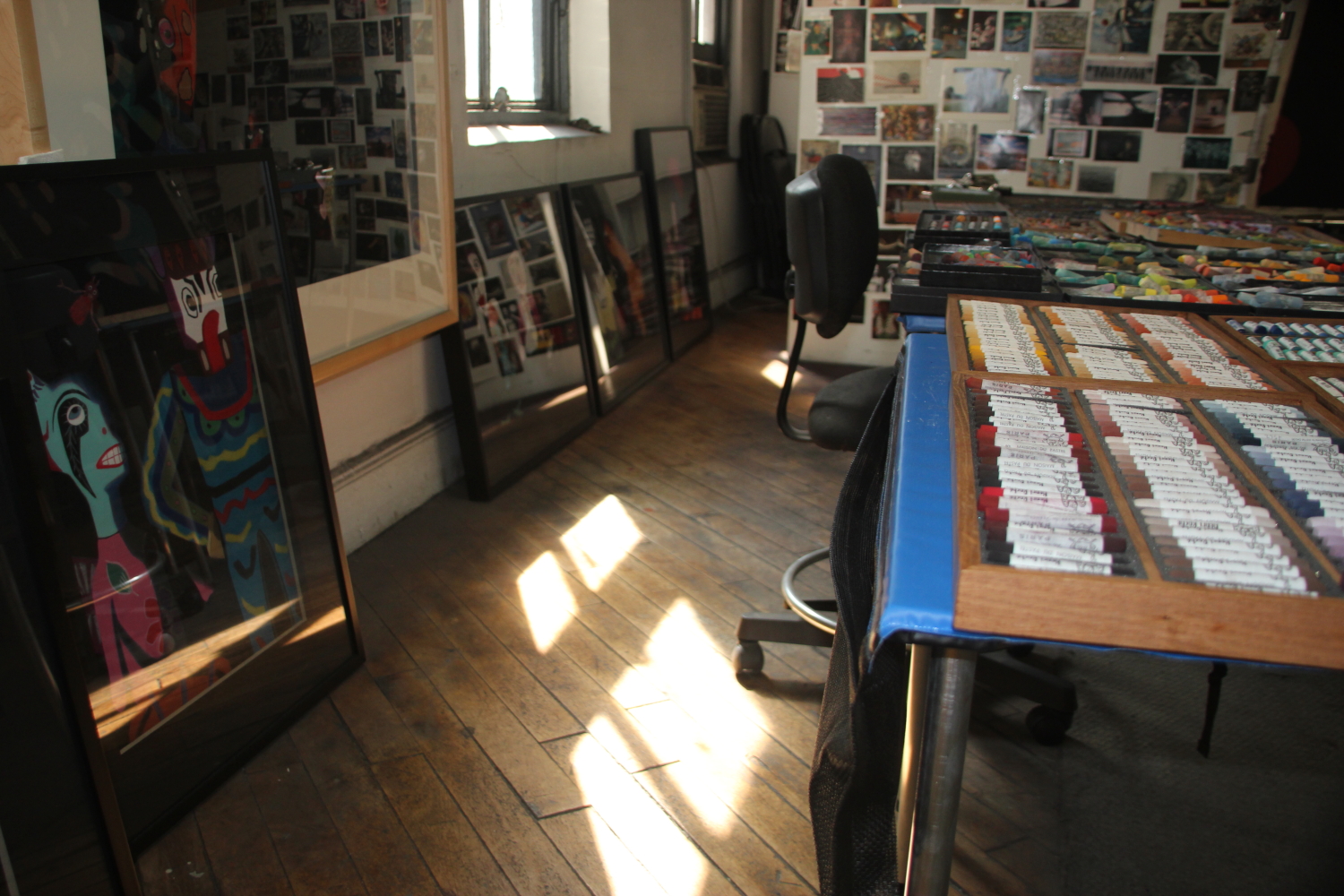
Morning sun at the studio
* an ongoing series of quotations – mostly from artists, to artists – that offers wisdom, inspiration, and advice for the sometimes lonely road we are on.
It’s one thing to be intelligent and it’s another to enjoy thinking, to relish the time spent alone with one’s thoughts, to happily muse, imagine, and analyze. Artists, who are introspective by nature, typically enjoy spending time in this fashion and may even prefer solitude to the company of others. Able to work by themselves, artists are often lost in a state of dreamy thoughtfulness of the sort described by the painter Hans Hofmann when he wrote, ” The first red spot on a white canvas may at once suggest to me the meaning of ‘morning redness,’ and from there I dream further with my color.” Artists are not introspective, thoughtful, lost in time and space because they wish to ignore the world. They’re introspective because out of that attitude artistic answers flow.
Eric Maisel in A Life in the Arts
Comments are welcome!
Q: The handmade frames on your large pastel-on-sandpaper paintings are quite elaborate. Can you speak more about them?
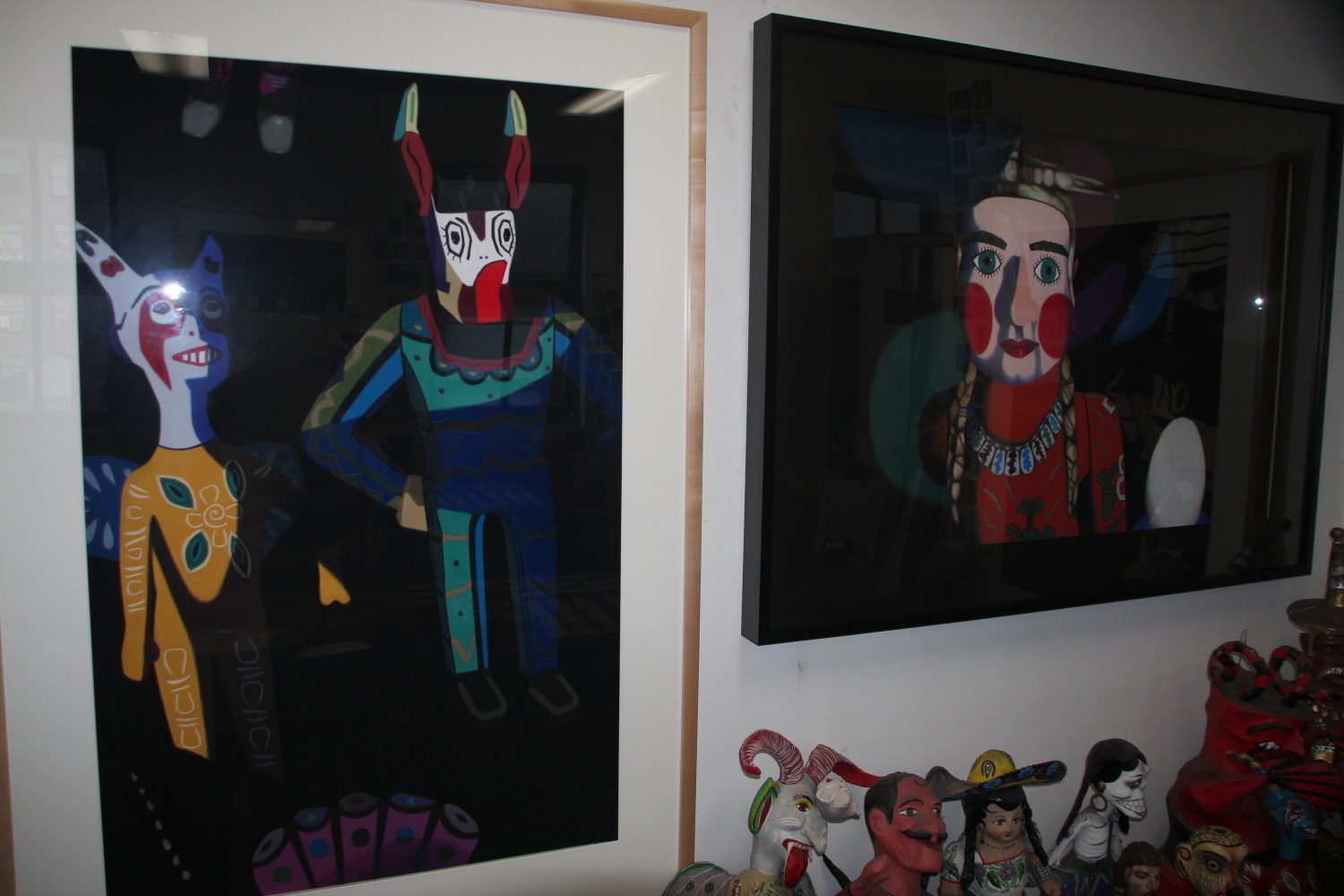
“Quartet” (left) and “Epiphany,” soft pastel on sandpaper
A: I have been working in soft pastel since 1986, I believe, and within six years the sizes of my paintings increased from 11″ x 14″ to 58″ x 38.” (I’d like to work even bigger, but the limiting factors continue to be first, the size of mat board that is available and second, the size of my pick-up truck). My earliest work is framed with pre-cut mats, do-it-yourself Nielsen frames, and glass that was cut-to-order at the local hardware store. With larger-sized paintings DIY framing became impractical. In 1989 an artist told me about Underground Industries, a custom framing business in Fairfax, Virginia, run by Rob Plati, his mother, Del, and until last year, Rob’s late brother, Skip. So Rob and Del have been my framers for 24 years. When I finish a painting in my New York studio, I drive it to Virginia to be framed.
Pastel paintings have unique problems – for example, a smudge from a finger, a stray drop of water, or a sneeze will ruin months of hard work. Once a New York pigeon even pooped on a finished painting! Framing my work is an ongoing learning experience. Currently, my frames are deep, with five layers of acid-free foam core inserted between the painting and the mat to separate them. Plexiglas has a static charge so it needs to be kept as far away from the pastel as possible, especially since I do not spray finished pastel paintings with fixative.
Once they are framed, my paintings cannot be laid face down. There’s a danger that stray pastel could flake off. If that happens, the whole frame needs to be taken apart and the pastel dust removed. It’s a time-consuming, labor-intensive process and an inconvenience, since Rob and Del, the only people I trust with my work, are five hours away from New York by truck.
Comments are welcome!
Q: What do you do to protect yourself from toxic pastel dust?
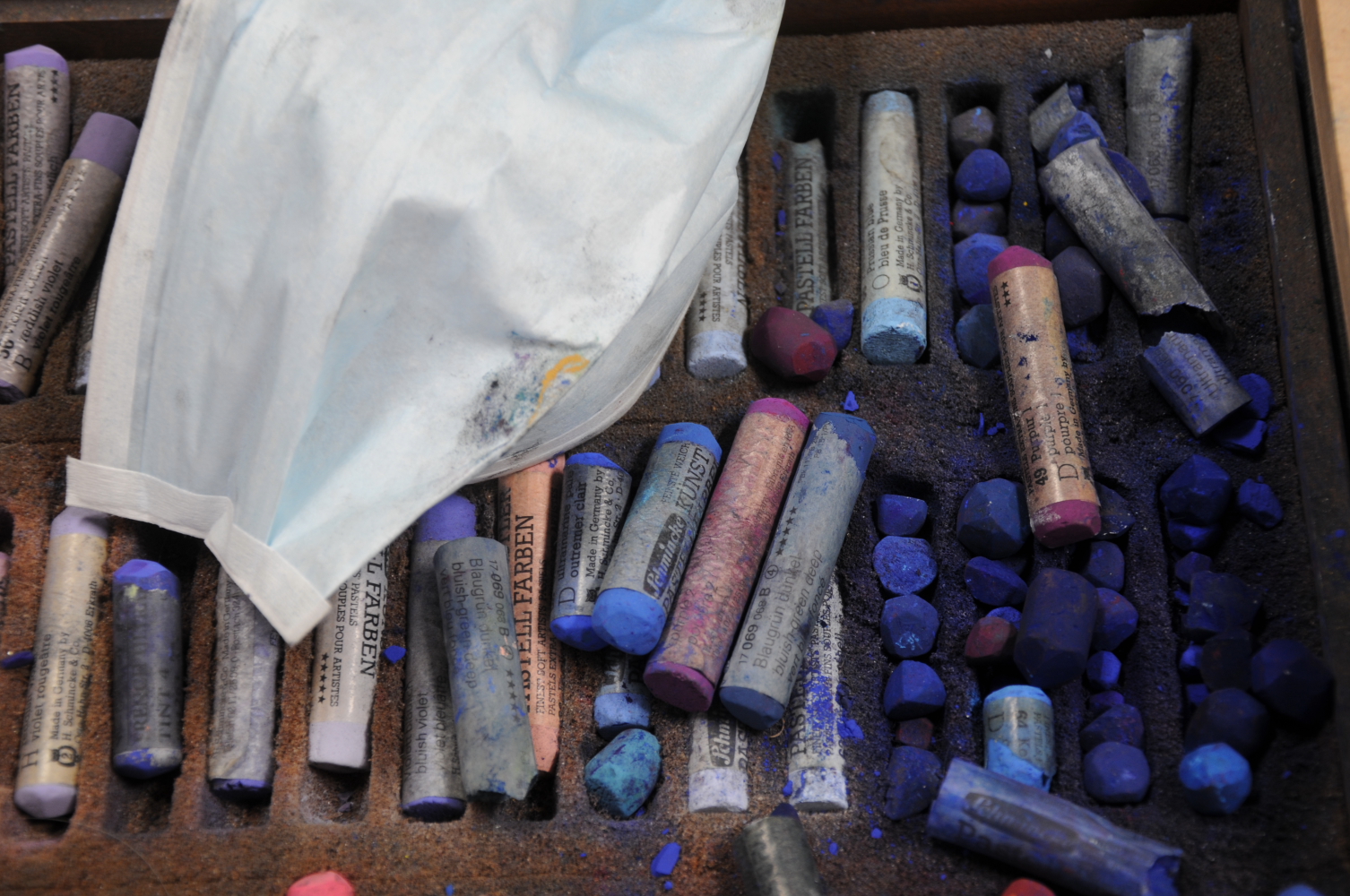
Used surgical mask
A: Certain sticks of soft pastel contain toxic lead and cadmium so some precautions are necessary. Before I begin working, I liberally apply a barrier cream, called Artguard, to my hands and wrists so that pastel will not be absorbed through my skin via small cuts that I might have. I wear a surgical mask to avoided breathing the dust. Also, I try to work so that my hand is below my head, to lessen the likelihood of breathing particles of pastel as they fall to the floor. I ensure there is good air circulation in my studio. Once the dust has settled onto the floor, I try not to stir it up again until I dispose of it. I’ve been working with soft pastel for 27 years and have managed to stay healthy so far.
Comments are welcome!
Q: Your new work explores relationships to figures through the medium of soft pastel. What prompted this departure from photography?
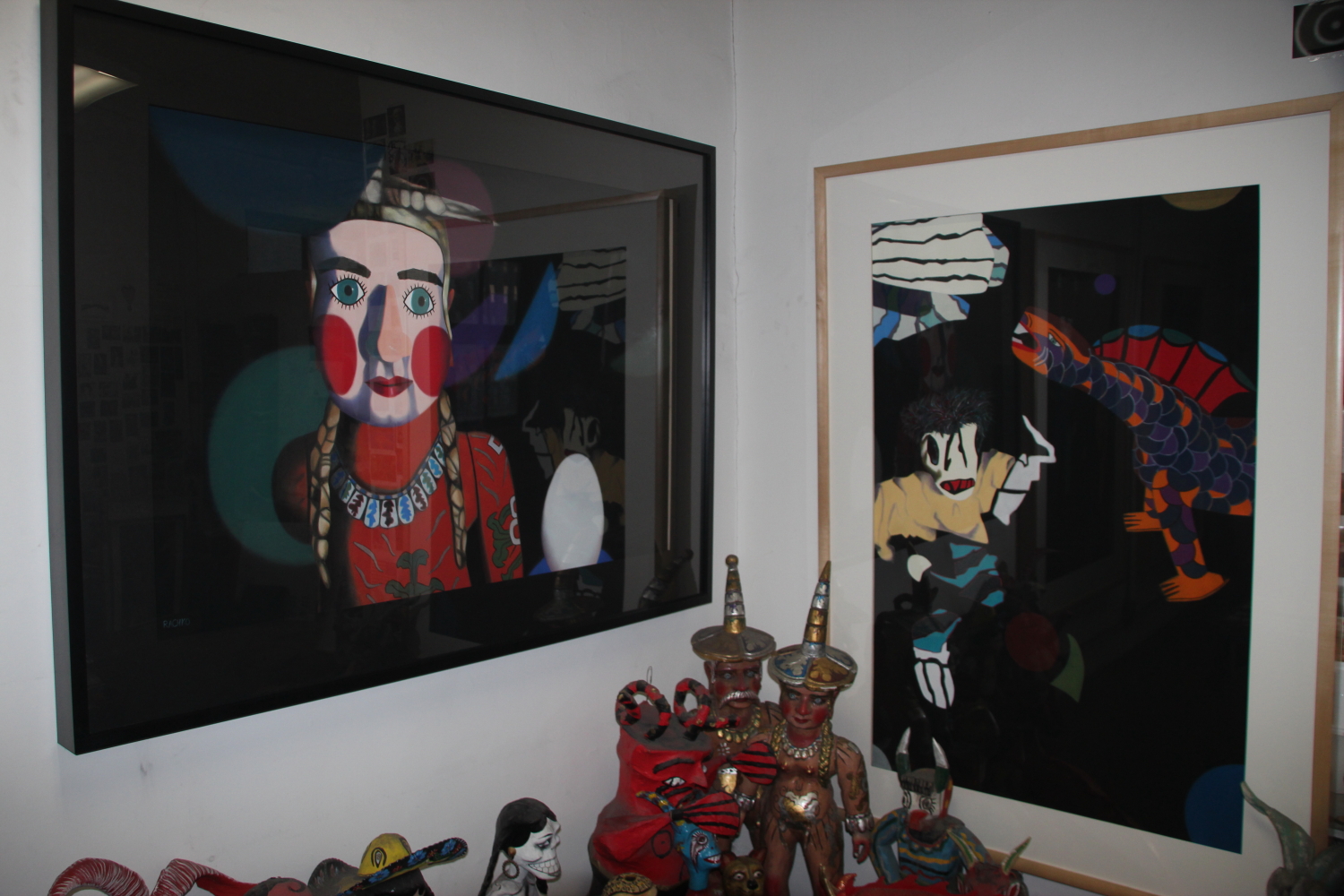
A corner of the studio
A: Actually it was the other way around. As I’ve mentioned, I was a maker of pastel-on-sandpaper paintings long before I became a photographer (1986 vs. 2002). However, the photos in the “Gods and Monsters” series were meant to be photographs in their own right, i.e., they were not made to be reference material for paintings. in an interesting turn of events, in 2007 I started a new series, “Black Paintings,” which uses the “Gods and Monsters” photographs as source material. Collectors who have been following my work for years tell me the new series is the strongest yet. For now I’m enjoying where this work is leading. The last three paintings are the most minimal yet and I’ve begun thinking of them as the “Big Heads.” There is usually a single figure (“Stalemate” has two) that is much larger than life size. “Epiphany” (above, left) is an example. All of them are quite dramatic when seen in person, especially with their black wooden frames and mats.
Comments are welcome!
Pearls from artists* # 31
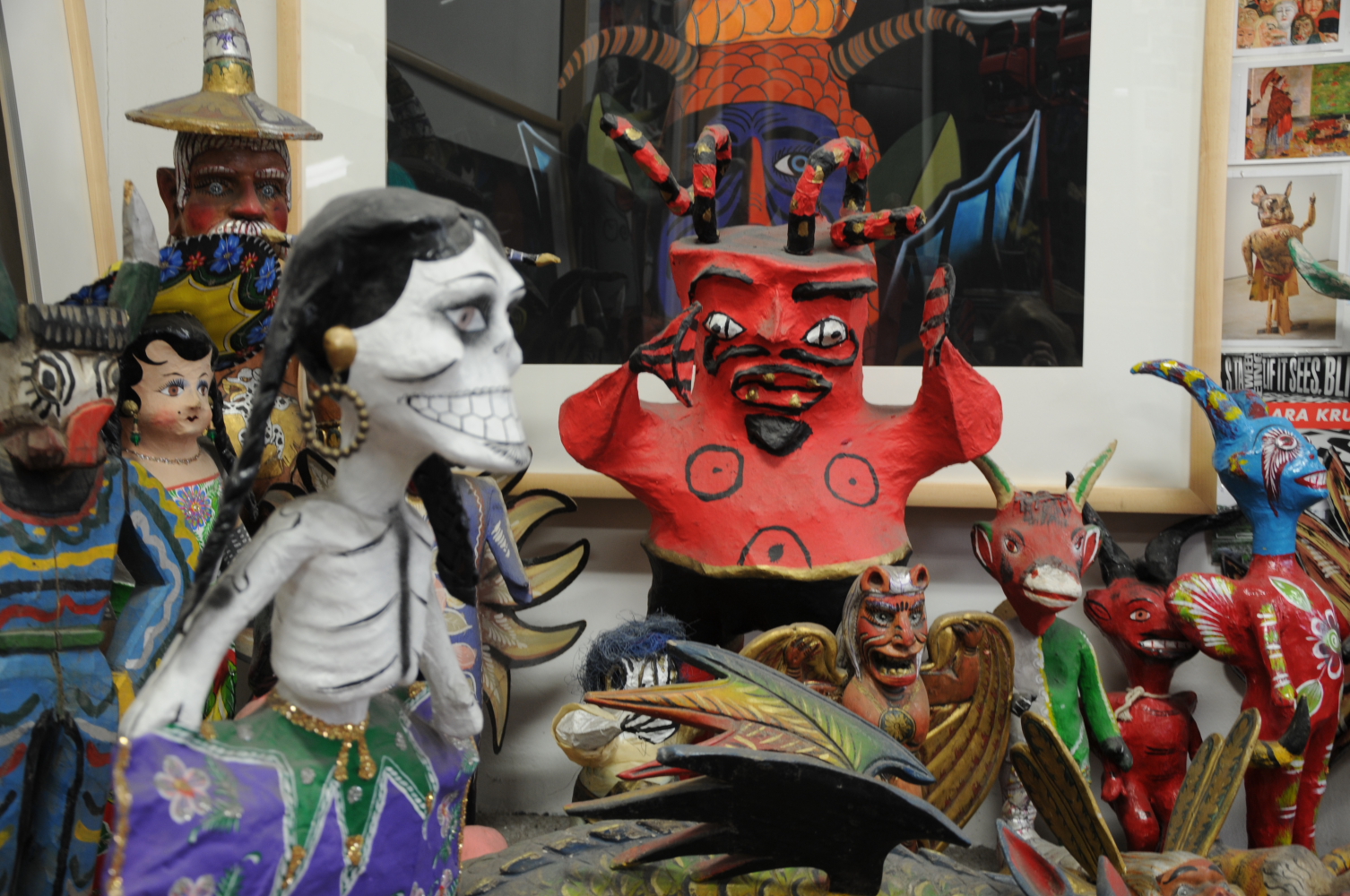
A corner of Barbara’s studio
* an ongoing series of quotations – mostly from artists, to artists – that offers wisdom, inspiration, and advice for the sometimes lonely road we are on.
When we are children we unquestioningly see the objects around us as alive; we speak to them, give them names, breathe life into them. The imagination knows no bounds. As we grow up, we gradually lose this facility, until we finally arrive in an utterly “demystified” world that draws clear boundaries between what is alive and what is not, between subjective and objective perception. According to Sigmund Freud, culture is the only domain in our modern society that gives a measure of legitimacy to the persistence of this infantile desire to see things as animate. In the field of art, imagination is the precondition on which fiction of any sort rests; in art, mental states can be projected onto objects and images, but not in social reality or the sciences.
Dietrich Karner in Animism: Modernity Through the Looking Glass
Comments are welcome!
Q: Please speak about your background as a Naval officer and aviator and how that has informed your sensibility as an artist.
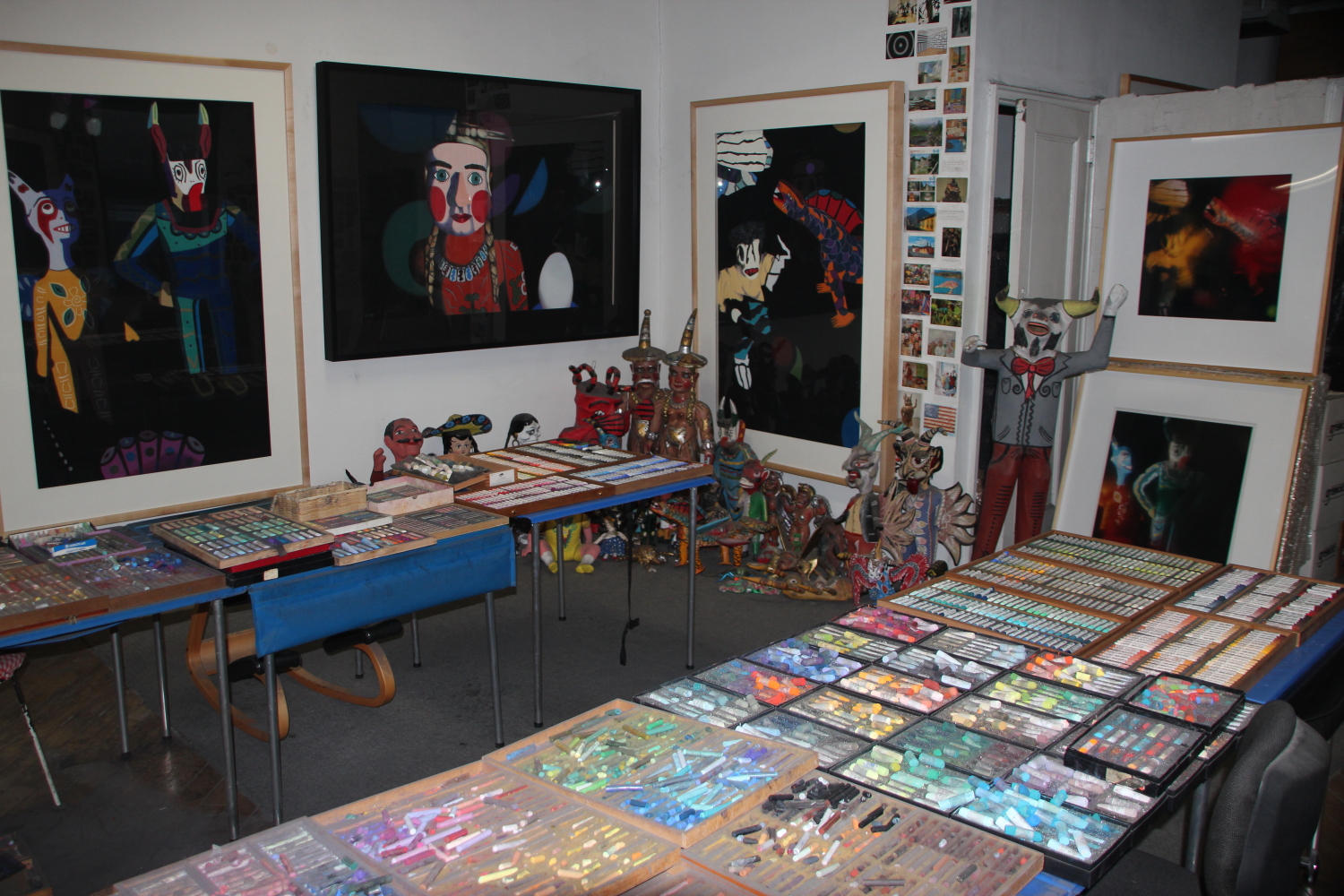
The studio yesterday
A: At the age of 25 I got my private pilot’s license before spending the next two years amassing thousands of hours of flight time as I earned every flying license and rating I could, ending with a Boeing-727 flight engineer certificate. I joined the Navy when I was 29. I used to think that the 7 years I spent on active duty were wasted – during those 7 years I should have been working on my art – but I see things differently now. The Navy taught me to be disciplined, to be goal-oriented and focused, to love challenges, and in everything I do, to pay attention to the details. Trying to make it as an artist in New York is nothing BUT challenges so these qualities serve me well, whether I’m creating paintings, shooting and printing photographs, or trying to understand the art business and keep up with social media. I enjoy spending long solitary hours working to become a better artist. I am meticulous about craft and will not let a work out of my studio or out of the darkroom until it is as good as I can make it.
Comments are welcome!
Q: Can you talk about the studios you have worked in over the years?

Studio entrance
A: From the beginning in the mid-1980’s I had a studio. My first one was in the spare bedroom of the Alexandria, Virginia, house that I shared with Bryan and that I still own. For about three years in the 1990s I had a studio on the third floor of the Torpedo Factory Art Center, a building in Alexandria that is open to the public; people come in and watch the artists work. In 1997 an opportunity to move to New York arose and I didn’t look back. By then I was showing in a good 57th Street gallery, Brewster Arts Ltd. (the gallery focused exclusively on Latin American artists; I was thrilled with the company I was in; the only fellow non-Latina represented by owner, Mia Kim, was Leonora Carrington), and I had managed to find a New York agent, Leah Poller, with whom to collaborate. I looked at one other space before finding my West 29th Street studio, where I still work. It was and continues to be my oasis in a chaotic city, a place to make art, to read, and to think. I feel more calm the moment I walk in.
Comments are welcome!
Q: Would you talk about some of your early experiences with art?
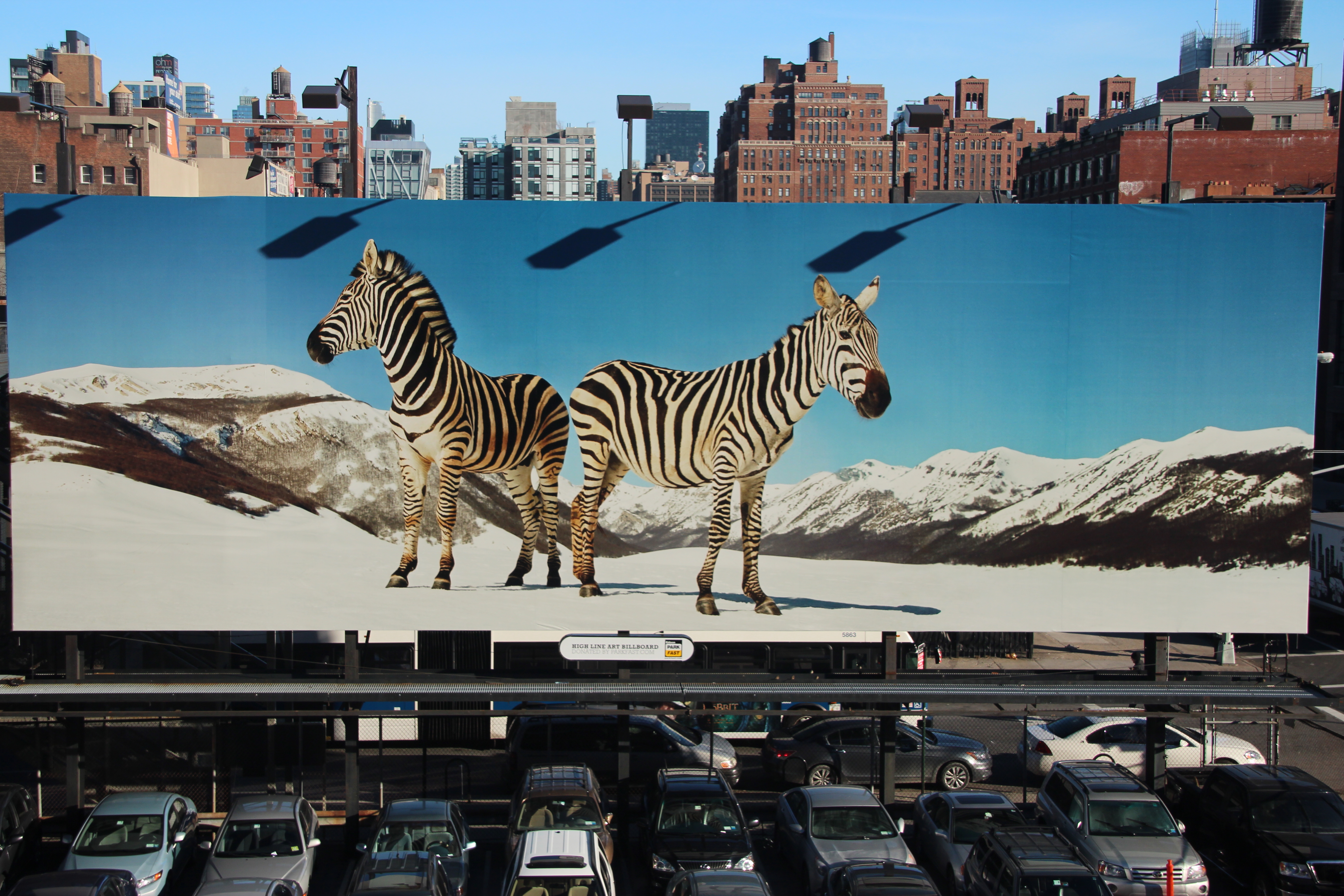
Zebras in Chelsea
A: I grew up in a blue collar family in suburban New Jersey. My father was a television repairman for RCA. For awhile my mother worked as a sewing machine operator in a factory that made women’s undergarments, but mostly she stayed home to raise my sister and me (at the time I had only one sister, Denise; Michele was born much later). My parents were both first-generation Americans and in those days no one in my extended family had gone to college. I was a smart kid and showed some artistic talent in kindergarten or earlier. I have always been able to draw anything, as long as I can see it (i.e., I require a visual reference as opposed to drawing from memory). I remember copying the Sunday comics, which in those days appeared in all the newspapers. At the age of 6 my mother enrolled Denise and me in Saturday morning painting classes at the studio of an artist named Frances Hulmes in Rutherford, NJ. I continued the classes for about 8 years and became a fairly adept oil painter. Living just 12 miles from New York City in Clifton, New jersey, my mother often took us to museums, particularly the Museum of Modern Art, the Metropolitan Museum of Art, and the Museum of Natural History. I remember falling in love with Rousseau’s “The Sleeping Gypsy” and being astonished by the violence and scale of Picasso’s “Guernica,” when it was on long-term loan to MoMA. I have fond memories of studying the dioramas at the Museum of Natural History. They are still my favorite part of the museum. I suppose it goes without saying that there were not any artists in my family so I had no role models. At the age of 15 my father decided that art was not a serious pursuit – he said it was a hobby, not a profession – so he abruptly stopped paying for my Saturday morning lessons. With no financial or moral support to pursue art, I turned my attention to other interests (ex. I learned to fly airplanes, becoming a commercial pilot and Boeing 727 flight engineer) and let my artistic abilities lie dormant.
Comments are welcome!



