Blog Archives
Pearls from artists* # 696

*an ongoing series of quotations – mostly from artists, to artists – that offers wisdom, inspiration, and advice for the sometimes lonely road we are on.
Although it’s important to make communities with like-minded people — people who are your age, your generation, who are working on projects that have resonance with yours — I am a firm believer in crossing generations to find mentorship and inspiration, and a sense of furthering the craft. So I’d say that as you begin to seek mentorship, be creative about where you look. Look in unlikely places, and make it more likely that you will cross boundaries and reach a wider, more culturally and intellectually diverse audience.
Anna Deavere Smith in Letters to a Young Artist: Straight-Up Advice on Making a Life in the Arts — for Actors, Performers, Writers, and Artists of Every Kind”
Comments are welcome!
Pearls from artists* # 692

*an ongoing series of quotations – mostly from artists, to artists – that offers wisdom, inspiration, and advice for the sometimes lonely road we are on.
Claiming space, money, and time to do our work requires fortitude. We need to say ‘no’ to projects and people fighting for our attention. We just follow our work through changes, even when it is comfortable, or in other people’s interests, for our work to stay the same. If we want to expand our careers, we get rejected… a lot. But artists are like sharks; we must keep moving to survive, creating authentic, original work as we outgrow it to evolve as human beings.
Kate Kretz in Art From Your Core: A Holistic Guide to Visual Voice
Comments are welcome!
Q: Do you have any big projects coming up?

A: I certainly do! I have been a painter for forty years, and for most of that time, my work has been shaped by foreign travel. At seventy-two, I find myself thinking about legacy — what I want to leave behind. Documenting my creative process on film has become an essential part of this objective.
In the “Bolivianos” series, I have been creating pastel-on-sandpaper paintings that transform the vivid masks of the Bolivian Carnival into universal archetypes. I first encountered these masks at a museum in La Paz in 2017.
Circumstances have aligned perfectly for an exciting next step: another trip to Bolivia and a new documentary. Our upcoming film will be a follow-up to the award-winning “Barbara Rachko: True Grit” (released in 2023), marking a deeper exploration of my thirty-five-year engagement with folk art from Mexico, Central America, and South America.
(See https://youtu.be/JJWLy84kXI0?si=v7JHIq9ViYGgs76U)
In February 2026, I will return to Bolivia with a two-person film crew to experience Carnival firsthand — to immerse myself in its rhythm, history, and meaning. Recognized by UNESCO as a Masterpiece of the Oral and Intangible Heritage of Humanity, this festival offers an extraordinary window into Bolivia’s cultural soul.
Our film will chronicle my journey as essential research — a vital continuation of my creative inquiry over these past decades. With this trip and film, I hope to create my next body of pastel-on-sandpaper paintings, rich with color, spirit, and the enduring vitality of Oruro’s Carnival.
Comments are welcome!
Q: What would you be if you were not an artist?

The studio with pastel paintings in progress!
A: I honestly have no idea, but whatever it might be, there is a good chance that I’d be bored! In my younger days boredom was a strong motivator. I left the active duty Navy out of boredom. I couldn’t bear not being intellectually challenged (most of my jobs consisted of paper-pushing), not using my flying skills (at 27 I was a licensed commercial pilot and Boeing 727 flight engineer), and not developing my artistic talent. In what surely must be a first, by spending a lot of time and money training me for jobs I hated, the Navy turned me into a hard-working artist! And once I left the Navy there was no plan B. There was no time to waste. It was “full speed ahead.”
Art is a calling. You do not need to be told this if you are among those who are called. It’s all about “the work,” that all-consuming focus of an artist’s life. If a particular activity doesn’t make you a better artist, you avoid it. You work hard to nourish and protect your gifts. As artists we invent our own tasks, learn whatever we need in order to progress, and complete projects in our own time. It is life lived at its freest.
My art-making has led me to fascinating places: Mexico, Guatemala, Brazil, Chile, Easter island, Argentina, Uruguay, France, England, Italy, Bali, Java, India, Bhutan, and more; and to in-depth studies of intriguing subjects: drawing, color, composition, art and art history, the art business, film and film history, photography, mythology, literature, music, jazz history, and archaeology, particularly that of ancient Mesoamerica (the Olmec, Zapotec, Mixtec, Aztec, Maya, etc.). And this rich mixture continually grows! For anyone wanting to spend their time on earth learning and meeting new challenges, there is no better life than that of an artist.
I SO agree with this exchange that I read years ago between between Trisha Brown and Mikhail Baryshnikov in the New York Times. I wrote it on a piece of paper and taped it to my studio wall:
Trisha: How do you think we keep going? Are we obsessed?
Mikhail: We do it because there’s nothing better. I’m serious. Because there is nothing more exciting than that. Life is so boring, that’s why we are driven to the mystery of creation.
Comments are welcome.
Pearls from artists* # 641

In the Studio
*an ongoing series of quotations – mostly from artists, to artists – that offers wisdom, inspiration, and advice for the sometimes lonely road we are on.
Artistic voice is the most critical aspect of creative practice, yet it is rarely taught…
Some schools teach ‘ideation’ (conceptualizing a work or series), but that is very different from cultivating an essential core that is uniquely your own. Ideation is a Band-Aid to get you through your next few projects, while voice is a consistent, profound, and idiosyncratic wellspring that you own. It is born of your singular fascinations, obsessions, and life experiences, both weighty and mundane. If you make the effort to build and consistently replenish it, this well will deepen, yielding creative riches over the course of your entire life. Cultivating visual voice needs to be a cornerstone of art education, not an afterthought.
Kate Kretz in Art From Your Core: A Holistic Guide to Visual Voice
Comments are welcome!
Pearls from artists* # 602
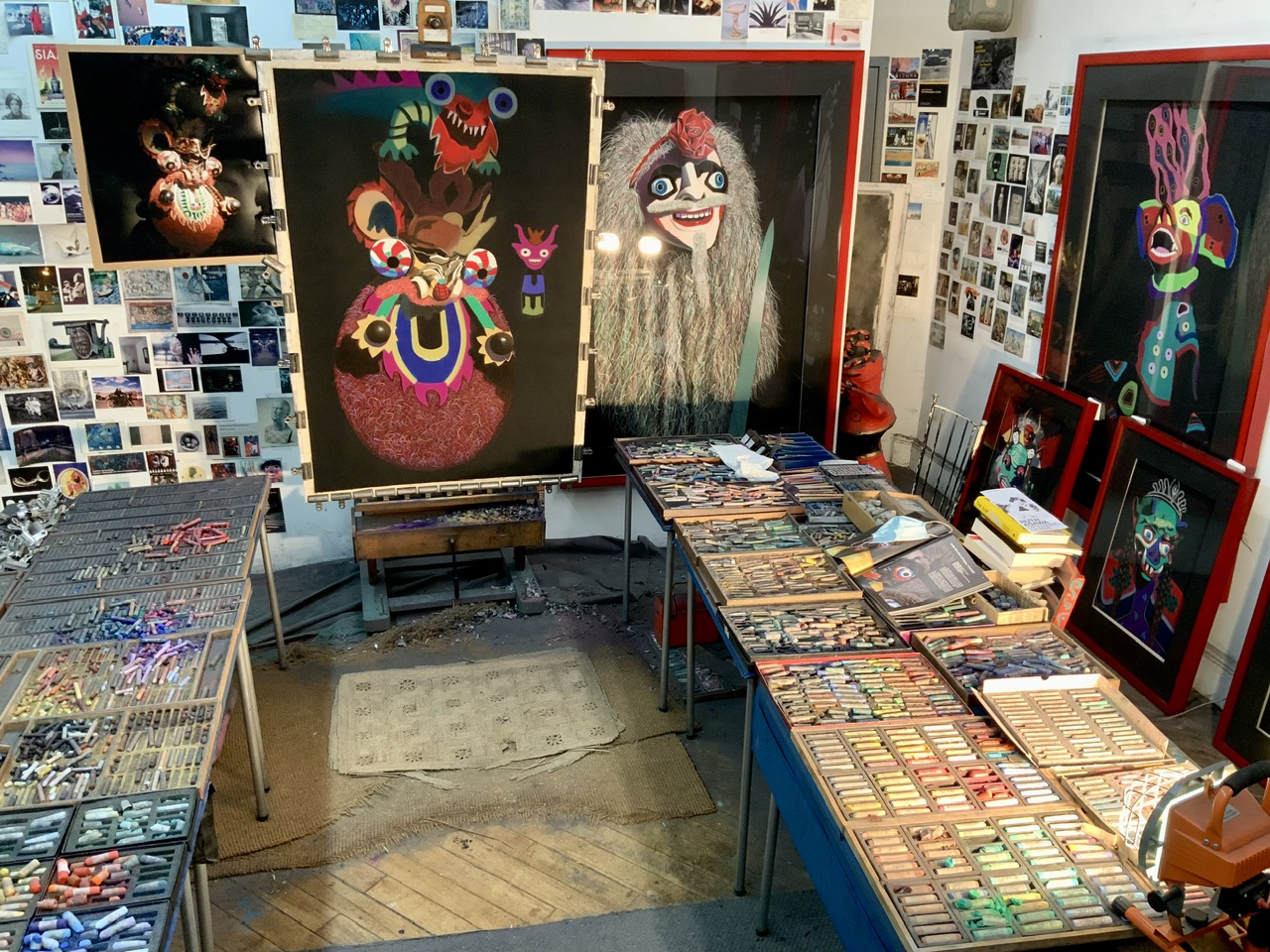
Barbara’s Studio
*an ongoing series of quotations – mostly from artists, to artists – that offers wisdom, inspiration, and advice for the sometimes lonely road we are on.
Anyone who studies an instrument, sport, or other art form must deal with practice, experiment, and training. We learn only by doing. There is a gigantic difference between the projects we imagine doing or plan to do and the ones we actually do. It is like the difference between a fantasied romance and one in which we really encounter another human being with all his or her complexities. Everyone knows this, yet we are inevitably taken aback by the effort and patience needed in the realization. A person may have great creative proclivities, glorious inspirations, and exalted feelings, but there is no creativity unless creations actually come into existence.
Stephen Nachmanovitch in Free Play: Improvisation in Art and Life
Comments are welcome!
Q: What’s on the easel today?


A: I just started a large 58″ x 38″ pastel painting based on the same reference photograph I used for “Shamanic,” 26″ x 20.” Sometimes ideas for new projects arrive in prosaic ways. I saw a mockup of “Shamanic” on my New Delhi gallery’s Instagram page. The mockup depicted my pastel painting as considerably larger than it actually is. I became intrigued with this unexpected format and decided to create a new one in a larger size.
For now I have turned Shamanic” to the wall so that it does not inadvertently influence my color choices. The two pastel paintings are already looking quite different.
Comments are welcome!
Q: Why do people need art in their daily lives?
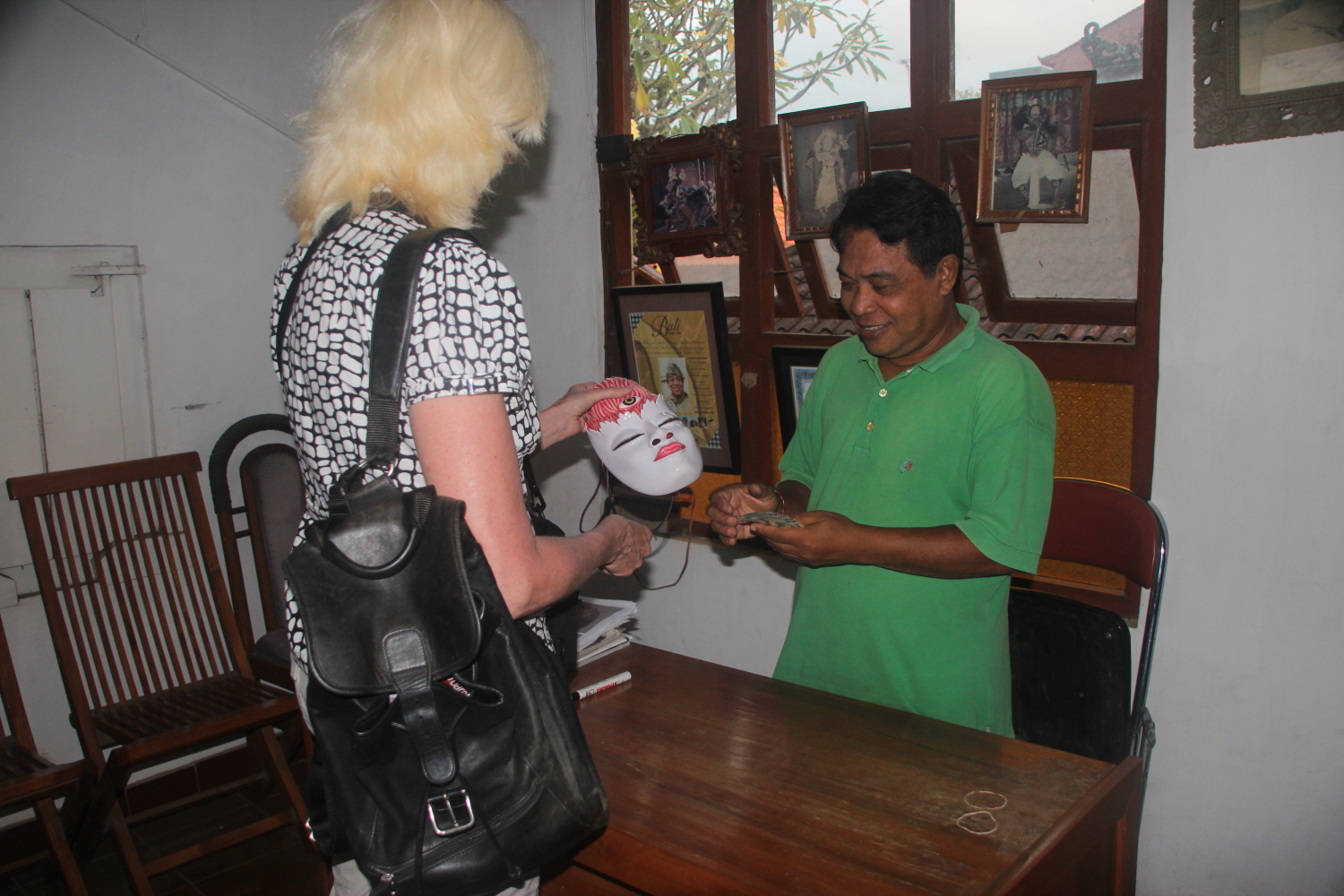
With Ida Bagus Anom, Mas, Bali; Photo: Donna Tang
A: That is for each person to decide, but as someone who devotes every waking moment to my work and to becoming a better artist, I cannot imagine my life without art.
I will tell you a little about what art has done for me. In my younger days boredom was a strong motivator. I left the active duty Navy out of boredom. I couldn’t bear not being intellectually challenged (most of my jobs consisted of paper-pushing), not using my flying skills (at 27 I was a licensed commercial pilot and Boeing-727 flight engineer), and not developing my artistic talents. In what surely must be a first, the Navy turned me into a hard-working and disciplined artist. And once I left the Navy there was no plan B. There was no time to waste. It was “full speed ahead.”
Art is a calling. You do not need to be told this if you are among those who are called. It’s all about “the work,” that all-consuming focus of an artist’s life. If a particular activity doesn’t seem likely to make me a better artist, I tend to avoid it. I work hard to nourish and protect my gifts. As artists we invent our own tasks, learn whatever we need in order to progress, and complete projects in our own time. It is life lived at its freest.
My art-making has led me to fascinating places: Mexico, Guatemala, Brazil, Argentina, Uruguay, France, England, Italy, Bali, Java, Sri Lanka, and more; and to in-depth studies of intriguing subjects: drawing, color, composition, art and art history, the art business, film and film history, photography, mythology, literature, music, jazz and jazz history, and archaeology, particularly that of ancient Mesoamerica (Olmec, Zapotec, Mixtec, Aztec, Maya, etc.). And this rich mixture continually grows! For anyone wanting to spend their time on earth learning and meeting new challenges, there is no better life!
Comments are welcome!
Pearls from artists* # 24
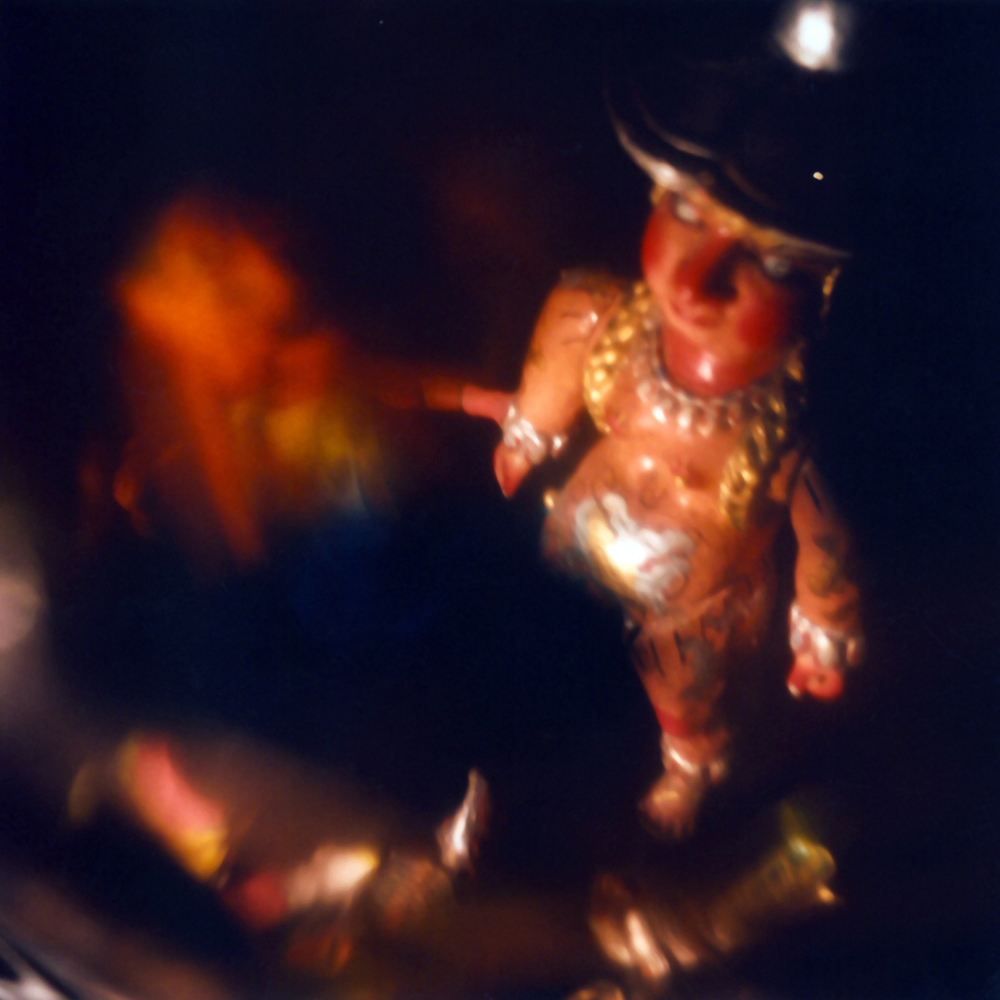
Untitled, chromogenic print, 24″ x 24,” edition of 5
* an ongoing series of quotations – mostly from artists, to artists – that offers wisdom, inspiration, and advice for the sometimes lonely road we are on.
A person is not an artist until he works at his art, no matter how eloquently he speaks during the cocktail hour or how fine are the images that come to his mind. As David Salle, the visual artist, put it, “It’s easy to be an artist in your head.” We, as artists, know this. We realize that often we are not able to translate our vision into splendid art. Even the finest artists write books that are not great, paint pictures that are not great, compose pieces that are not great, involve themselves in projects that are not great. But artists can only try – and must try.
When you love what you are doing, know what you are doing, and do it, a confidence is bred in you that is the best stretcher of limits. Then you can say, as the visual artist June Wayne said, “Now when I start something, I expect to carry it off.”
Eric Maisel, A Life in the Arts
Comments are welcome!


 barbararachkoscoloreddust.com