Blog Archives
Pearls from artists* # 562

“Shadow,” soft pastel on sandpaper, 26” x 20,” in progress
*an ongoing series of quotations – mostly from artists, to artists – that offers wisdom, inspiration, and advice for the sometimes lonely road we are on.
Jung observed that complexes could affect groups of people en masse. He saw that certain moments seemed to be expressions of a collective shadow, a bursting forth of a mass psychosis; the repressed side of a whole group coming alive; a tribal Mr. Hyde. He saw this madness first-hand in Germany in the 1930s and wrote about it. But every era carries some measure of collective shadow.
One could argue that no moment in time has seen more of the reality of human darkness than ours. Having witnessed the Holocaust and faced the threat of nuclear war in the twentieth century, and now facing the environmental impact of fossil fuels and plastics in the twenty-first century, we are undoubtedly aware of more of humanity’s potential for destruction than any of our ancestors ever were. Such a view does not come from a moralizing stance. Our era has made forced witnesses of us all.
The shadow is about where we put the Devil – where do we allow darkness to be housed? Racism and bigotry offer the relief of foisting our group’s shadow onto another whom we view as lesser. Doing so enables us not to look at or feel our shadow, and not see our own worst selves. But this collective shadow of our modern culture is also bigger and wider than group-to-group projections. There are culture-wide or civilization expressions of the collective shadow.
Jung saw the widespread loss of connection to the inner life and to a lived spirituality as one of the primary illnesses of our time. He observed that people were no longer animated by the traditional religions… For Jung, this meant that we’ve lost the old way but not yet found the new, and are sitting in a spiritual vacuum.
Into that vacuum, without our awareness, has slipped our fascination with human technology. Observe people closely today and you’ll notice that we have an almost magical faith in our devices. People see their computers and phones as all-knowing and expect them to function perfectly all the time, and view pharmaceuticals as magic cure-alls. Where we used to put God, we now have put technology. Where spirit was, we have unconsciously placed human genius.
Gary Bobroff in Carl Jung: Knowledge in a Nutshell
Comments are welcome!
Q; What was the spark that got you started? (Question from Barbara Smith via Facebook)

A: If I had to select one factor, I would say, profound unhappiness with my professional life. In 1986 I was a 33-year-old Navy Lieutenant working as a computer analyst at the Pentagon. I hated my job, was utterly miserable, and moreover, I was trapped because unlike many jobs, it’s not possible to resign a Naval commission with two weeks notice.
My bachelor’s degree had been in psychology. When I was in my 20s and before I joined the Navy, I had spent two years and my own money training to become a licensed commercial pilot and Boeing-727 Flight Engineer. I had planned to become an airline pilot, but due to bad timing (airlines were not hiring pilots when I was looking for a job), that did not come to pass.
So there I was with absolutely no interest, nor any training in computers, working for the Joint Chiefs of Staff, and completely bored. I knew I must have taken a wrong turn somewhere and resolved to make a significant change. Searching around, I discovered a local art school, the Art League School in Alexandria, VA, and began taking drawing classes.
One drawing class lead to more. Within a couple of years, due to being highly motivated to change my life, my technical skills rapidly improved. Even then, I believe, it was obvious to anyone who knew me that I had found my calling. I resigned my active duty Naval commission and have been a fulltime professional artist since October 1989. (Note: For fourteen more years I remained in the Naval Reserve working, mostly at the Pentagon, one weekend a month and two weeks each year, and retired as a Navy Commander in 2003).
Life as a self-employed professional artist is endlessly varied, fulfilling, and interesting. I have never once regretted my decision to pursue art fulltime!
Comments are welcome!
Q: Can you talk about how you transport your large pastel-on-sandpaper paintings?
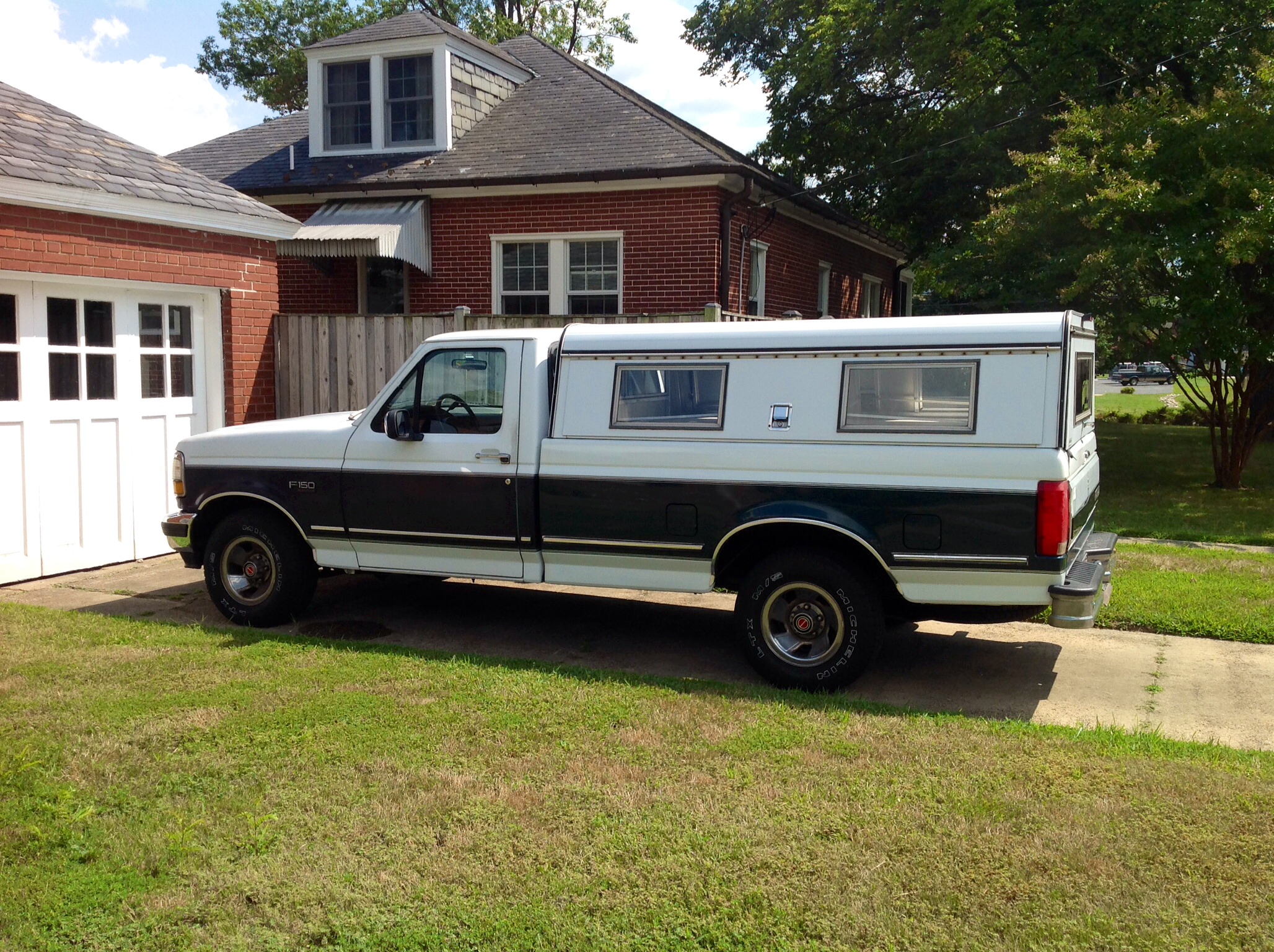
Barbara’s 1993 Ford truck
A: In 1993 Bryan and I bought a Ford F-150 pickup truck (he dubbed it “Sisyphus”) because it was the perfect size – 54” between the wheel wells – to slide my wrapped, framed paintings in and out of. Pastel paintings are fragile and need to lie flat while being transported. I remember that Bryan and I would go to a car dealership, a salesman would start his sales pitch, one of us would say, “Wait a minute,” and Bryan would hop into the back of a new truck with a tape measure to take a measurement! We both got a kick out of being such eccentric customers.
Fortunately, Ford trucks of that era are well-made. Mine has 198,000 miles on it. Whenever I bring it in for maintenance, there is some excitement at the dealership because, it’s all metal (not fiberglass) and there are no computers. Late model trucks are much smaller (most customers cares about low gas mileage; I still need that distance between the wheel wells). My paintings would not fit in any trucks made today (or any model since 1997, I believe) so I take good care of “Sisyphus.” I’m hoping it will still be going strong well beyond 200,000 miles!


 barbararachkoscoloreddust.com