Category Archives: 2013
Q: Would you talk about some of your early experiences with art?

Zebras in Chelsea
A: I grew up in a blue collar family in suburban New Jersey. My father was a television repairman for RCA. For awhile my mother worked as a sewing machine operator in a factory that made women’s undergarments, but mostly she stayed home to raise my sister and me (at the time I had only one sister, Denise; Michele was born much later). My parents were both first-generation Americans and in those days no one in my extended family had gone to college. I was a smart kid and showed some artistic talent in kindergarten or earlier. I have always been able to draw anything, as long as I can see it (i.e., I require a visual reference as opposed to drawing from memory). I remember copying the Sunday comics, which in those days appeared in all the newspapers. At the age of 6 my mother enrolled Denise and me in Saturday morning painting classes at the studio of an artist named Frances Hulmes in Rutherford, NJ. I continued the classes for about 8 years and became a fairly adept oil painter. Living just 12 miles from New York City in Clifton, New jersey, my mother often took us to museums, particularly the Museum of Modern Art, the Metropolitan Museum of Art, and the Museum of Natural History. I remember falling in love with Rousseau’s “The Sleeping Gypsy” and being astonished by the violence and scale of Picasso’s “Guernica,” when it was on long-term loan to MoMA. I have fond memories of studying the dioramas at the Museum of Natural History. They are still my favorite part of the museum. I suppose it goes without saying that there were not any artists in my family so I had no role models. At the age of 15 my father decided that art was not a serious pursuit – he said it was a hobby, not a profession – so he abruptly stopped paying for my Saturday morning lessons. With no financial or moral support to pursue art, I turned my attention to other interests (ex. I learned to fly airplanes, becoming a commercial pilot and Boeing 727 flight engineer) and let my artistic abilities lie dormant.
Comments are welcome!
Pearls from artists* # 22

Alexandria living room
* an ongoing series of quotations – mostly from artists, to artists – that offers wisdom, inspiration, and advice for the sometimes lonely road we are on.
So inclination you see is not lacking, and yet in all probability I shall have to try right here to clamber in the dark and all alone over the crest of the year, so to speak, for disciplinary reasons. I shall not deserve it otherwise, that is: I have long wanted to be here all alone, strictly alone, to go into my cocoon, to pull myself together, in short, to live by my heart and nothing else. Now since day before yesterday I have really been here all alone inside the old walls – outside, the sea, outside, the Karst, outside, the rain, perhaps tomorrow the storm – now must appear what is within by way of counterweight to such great and fundamental things. So, if something quite unexpected does not come, it may be the right thing to say, to hold out, to hold still with a kind of curiosity toward oneself, don’t you think? That is how things stand, and if I stir now everything will shift again; and then hearts are labeled, like certain medicines: shake before taking; I have been continually shaken in these last years, but never taken, that is why it is better that I should quietly arrive at clarity and precipitation…
Jane Bannard Greene and M.D. Herter Norton, translators, Letters of Rainer Maria Rilke 1910 – 1926
Comments are welcome!
Q: What’s on the easel today?
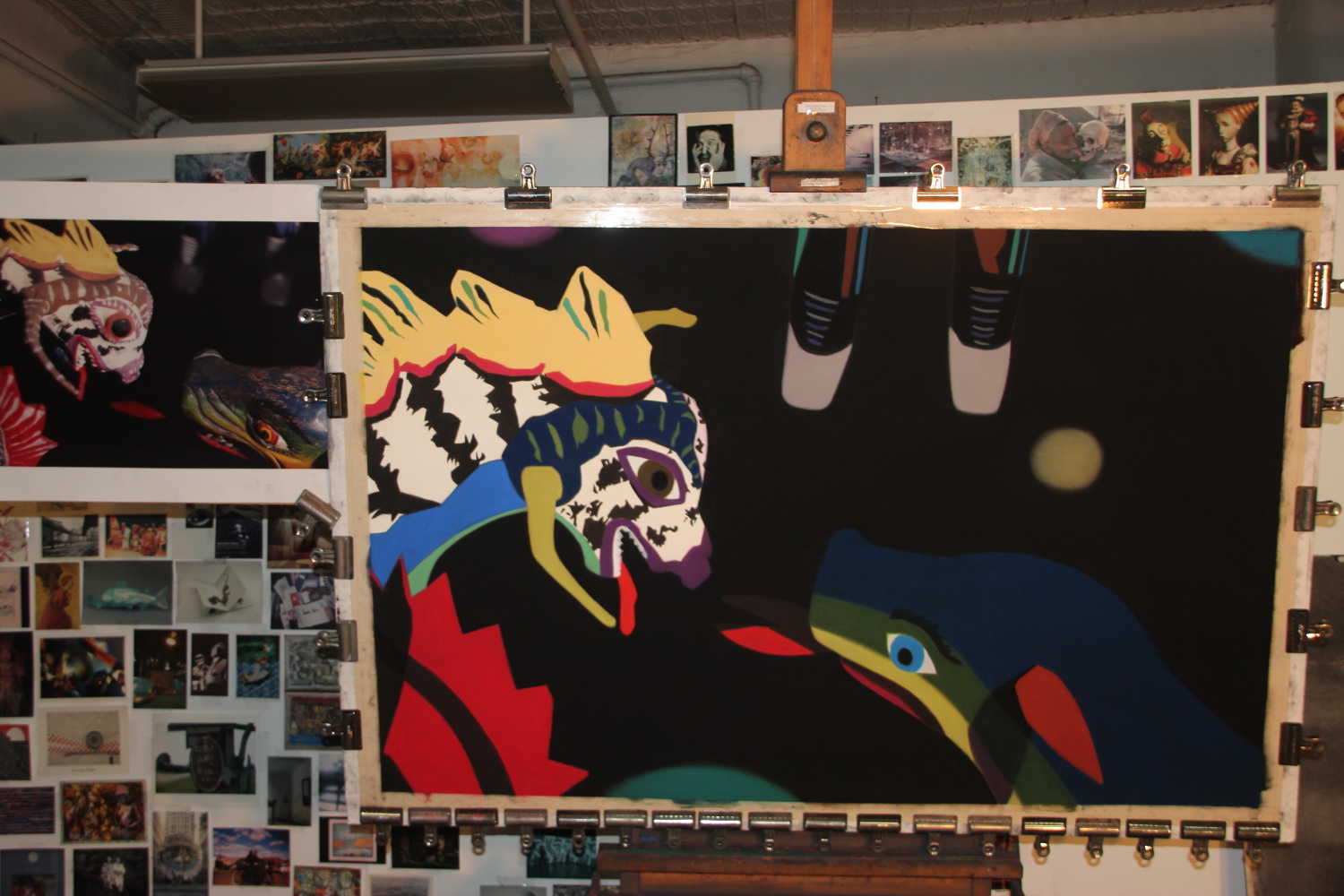
“Stalemate” in progress, soft pastel on sandpaper
A: A large pastel painting with the working title, “Stalemate.” For this one I went back and looked at some of my older 35 mm negatives. I selected one from 2002 and made the photographic print you see above, clipped to the left side of my easel. This piece is unusual because I’m painting the figures much larger than life size. I like what’s happening, but it’s slow going.
The title, “Stalemate,” is one I thought of some twenty-odd years ago, when I worked on a very different pastel painting – a table top still life – by that name. Somehow I couldn’t resolve some problems in the composition so I never finished it. I haven’t seen it in years, but it’s probably sitting in my Alexandria basement someplace.
Comments are welcome!
Pearls from artists* # 21

Apartment building, New York City
* an ongoing series of quotations – mostly from artists, to artists – that offers wisdom, inspiration, and advice for the sometimes lonely road we are on.
It is the beginning of a work that the writer throws away.
A painting covers its tracks. Painters work from the ground up. The latest version of a painting overlays earlier versions, and obliterates them. Writers, on the other hand, work from left to right. The discardable chapters are on the left. The latest version of a literary work begins somewhere in the work’s middle, and hardens toward the end. The earlier version remains lumpishly on the left; the work’s beginning greets the reader with the wrong hand. In those early pages and chapters anyone may find bold leaps to nowhere, read the brave beginnings of dropped themes, hear a tone since abandoned, discover blind alleys, track red herrings, and laboriously learn a setting now false.
Several delusions weaken the writer’s resolve to throw away work. If he has read his pages too often, those pages will have a necessary quality, the ring of the inevitable, like poetry known by heart; they will perfectly answer their own familiar rhythms. He will retain them. He may retain those pages if they possess some virtues, such as power in themselves, though they lack the cardinal virtue, which is pertinence to, and unity with, the book’s thrust. Sometimes the writer leaves his early chapters in place from gratitude; he cannot contemplate them or read them without feeling again the blessed relief that exalted him when the words first appeared – relief that he was writing anything at all. That beginning served to get him where he was going, after all; surely the reader needs it, too, as groundwork. But no.
Every year the aspiring photographer brought a stack of his best prints to an old, honored photographer, seeking his judgment. Every year the old man studied the prints and painstakingly ordered them into two piles, bad and good. Every year the old man moved a certain landscape print into the bad stack. At length he turned to the young man: “You submit this same landscape every year, and every year I put it in the bad stack. Why do you like it so much?” The young photographer said, “Because I had to climb a mountain to get it.”
Annie Dillard, The Writing Life
Comments are welcome!


 barbararachkoscoloreddust.com