Blog Archives
Pearls from artists* # 612
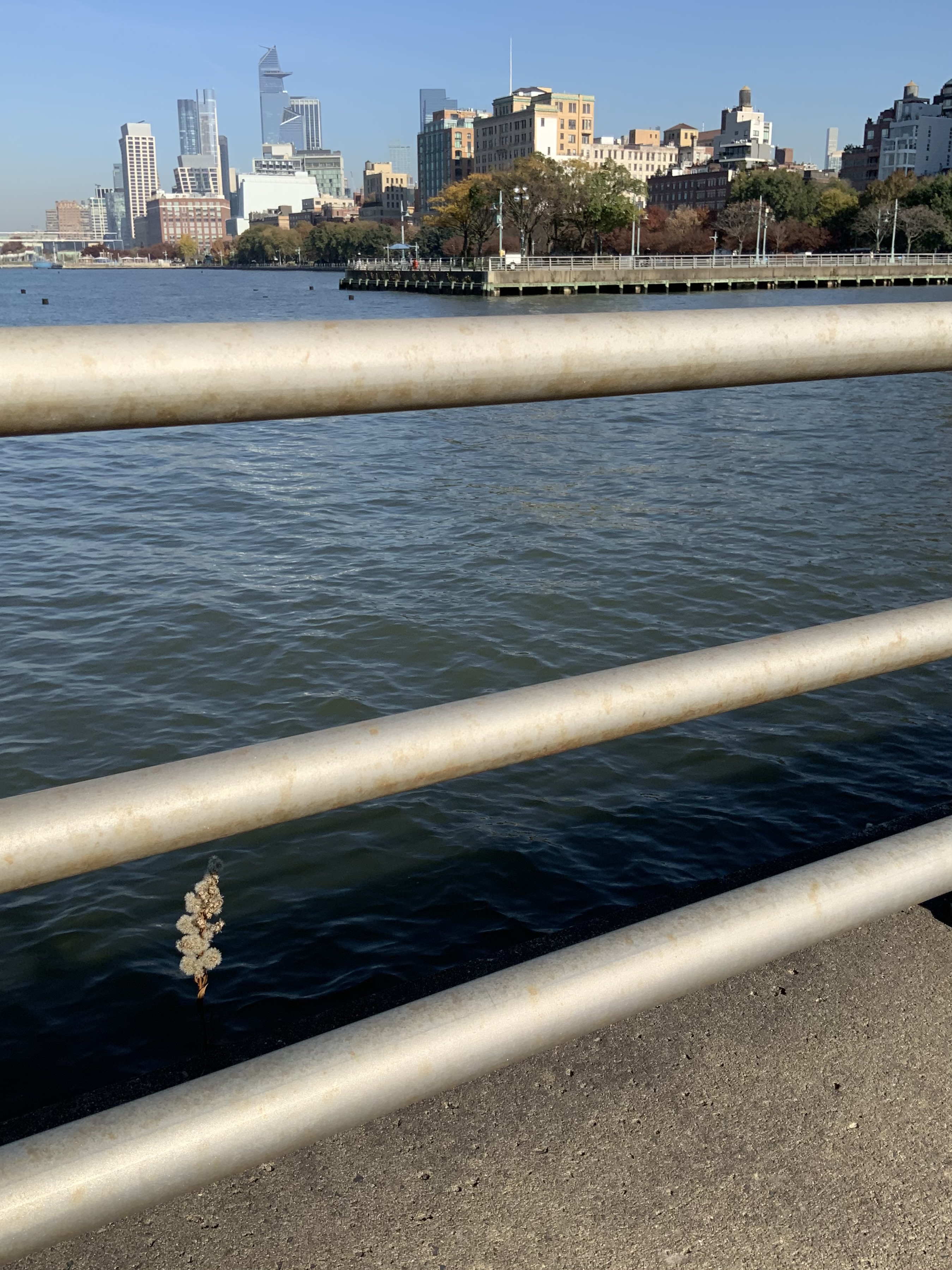
New York, NY
*an ongoing series of quotations – mostly from artists, to artists – that offers wisdom, inspiration, and advice for the sometimes lonely road we are on.
It is the poet and philosopher who provide the community of objectives in which the artist participates. Their chief preoccupation, like the artist, is the expression in concrete form of their notions of reality. Like him, they deal with verities of time and space, life and death, and the heights of exaltation as well as the depths of despair. The preoccupation with these external problems creates a common ground which transcends the disparity of the means used to achieve them. And it is in the language of the philosopher and poet or, for that matter, of other arts which share the same objective that we must speak if we are to establish some verbal equivalent of the significance of art.
Let us not for a moment conceive that the language of one is interchangeable with that of the other: that one can duplicate the sense of a picture by the sense of words or sounds, or that one can translate the truth of words by means of pictorial delineations. Not all odes of Pindar, framed and embroidered, could duplicate the portrayal by Apelles’ brush of the Hero of the Palaestra. The Pandemonium of Milton or Dante’s Inferno can never replace the vision of the Last Judgment by either Michelangelo or Signorelli. No more so than the Pastoral Symphony of Beethoven can be apprehended through the reading of idyllic poems, augmented by descriptions of woodland and fields, of torrents and streams, the study of ornithological sounds, and the laws of harmonics. Neither books on jurisprudence, nor costume plates, can possibly reconstruct Raphael’s School of Athens. And the man who knows a book or a picture through its critics, whatever his experience, has no experience of the art itself. The truth, the reality of each, is confined within its own boundaries and must be perceived in terms of the means generic to itself.
In speaking of art here, there is no thought of recreating the experience of the picture. If we compare one art to another, it is not with the intention of contrasting their actuality, but to speak rather of the motivations and properties such as are admissible to the world of verbal ideas. And if… we are partial to the philosopher – at the expense of those others who share with the artist his common objectives, it is not because we divine in his effort a greater sympathy to the artist, but because philosophy shares with art it’s preoccupation with ideas in the terms of logic.
Mark Rothko in The Artist’s Reality: Philosophies of Art
Comments are welcome!
Pearls from artists* # 43

Boulder, CO
* an ongoing series of quotations – mostly from artists, to artists – that offers wisdom, inspiration, and advice for the sometimes lonely road we are on.
Why would anyone read a book instead of watching big people move on a screen? Because a book can be literature. It is a subtle thing – a poor thing, but our own. In my view, the more literary the book – the more purely verbal, crafted sentence by sentence, the more imaginative, reasoned, and deep – the more likely people are to read it. The people who read are the people who like literature, after all, whatever that might be. They like, or require, what books alone have. If they want to see films that evening, they will find films. If they do no like to read, they will not. People who read are not too lazy to flip on the television; they prefer books. I cannot imagine a sorrier pursuit than struggling for years to write a book that attempts to appeal to people who do not read in the first place.
Annie Dillard in The Writing Life
Comments are welcome!
Pearls from artists* # 27
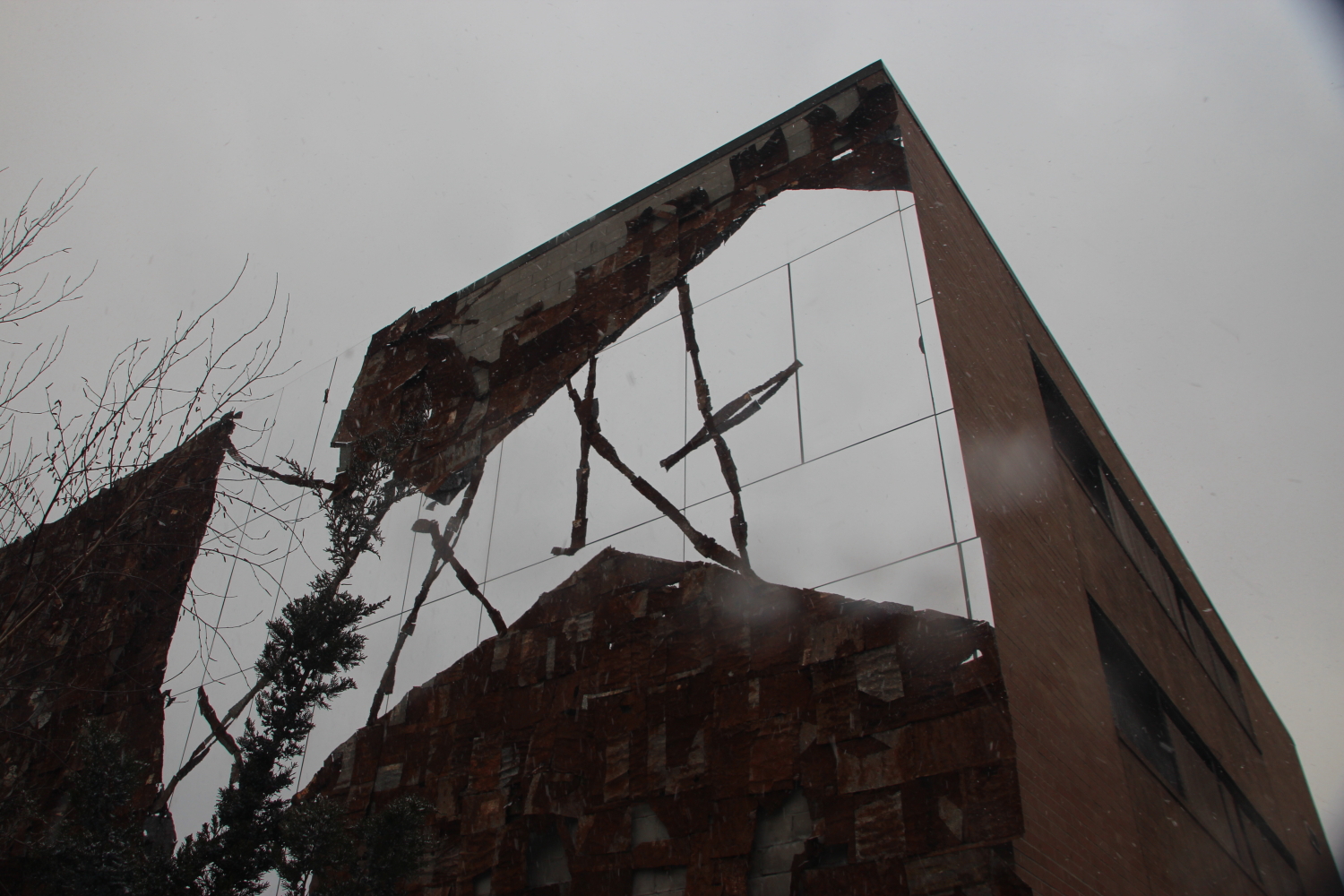
Broken Bridge II, by El Anatsui, on the High Line
* an ongoing series of quotations – mostly from artists, to artists – that offers wisdom, inspiration, and advice for the sometimes lonely road we are on.
Of course, when people said a work of art was interesting, this did not mean that they necessarily liked it – much less that they thought it beautiful. It usually meant no more than that they thought they ought to like it. Or that they liked it, sort of, even though it wasn’t beautiful.
Or they might describe something as interesting to avoid the banality of calling it beautiful. Photography was the art where “the interesting” first triumphed, and early on: the new, photographic way of seeing proposed everything as a potential subject for the camera. The beautiful could not have yielded such a range of subjects; and it soon came to seem uncool to boot as a judgment. Of a photograph of a sunset, a beautiful sunset, anyone with minimal standards of verbal sophistication might well prefer to say, “Yes, the photograph is interesting.”
What is interesting? Mostly, what has not previously been thought beautiful (or good). The sick are interesting, as Nietzsche points out. The wicked, too. To name something as interesting implies challenging old orders of praise; such judgments aspire to be found insolent or at least ingenious. Connoisseurs of “the interesting” – whose antonym is “the boring” – appreciate clash, not harmony. Liberalism is boring, declares Carl Schmitt in The Concept of the Political, written in 1932. (The following year he joined the Nazi Party). A politics conducted according to liberal principles lacks drama, flavor, conflict, while strong autocratic politics – and war – are interesting.
Paolo Dilonardo and Anne Jump, editors, Susan Sontag: At the Same Time
Comments are welcome!


 barbararachkoscoloreddust.com