Blog Archives
Q: Why do you have so many pastels?

Barbara’s Studio
A: Our eyes can see infinitely more colors than the relative few that are made into pastels. When I layer pigments onto the sandpaper substrate, I mix new colors directly on the paper. The short answer is, I need lots of pastels so that I can make new colors.
I have been working exclusively with soft pastel for 40 years. Whenever I feel myself getting into a rut in how I select and use my colors, I look around for new materials to try. Fortunately, new brands of soft pastels are continually coming onto the market. There are pastels that are handmade by artists – I love discovering these – and new colors manufactured by well-known pastel companies. Some sticks of soft pastel are oily, some are buttery, some more powdery, some crumble easily, some are more durable. Each one feels distinct in my hand.
Furthermore, they each have unique mixing properties. It’s an under-appreciated science that I stumbled upon (or maybe I invented it, I’m not sure since I cannot know how other pastel painters work). In this respect soft pastel is very different from other paint media. Oil painters, for example, need only a few tubes of paint to make any color in the world. I don’t go in much for studying color theory as a formal discipline. If you want to really understand and learn how to use color, try soft pastel and spend 10,000+ hours (the amount of time Malcolm Gladwell says, in his book, “Outliers,” that it takes to master a skill) figuring it all out for yourself!
Comments are welcome.
Q: Why do you have so many pastels?

Barbara’s Studio
A: Our eyes can see infinitely more colors than the relative few that are made into pastels. When I layer pigments onto the sandpaper substrate, I mix new colors directly on the painting. This has the result of making many of my colors unrepeatable. The short answer is, I need lots of pastels so that I can mix new colors.
I have been working exclusively with soft pastel for nearly 40 years. Each pastel stick has unique mixing properties that depend on what was used as a binder to hold the dry pigment together. Some soft pastels are oily, some are buttery, some are powdery, some crumble easily, some are harder. Each one feels slightly different when I apply it to the sandpaper.
Soft pastel is distinct among paint media. Oil painters need only a few tubes of paint to make any number of colors, but pastels are not easily combined to form new colors. I learned how to mix colors by experimenting. In the process I developed a personal and unique science of color-mixing and blending. This is one of the factors that makes my work so recognizable and sets it apart from that of other pastel painters.
Comments are welcome.
Pearls from artists* # 468

*an ongoing series of quotations – mostly from artists, to artists – that offers wisdom, inspiration, and advice for the sometimes lonely road we are on.
Why does art elicit such different reactions from us? How can a work that bowls one person over leave another cold? Doesn’t the variability of the aesthetic feeling support the view that art is culturally determined and relative? Maybe not, if we consider the possibility that the artistic experience depends not on some subjective mood but on an individually acquired (hence variable) power to be affected by art, a capacity developed through one’s culture in tandem with one’s unique character. For evidence of this we can point to works that seem to ignore cultural boundaries altogether, affecting people of different backgrounds in comparable ways even though a specific articulation of their personal responses continues to vary. Consider the plays of William Shakespeare or Greek theater, or the fairy tales that have sprung up in similar forms on every continent. We could not be further removed from the people who painted in the Chauvet Cave, nor could we be more oblivious as to the significance they ascribed to their pictures. Yet their work affects us across the millennia. Everyone responds to them differently, of course, and the spirit in which people are likely to receive them now probably differs significantly from how it was at the beginning. But these permutations revolve around a solid core, something present in the images themselves.
J.F. Martel in Reclaiming Art in the Age of Artifice: A Treatise, Critique, and Call to Action
Comments are welcome!
Pearls from artists* # 28
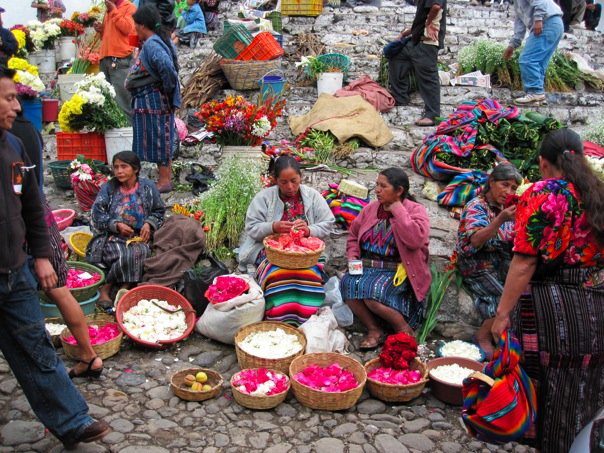
Flower sellers in Chichicastenango, Guatemala
* an ongoing series of quotations – mostly from artists, to artists – that offers wisdom, inspiration, and advice for the sometimes lonely road we are on.
We have talked a good deal about our duty, and how we could attain the right goal, and we came to the conclusion that in the first place our aim must be to find a steady position and a profession to which we can entirely devote ourselves. It is wise to do so, for life is but short and time passes quickly; if one is master of one thing and understands one thing well, one has at the same time insight into and understanding of many things.
One must especially have the end in mind, and the victory one would gain after a whole life of work and effort is better than one that is gained earlier. Whoever lives sincerely and encounters much trouble and disappointment, but is not bowed down by them, is worth more than one who has always sailed before the wind and has only relative prosperity. One must never trust the occasion when one is without difficulties.
Irving Stone with Jean Stone, editors, Dear Theo: The Autobiography of Vincent Van Gogh
Comments are welcome!


 barbararachkoscoloreddust.com