Blog Archives
Q: Have you noticed any common characteristics among the people who collect your work?

“Poseur,” soft pastel on sandpaper, 70” x 50” framed
A: Yes! They are fascinating people living lives devoted to nonstop learning, adventurous travel, and other proactive pursuits. Collectors of my work typically range in age from 40 to around 80. They are college graduates with advanced degrees. Sometimes they don’t have kids, which is why they have disposable income and time to pursue their interests in art and culture.
When I meet them (presuming my work was sold through a gallery or other third party), we usually have much to talk about – art, art history, photography, cinema, film history, dance, drama, music, travel, archaeology, Mexico, Central and South America, Bali – the list goes on and on. With so much in common, we quickly become good friends!
Comments are welcome!
Pearls from artists* # 625

Downtown Manhattan
*an ongoing series of quotations – mostly from artists, to artists – that offers wisdom, inspiration, and advice for the sometimes lonely road we are on.
Think of one of those rare, truly exceptional outings to the cinema. In the lobby afterward the experience elicits from us a language of paralysis and disappearance: “I forgot myself. It could have gone on forever.” Stepping out onto the street, we feel that somehow nothing is as it was before. The passing cars, the night sky above the glass towers, the streetlights reflected on the wet pavement: everything glows with a strange immediacy and newness. It is as if the film had done something to the world. A similar thing might happen when we put down a great novel or take in a powerful piece of music.
The Book of Revelation contains a memorable line: “Behold, I make all things new.” Reflecting on this ancient text, the critic Northrop Frye defined the Apocalypse as “the way the world looks once the ego has disappeared.” Every great artistic work is a quiet apocalypse. It tears off the veil of ego, replacing old impressions with new ones at once inexorably alien and profoundly meaningful. Great works of art have a unique capacity to arrest the discursive mind, raising it to a level of reality that is more expansive than the egoic dimension we normally inhabit. In this sense, art is the transfiguration of the world.
J.F. Martel in Reclaiming Art in the Age of Artifice: A Treatise,Critique, and Call to Action
Comments are welcome!
Q: What would you say collectors of your work have in common?
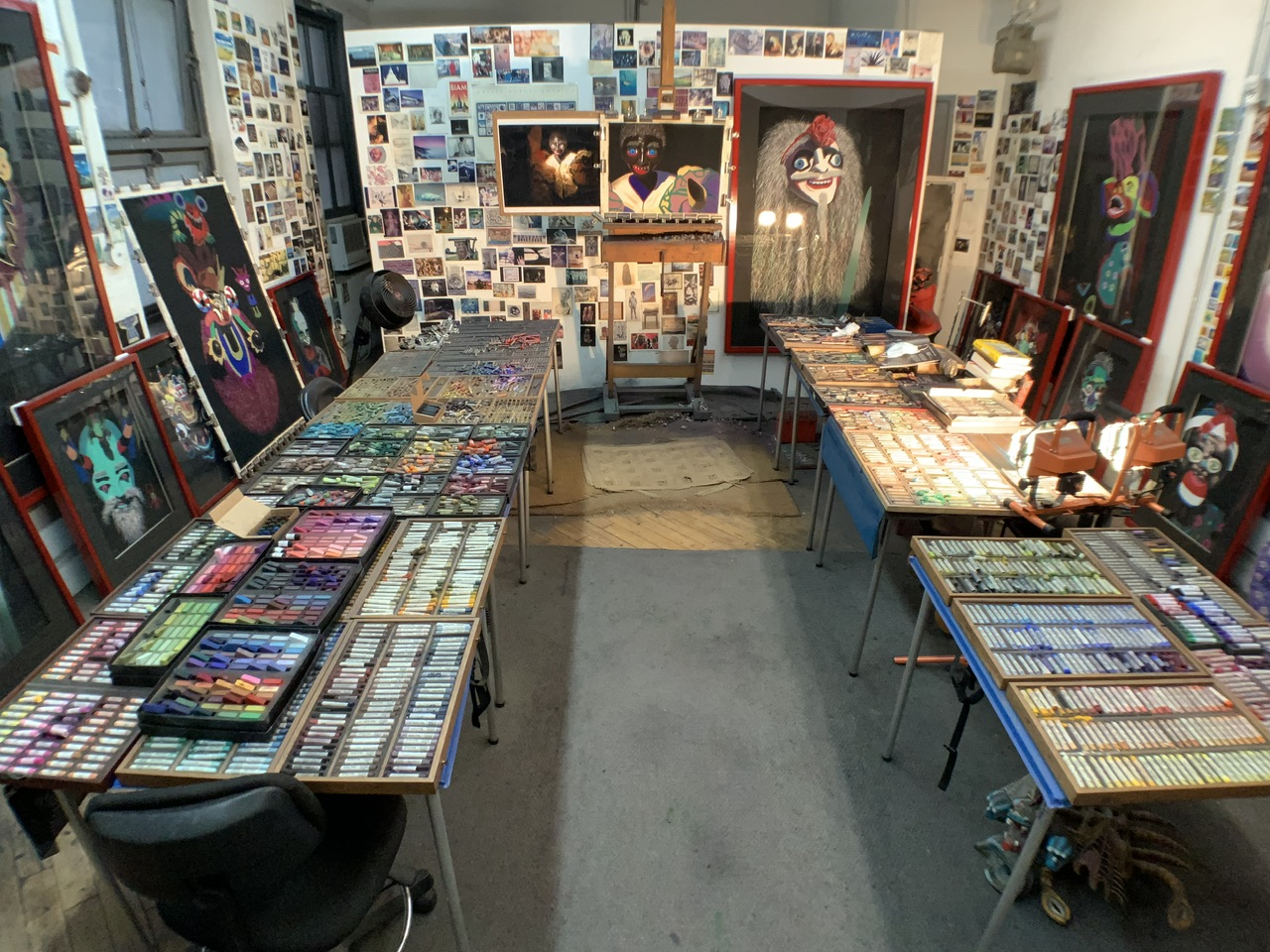
Barbara’s Studio
A: That’s a great question! I’d say that collectors of my work typically range in age from about 40 to their late 70s, they are college graduates with advanced degrees, they often don’t have kids, which is why they have disposable income and time to pursue their interests in art and culture. When I meet them (presuming my work was sold through a gallery or other third party), we usually have much to talk about – art, art history, photography, cinema, film history, dance, drama, music, travel, archaeology, Mexico, Central and South America, India, Asia – the list goes on and on.
Comments are welcome!
Q: What do your collectors have in common?

Screenshot from “Barbara Rachko: True Grit,” Photo: Jennifer Cox
A: Generally speaking, the people who collect my work typically range in age from about 40 to the late 70s, they are college graduates with advanced degrees, and they often don’t have kids, which is why they have disposable income and time to pursue their interests in art and culture. When I meet them (presuming my work was sold through a gallery or other third party), we usually have much to talk about – art, art history, photography, cinema, film history, dance, drama, music, travel, archaeology, Mexico, Central and South America, Bali, India – the list goes on and on.
Comments are welcome!
Pearls from artists* # 489

*an ongoing series of quotations – mostly from artists, to artists – that offers wisdom, inspiration, and advice for the sometimes lonely road we are on.
Murch: …The only time one is able to exercise control over the film is in the editing. The images themselves are not sufficient. They’re very important, but they’re only images. What’s essential is the duration of each image: the whole eloquence of cinema is that it’s achieved in the editing room.
In The Conversations: Walter Murch and the Art of Editing Film by Michael Ondaatje
Comments are welcome!
Pearls from artists* # 30

East Hampton house
* an ongoing series of quotations – mostly from artists, to artists – that offers wisdom, inspiration, and advice for the sometimes lonely road we are on.
And, just as the analysis of a film by a psychoanalyst can tell us about some implications and some sources of a labour that is all the less tightly under our control since the material problems we encounter during it make us insensible to tiredness and leave our unconscious quite free, so the interpretation of one of our works by the mind of an outsider can show it to us from a new, and revealing perspective.
How disturbed we should be, were there some machine that would allow us to follow the thousand brains in a cinema! No doubt, we should stop writing. We should be wrong to do so, but it would be a hard lesson. What Jules de Noailles said (recounted by Liszt) is true: ‘You will see one day that it is hard to speak about anything to anyone.’ Yet it is equally true that each person takes in or rejects the sustenance that we offer, and that the people who absorb it, do so in their own way; and this it is that determines the progress of a work through the centuries, because if a work were to send back only a perfect echo, the result would be a kind of pleonasm, an inert exchange, a dead perfection.
Andre Bernard and Claude Gauteur, editors, Jean Cocteau: The Art of Cinema
Comments are welcome!


 barbararachkoscoloreddust.com