Blog Archives
Q: Would you speak more about being represented by Brewster Gallery in the late 1990s?

A: In 1996 I landed my first major New York gallery, Brewster Gallery. I was still living in Virginia and Mia Kim, the director, had accepted my work on the basis of unsolicited slides mailed to the gallery in July. The first time she saw my pastel paintings in person was when I delivered them for a solo exhibition in October.
Brewster represented Latin American masters such as Frida Kahlo, Francisco Zuniga, Diego Rivera, Francisco Toledo, and Rufino Tamayo. Mia Kim, the director, said that she sometimes had to defend her decision to represent me. Mia’s fabulous response was, “Barbara has the SOUL of a Latina!” My work at that time was heavily influenced by Mexican culture. Mia immediately understood what I was doing in my work. How thrilled and honored I was to be represented by a gallery where my fellow sole non-Latina was Leonora Carrington! Leonora came to my opening.
Those were wonderful days!
Comments are welcome!
Q: Would you talk about your early art exhibitions? (Question from “Culture Focus Magazine”)
Review of my first exhibition at Brewster Arts, New York City!
A: Certainly! My very first group exhibition was in a juried show in the late 1980s at the Art League Gallery in Alexandria, VA. This was a gallery that offered monthly juried shows for members. I applied regularly, had work accepted many times, and frequently won first prize for my pastel paintings.
Early exhibitions at the Art League were followed by group and solo exhibitions at nonprofit and university spaces in Virginia, Washington, D.C., Maryland, North Carolina, Pennsylvania, Ohio, Rhode Island, Connecticut, Massachusetts, New Jersey, and New York; more or less up and down the mid-Atlantic states and the northeast, which were all places I could drive my truck to hand-deliver fragile pastel paintings.
My very first solo exhibition at a commercial gallery was at 479 Gallery in SoHo (New York City) in July 1996. In 1995 I had submitted work to a juried group show and was awarded first prize, which was a solo exhibition at 479 the following year.
My exhibition with 479 Gallery was quickly followed by representation at a prestigious New York gallery, Brewster Arts Ltd., which specialized in Latin American masters such as Frida Kahlo, Leonora Carrington, Diego Rivera, Rufino Tamayo, and many others. I was awarded my first two-person exhibition there in October 1996 and got to meet fellow gallery artist Leonora Carrington when she came to the opening. I could hardly believe my good fortune at gaining representation at such a revered and elegant gallery!
Comments are welcome!
Q: When did you begin seriously studying photography?

A: After I lost my husband, Bryan, on 9/11 – as I’ve discussed elsewhere, Bryan photographed most of the setups for my “Domestic Threats” series – I needed to find a way to continue making art. In June 2002 I began studying photography at the International Center of Photography (ICP) in New York. I took a one week 4 x 5 view camera workshop because Bryan had photographed the setups with a Toyo-Omega view camera. I was surprised to discover that I had absorbed quite a bit of technical information just by watching him. Once I completed the workshop, I decided to start over from the beginning and to learn as much as I could about photography. So I enrolled in Photography I. Over the next several years I completed about a dozen courses at ICP, eventually learning to make my own large-scale chromogenic prints.
Around 2007 I began working seriously as a photographer, creating my photographic series, “Gods and Monsters,” with Bryan’s Mamiya 6 camera. In October 2009 HP Garcia Gallery in New York gave me my first solo photography exhibition.
Comments are welcome!
Q: Would you speak about someone who made a difference in your professional life?
A: The first person who comes to mind is my favorite aunt, Teddie. In 1997 she was headed to northern California to attend a three-year-plus silent Tibetan Buddhist retreat at her teacher’s center. Teddie offered me her West 13th Street 6th-floor walkup apartment to live in while she was away. At the time I was based in Alexandria, VA and had just had my first solo exhibition at an important West 57th Street gallery, Brewster Fine Arts. I was becoming increasingly frustrated with the limited Washington, DC art scene, had outgrown everything it had to offer, and felt New York pulling me towards new and exciting professional adventures.
Teddie, recognizing my talent and ambition, made it possible for me to afford to move to New York. She had practiced Tibetan Buddhism for 35 years and was soon to become a Buddhist lama. She had an extraordinary mind and thought deeply about life. We used to talk for hours. Teddie was 7 years older and seemed more like a sister than an aunt. Indeed, she was my first soul mate. (I have been extremely fortunate to have had two such relationships in my life. The other was my late husband, Bryan).
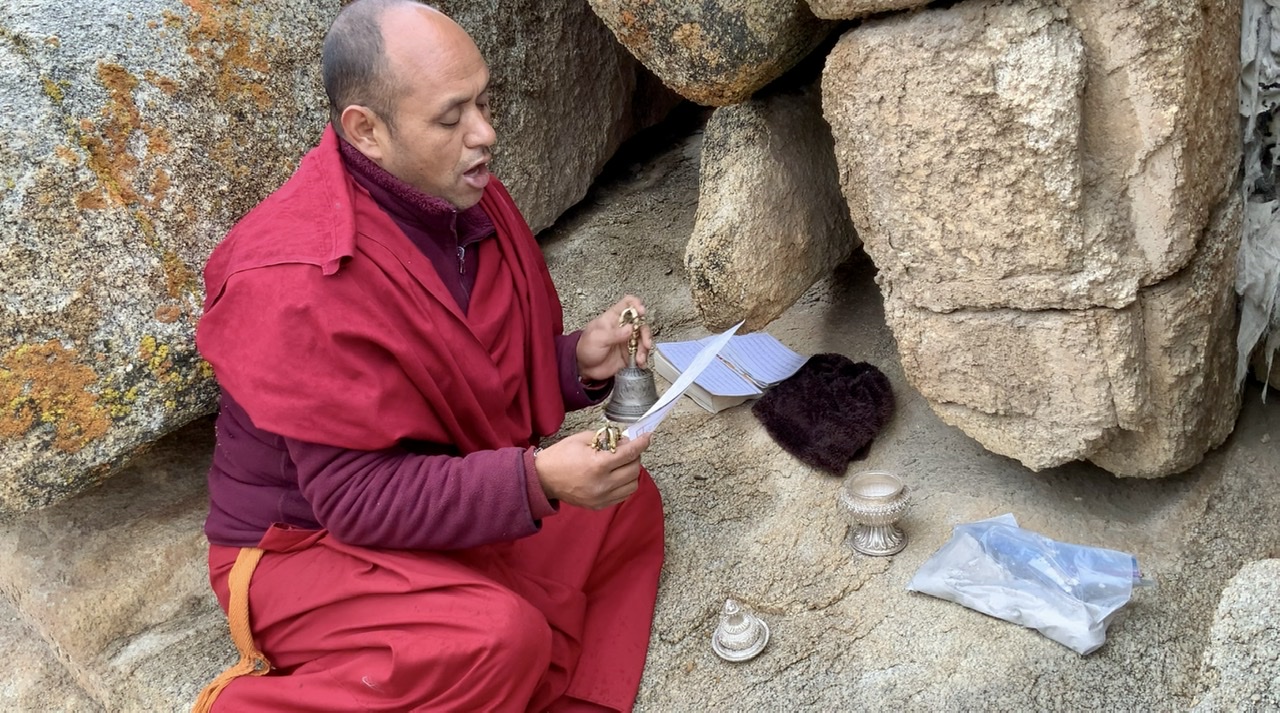
Unfortunately, dear Aunt Teddie died at the age of 67 of breast cancer. Recently, on September 25 I honored her life in a short ceremony on a mountain cliff in Leh, Ladakh (India). A Tibetan Buddhist monk recited prayers as he placed her ashes among the rocks.
Comments are welcome!
Q: What was the first review you ever received and how did you get it?
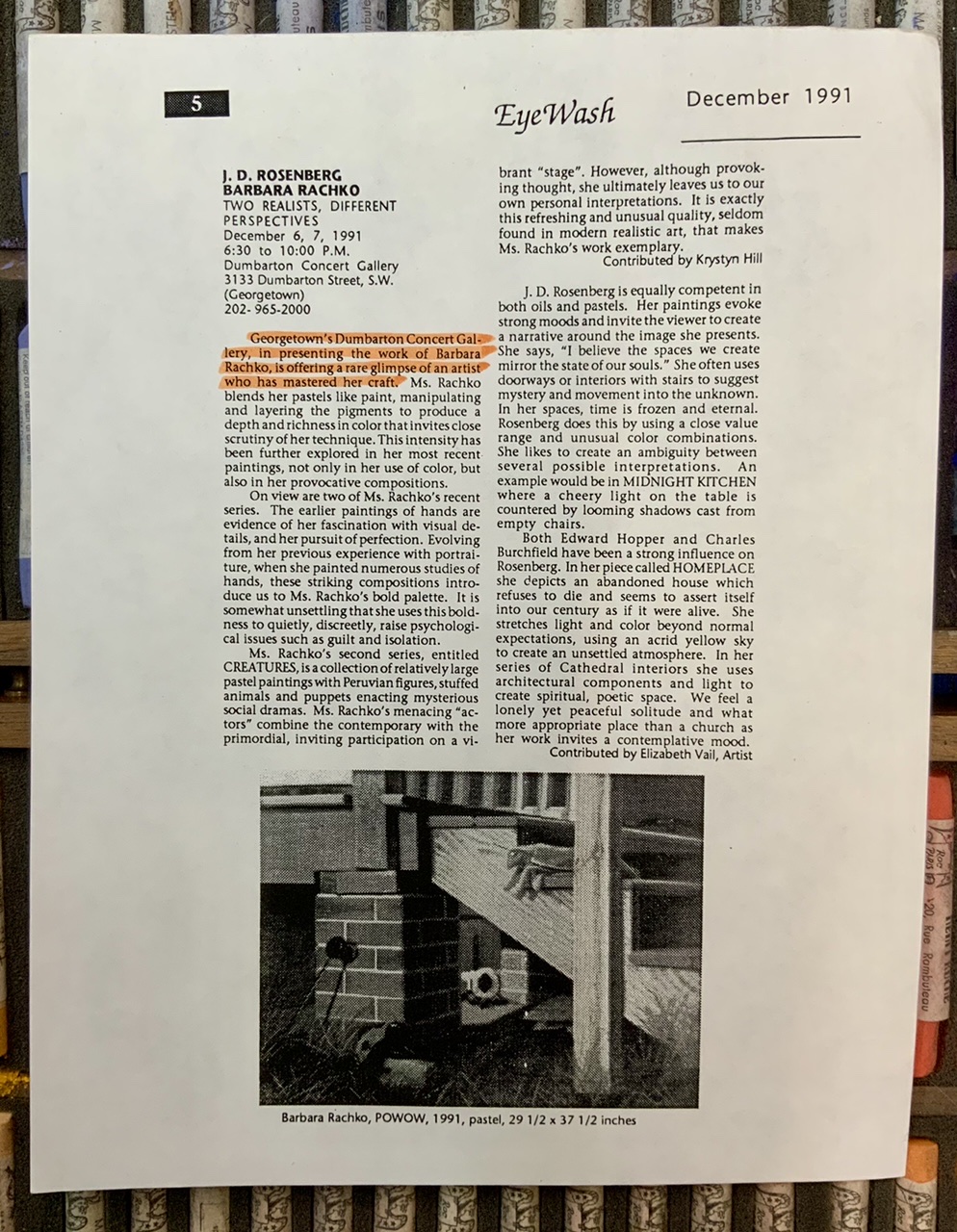
A: In 1991 I was in my late thirties and had resigned my active duty Naval commission two years before. I had been an artist for five years. I was anxious to get my pastel paintings exhibited, seen by an audience, and collected! As I worked hard to build my resume, I hustled to exhibit in all sorts of spaces that were not galleries: restaurants, hospitals, real estate offices, law offices, theaters, doctors’ offices, and more. The goal was to just get the work out of my home studio.
In December 1991 I presented a solo exhibition at Dumbarton Church in Georgetown (Washington, DC). For years Bryan had volunteered to set up chairs, a Steinway piano, and other miscellaneous equipment for their classical music concert series. The church’s downstairs space was used to showcase artists’ work. So I applied for a solo exhibition, was accepted, and got my first review in a local Washington, DC newspaper called “Eye Wash!”
Moral: artists have to work extremely hard for every little thing that comes our way!
Comments are welcome!
Q: During one of the most gripping times of your life, you were personally affected by the 9/11 attack on our country. Your husband was killed on the plane that crashed into the Pentagon. Would you mind telling us about it and how it has shaped your work?
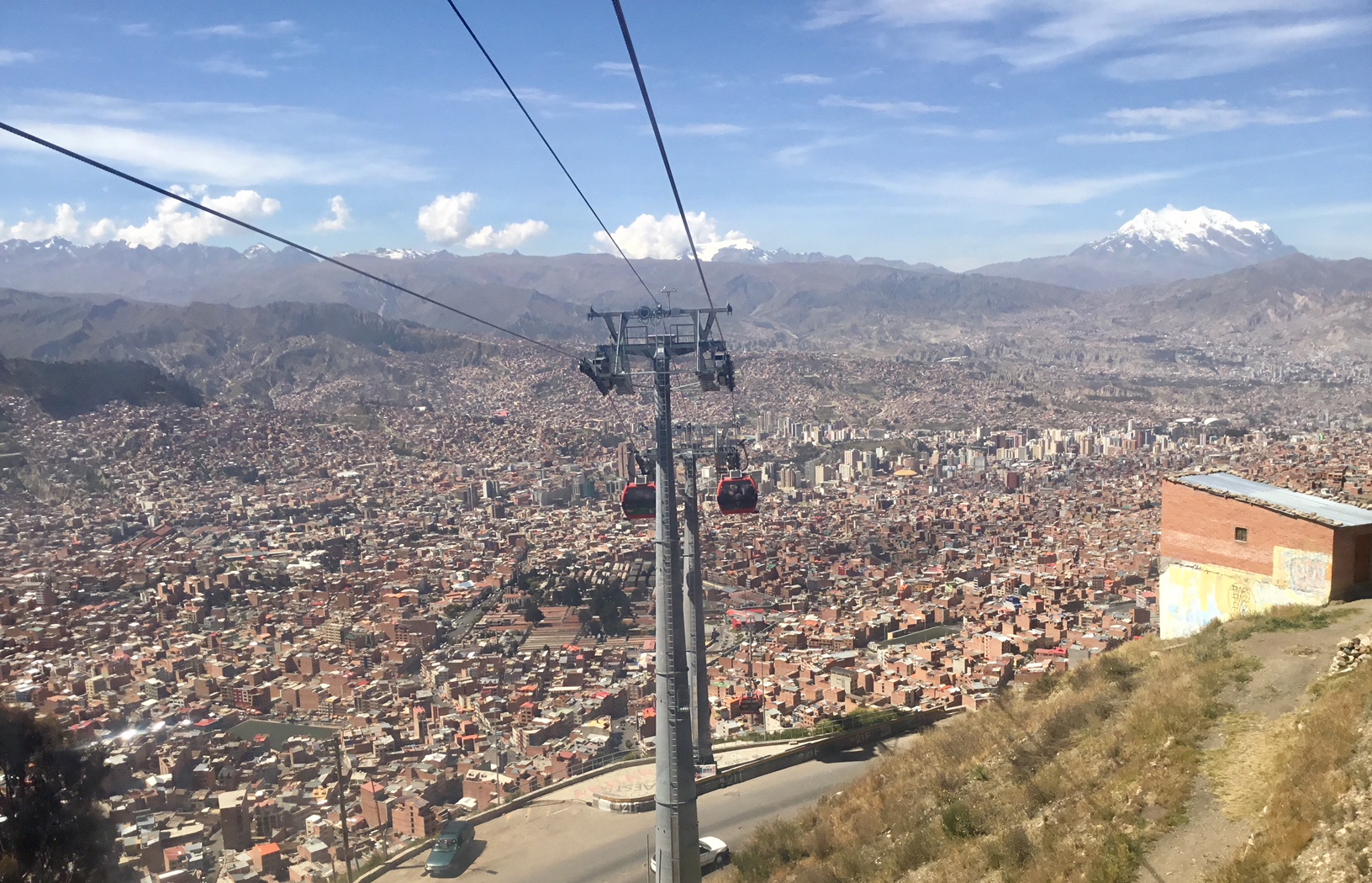
‘Mi Teleferico’ line, La Paz, Bolivia
A: In the summer of 2002 I was ready to – I HAD to – get back to work in my studio. I knew exactly what I must do. More than ever before, learning and painting would become the avenues to my well-being.
Because I use reference photos for my pastel paintings, the first challenge was to learn how to use Bryan’s 4 x 5 view camera. At that time I was not a photographer. Bryan had always taken reference photos for me.
In July 2002 I enrolled in a view camera workshop at New York’s International Center of Photography. Much to my surprise I had already absorbed quite a lot from watching Bryan. After the initial workshop, I continued more formal studies of photography for several years. In 2009, I am proud to say, I was invited to present a solo photography exhibition at a New York gallery!
In 2003 I resumed making my Domestic Threats series of pastel paintings, something that had seemed impossible after Bryan’s death. The first large pastel painting that I created using a reference photograph taken by me confirmed that my life’s work could continue. The title of that painting, “She Embraced It and Grew Stronger,” was autobiographical. “She” is me, and “it” meant continuing on without Bryan and living life for both of us.
Having had a long successful run, the Domestic Threats series finally ended in early 2007. Around that time I was feeling happier and had come to better terms with losing Bryan. While this is a tragedy I will never truly be at peace with, dealing with the loss became easier with time.
Then in 2007 I suddenly became blocked and did not know where to take my work next. I had never experienced creative block and especially for a full-time professional artist, this was a painful time. Still, I continued to go to the studio every day and eventually, thanks to a confluence of favorable circumstances, the block ended.
My next pastel painting series was called Black Paintings. I viewed the black background as literally, the very dark place that I was emerging from, exactly like the figures emerging in these paintings. The figures themselves were wildly colorful and full of life, but that black background – one critic has dubbed it my “blackground” – is always there.
Still the work continues to evolve. In 2017 I began my third pastel painting series called Bolivianos, based on a mask exhibition encountered in La Paz at the The National Museum of Ethnography and Folklore. Many people have proclaimed this to be my most bold, daring, and exciting pastel painting series yet. And I think they may be right! Continuing on the journey I began 30+ years ago, I am looking forward to creating many new, striking pastel paintings!
Comments are welcome!


 barbararachkoscoloreddust.com