Blog Archives
Pearls from artists* # 595

Film still from “Barbara Rachko: True Grit,” directed by Jennifer Cox, Moto Films LLC
*an ongoing series of quotations – mostly from artists, to artists – that offers wisdom, inspiration, and advice for the sometimes lonely road we are on.
One of the great paradoxes of the writing life is that our words – chosen carefully, so thoughtfully, with deep focus and concentration – those words once on the page go dead on us. Language is ours only when we are forming sentences, moving elements around, grappling with punctuation, speaking words aloud, feeling them on our lips. While we are shaping a scene into something we can hear and touch and see, that scene lives and breathes. We are inside language like painters, we are working in our medium: the tempera, the thin line, the wet oil on canvas, still in process, still alive.
But once we commit – once those words dry like paint, are affixed to the page – it becomes nearly impossible to see them. This? We think to ourselves. Our most loathsome critic emerges with a swirl of her cape. Really? What the hell is this? The sentences appear to have been written in another language – a dark dream language, tucked into some musty, inaccessible corner of our psyche. Attempting to discern its meaning is a bit like looking at our own face in the mirror. It is at once so familiar as to be invisible, and so intimate that we turn away, baffled, ashamed.
Can we ever see ourselves, really? Can we read ourselves?
It is a powerful conundrum because without the ability to see our writing afresh we cannot do the necessary work. How do we know whether a problem lies with the work, or with our inability to enter it? We need clarity, but not coldness. Openness, but not attachment. We want optimism, but that optimism must not go hand in hand with discernment. We’re not looking for a cheerleader, nor a fault-finding judge. We want to read ourselves with equanimity.
Dani Shapiro in Still Writing: The Pleasures and Perils of a Creative Life
Comments are welcome!
Pearls from artists* # 396
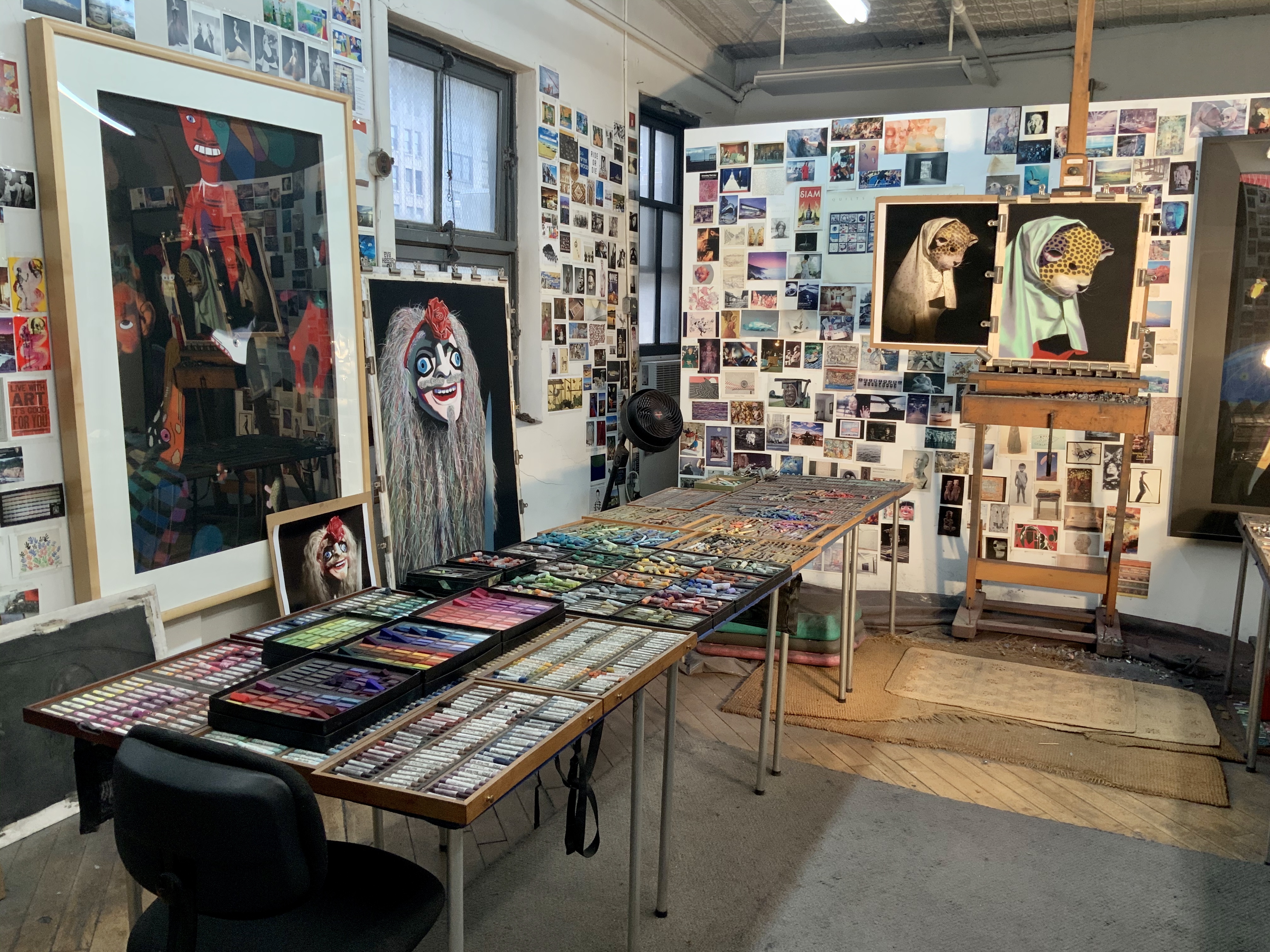
Barbara’s Studio
* an ongoing series of quotations – mostly from artists, to artists – that offers wisdom, inspiration, and advice for the sometimes lonely road we are on.
To summarize, art is expression. Expression is nonutilitarian and has no purpose beyond itself. Early on this led me to define works of art as things whose only function is to be perceived. Since the appearance of such things in everyday life breaks the drift of habit for which we have been hard-wired by evolution, art always occurs as an interruption. In the course of time, humans have produced innumerable works of art, subordinating them to innumerable ends according to the needs of the hour, yet all art exhibits a primal quality that exceeds those appropriations. Because the inherent multivalence of art threatens the desire to reduce things to clear significations, human societies have a tendency to overlook it, with the result that a great many aesthetic objects are called art when they are perhaps something else. To clarify this distinction I called art designed to serve instrumental reason “artifice.” In its worst forms, artifice amounts to aesthetic manipulation of a kind that is indisputably hostile to the ideals of openness, plurality, freedom of thought, and rational disclosure that we were told were the cornerstones of modernity. Art, on the other hand, is innately emancipatory, being itself the affirmation or sign of freedom.
J.F. Martel in Reclaiming Art in the Age of Artifice: A Treatise, Critique, and Call to Action
Comments are welcome!


 barbararachkoscoloreddust.com