Blog Archives
Q: What first intrigued you about Mexico?

“Myth Meets Dream,” 1993, soft pastel on sandpaper, first painting that includes Oaxacan figures
A: In the early 90’s my husband, Bryan, and I made our first trip to Oaxaca and to Mexico City. At the time I had become fascinated with the Mexican “Day of the Dead” celebrations so our trip was timed to see them firsthand. Along with busloads of other tourists, we visited several cemeteries in small Oaxacan towns. The indigenous people tending their ancestor’s graves were so dignified and so gracious, even with so many mostly-American tourists tromping around on a sacred night, that I couldn’t help being taken with these beautiful people and their beliefs. From Oaxaca we traveled to Mexico City, where again I was entranced, but this time by the rich and ancient history. On our first trip we visited the National Museum of Anthropology, where I was introduced to the fascinating story of ancient Meso-American civilizations (it is still one of my favorite museums in the world); the ancient city of Teotihuacan, which the Aztecs discovered as an abandoned city and then occupied as their own; and the Templo Mayor, the historic center of the Aztec empire, infamous as a place of human sacrifice. I was astounded! Why had I never learned in school about Mexico, this highly developed cradle of western civilization in our own hemisphere, when so much time had been devoted to the cultures of Egypt, Greece, and elsewhere? When I returned home to Virginia I began reading everything I could find about ancient Mexican civilizations, including the Olmec, Zapotec, Mixtec, Aztec, and Maya. This first trip to Mexico opened up a whole new world and was to profoundly influence my future work. I would return there many more times.
Comments are welcome!
Pearls from artists * # 20
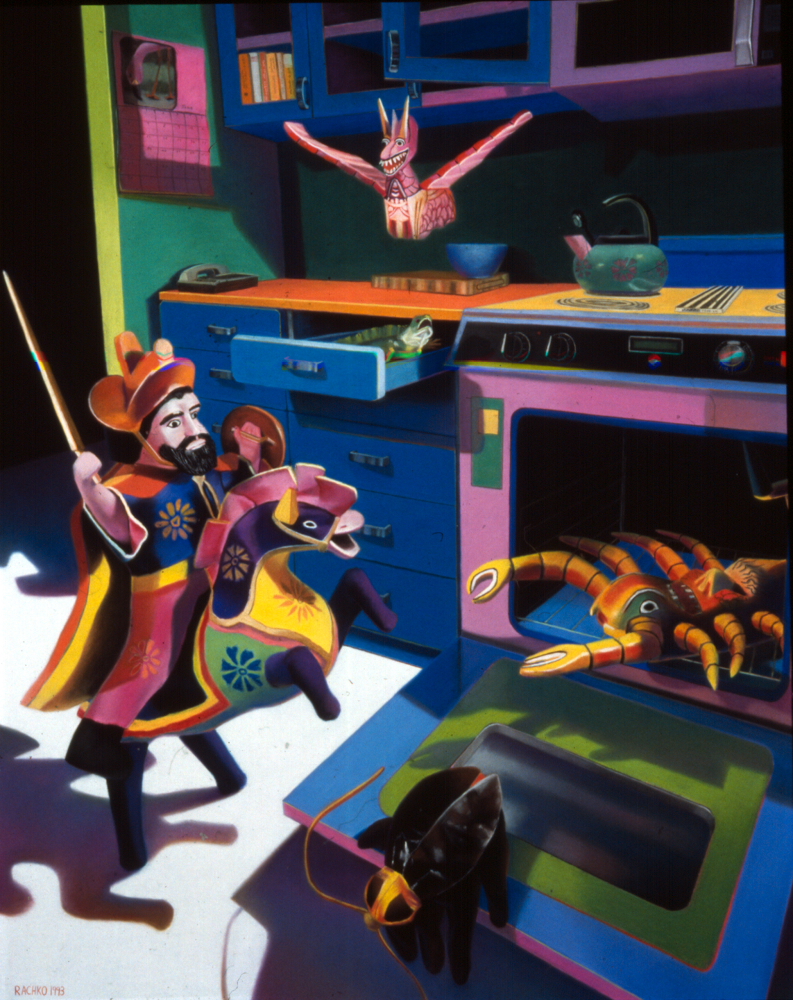
“The Magical Other,” soft pastel on sandpaper, 1993, 48″ x 38″
* an ongoing series of quotations – mostly from artists, to artists – that offers wisdom, inspiration, and advice for the sometimes lonely road we are on.
If, indeed, for any given time only a certain sort of work resonates with life, then that is the work you need to be doing in that moment. If you try to do some other work, you will miss your moment. Indeed, our own work is so inextricably tied to time and place that we cannot recapture even our own aesthetic ground of past times. Try, if you can, to reoccupy your own aesthetic space of a few years back, or even a few months. There is no way. You can only plunge ahead, even when that carries with it the bittersweet realization that you have already done your best work.
This heightened self-consciousness was rarely an issue in earlier times when it seemed self-evident that the artist (and everyone else, for that matter) had roots deeply intertwining their culture. Meanings and distinctions embodied within artworks were part of the fabric of everyday life, and the distance from art issues to all other issues was small. The whole population counted as audience when artists’ work encompassed everything from icons for the Church to utensils for the home. In the Greek amphitheater twenty-two hundred years ago, the plays of Euripides were performed as contemporary theater before an audience of fourteen thousand. Not so today.
Today art issues have for the most part become solely the concern of artists, divorced from – and ignored by – the larger community. Today artists often back away from engaging the times and places of their life, choosing instead the largely intellectual challenge of engaging the times and places of Art. But it’s an artificial construct that begins and ends at the gallery door. Apart from the readership of Artforum, remarkably few people lose sleep trying to incorporate gender-neutral biomorphic deconstructivism into their personal lives. As Adam Gopnik remarked in The New Yorker, “Post-modernist art is, above all, post-audience art.”
David Bayles & Ted Orland, Art & Fear: Observations on the Perils (and Rewards)of Artmaking
Comments are welcome!
Pearls from artists* # 12

Grand Falls, AZ
* an ongoing series of quotations – mostly from artists, to artists – that offers wisdom, inspiration, and advice for the sometimes lonely road we are on.
People who set their sails into art tend to work very hard. They train themselves in school; they practice and they read and they think and they talk. But for most of them there seems to be a more or less conscious cutoff point. It can be a point in time: “I will work until I am twenty-one (twenty-five, thirty, or forty).” Or a point in effort: “I will work three hours a day (or eight or ten).” Or a point in pleasure: “I will work unless…” and here the “enemies of promise” harry the result. These are personal decisions, more or less of individual will. They depend on the scale of values according to which artists organize their lives. Artists have a modicum of control. Their development is open-ended. As the pressure of their work demands more and more of them. they can stretch to meet it. They can be open to themselves, and as brave as they can be to see who they are, what their work is teaching them. This is never easy. Every step forward is a clearing through a thicket of reluctance and habit and natural indolence. And all the while they are at the mercy of events. They may have a crippling accident, or may find themselves yanked into a lifelong responsibility such as the necessity to support themselves and their families. Or a war may wipe out the cultural context on which they depend. Even the most fortunate have to adjust the demands of a personal obsession to the demands of daily life.
Anne Truitt, Daybook: The Journal of an Artist
Comments are welcome.
Q: What do your collectors have in common?
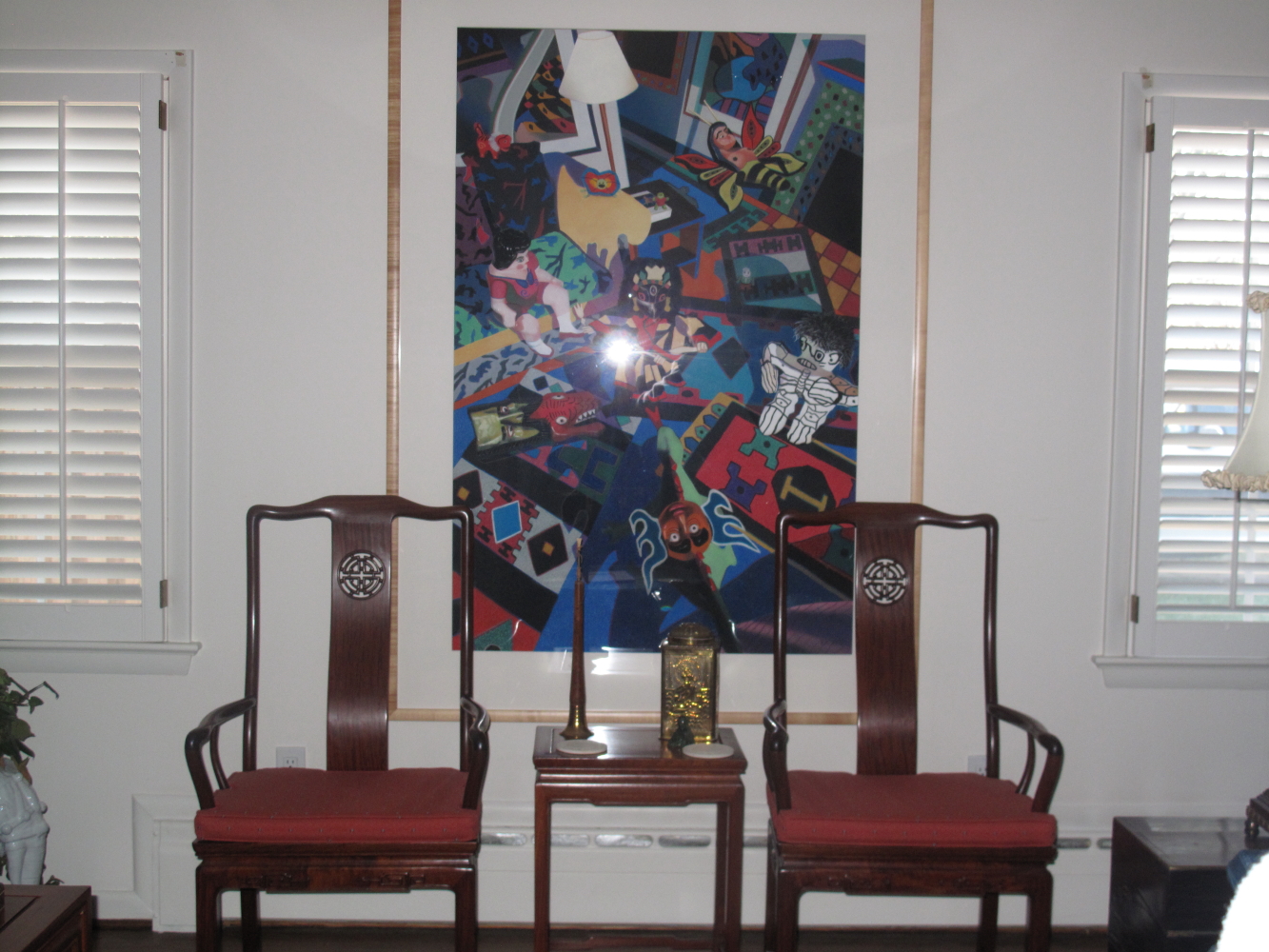
“She Braced Herself for Their Show of Force” at Jim and Judy’s; photo by Judy Bexfield
A: Collectors of my work typically range in age from about 40 to 70, they are college graduates with advanced degrees, they often don’t have kids, which is why they have disposable income and time to pursue their interests in art and culture. When I meet them (presuming my work was sold through a gallery or other third party), we usually have much to talk about – art, art history, photography, cinema, film history, dance, drama, music, travel, archaeology, Mexico, Central and South America, Bali – the list goes on and on.



