Blog Archives
Pearls from artists* # 255
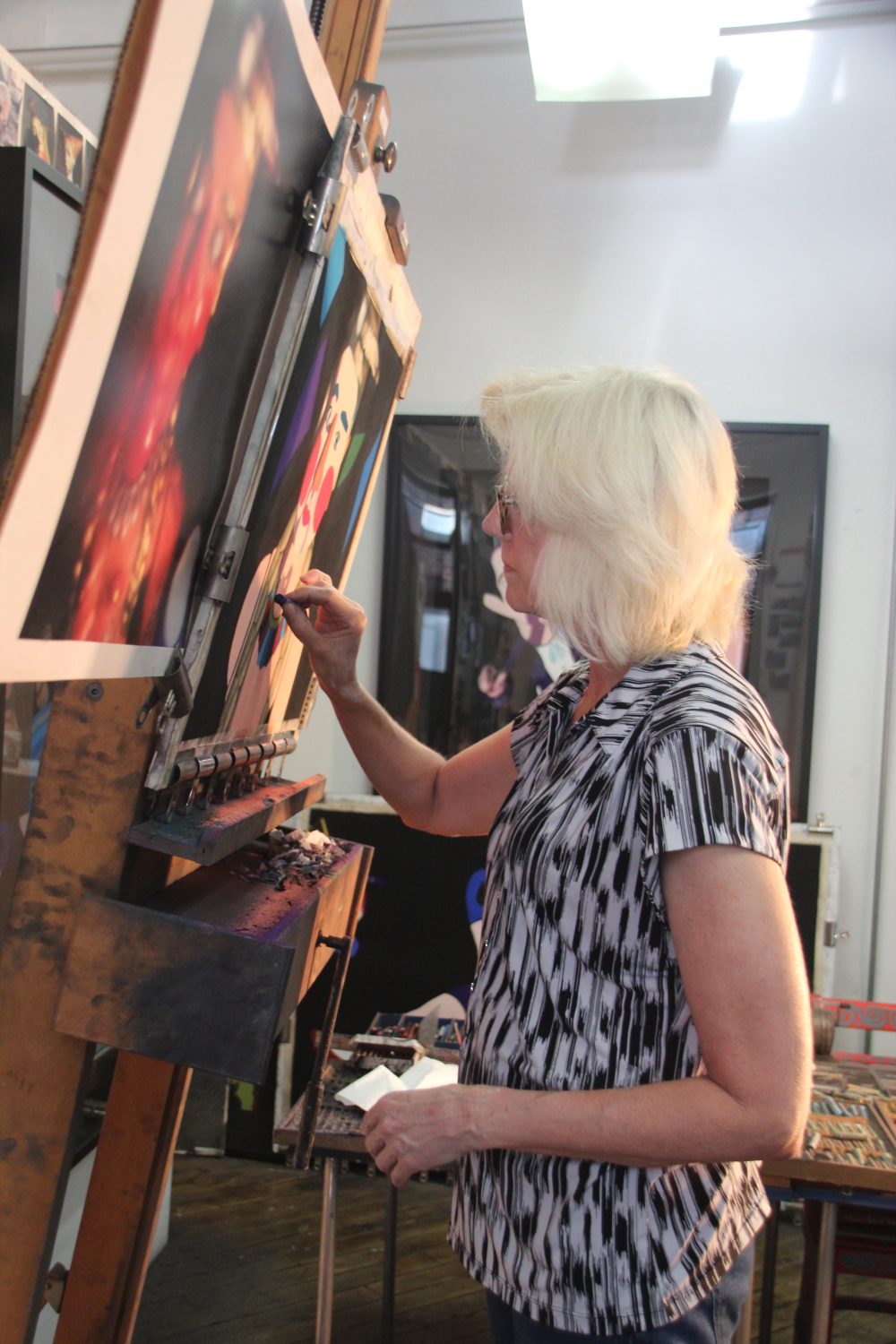
Barbara at work on “The Storyteller”
* an ongoing series of quotations – mostly from artists, to artists – that offers wisdom, inspiration, and advice for the sometimes lonely road we are on.
… several basic assumptions I have about the need for authenticity:
- Because in the end there is no other kind of art.
- I could have used the word ‘originality,” rather than authenticity, if the word’s root in “origin,” as in, “from the depth or source,” is recognized. However, the word implies a certain newness, “never done before,” that authenticity does not, and art in general does not need, in order to be deeply personal.
- Something that is authentic “rings true” for us. It comes from an inner truth. We draw from a source that is inner-directed rather than outer-directed, to use Maslow’s expression about self-actualization.
- Creating work that is authentic has a sacredness about it. It may be a way out – a small way perhaps, but at least a personal way – of a social dynamic that is all economics, consumerism, greed, and disregard for inner life. The word “science” comes from a root meaning “to separate.” Our cultural world view has been deeply influenced by that. Anything that we come to authentically in our artistic expression demands a personal inner synthesis. It is experience and insight won firsthand. The more we assimilate our “experience” from the advertising/media/consumer/government perspective the less authentic it will be.
- Most of what we express creatively is prelinguistic. The deeper insights are obviously coming from somewhere. They are not logically structured in the mind, but it may take logic to get them expressed.
- Ultimately, it doesn’t matter to the world if you paint or dance or write. The world can probably get by without your efforts. But that is not the point. The point is what the inner process of following your creative process will do, to you. It is clearly abut process. Love the work, love the process. Our fascination will pull our attention forward. That, also, will fascinate the viewer.
Ian Roberts in Creative Authenticity: 16 Principles to Clarify and Deepen Your Artistic Vision
Comments are welcome!
Q: What personality traits do you possess that have been most helpful in your art career?
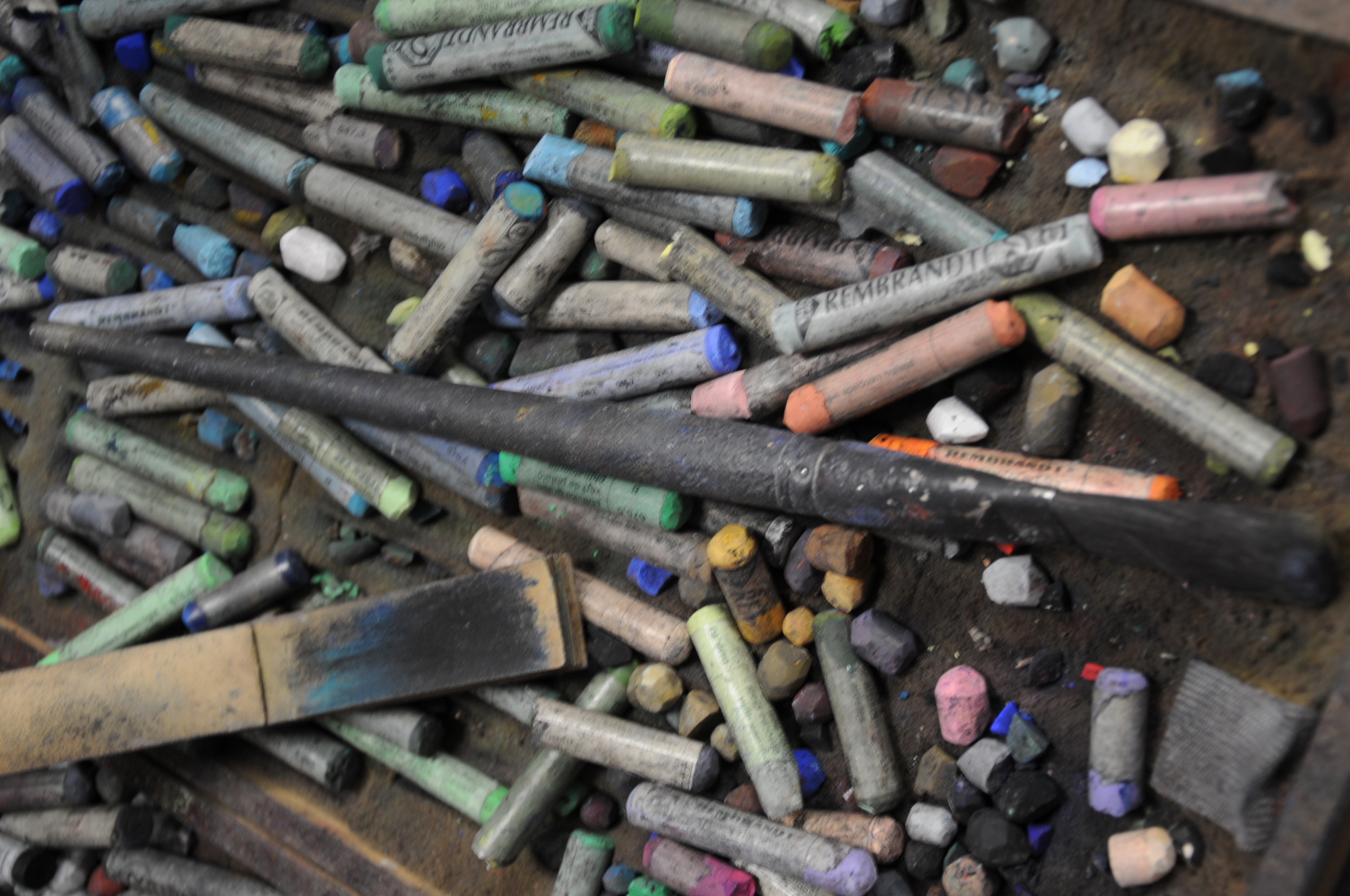
A few of Barbara’s pastels
A: I suppose it’s curiosity about all sorts of things, but particularly about the creative process. I am forever curious about how my personal creative process might evolve and develop and where it might possibly lead. Making art is an ongoing source of discovery. The longer I am an artist, the richer the whole experience becomes.
Also, I possess an unwavering love of craft. Even after thirty years, I still enjoy experimenting with new pastels, pushing myself to use them in new ways, and endeavoring to create the best work I can.
Comments are welcome!
Q: How do you decide what to paint next?
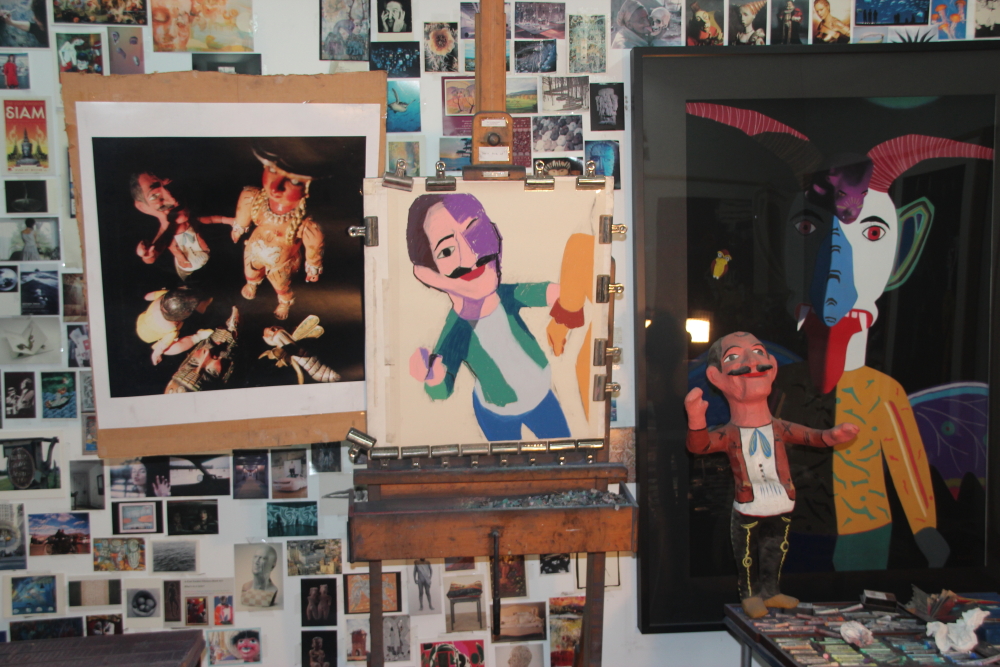
Work in progress
A: It’s interesting how my creative process is simplifying the longer I work at this. For my most recent piece, I looked at my old 20″ x 24″ c-prints until a particular image seemed to call out. It became my next project.
Comments are welcome!
Q: How do you experience art in New York?

Lower Manhattan
A: As a New York artist I am very fortunate to live in a city with a vibrant, exciting cultural scene. Simply put, art is in the air here and I take inspiration from everything I see and experience: painting, photography, sculpture, installation, performance art, public art, dance, theater, film, opera, jazz, etc. This city itself is an endlessly fascinating place. Visually it is always thrilling! I never know what I am going to see – good and bad – whenever I leave my apartment.
I have been living here since April 1997. The city provides a heady mix to ponder and this mix mysteriously enriches, influences, and somehow finds its way into the work. I have been an artist for nearly thirty years and I continue to be intrigued with watching the intricacies of how my creative process evolves and grows.
Comments are welcome!
Q: How do you select a photograph to use as reference material to make a pastel painting?
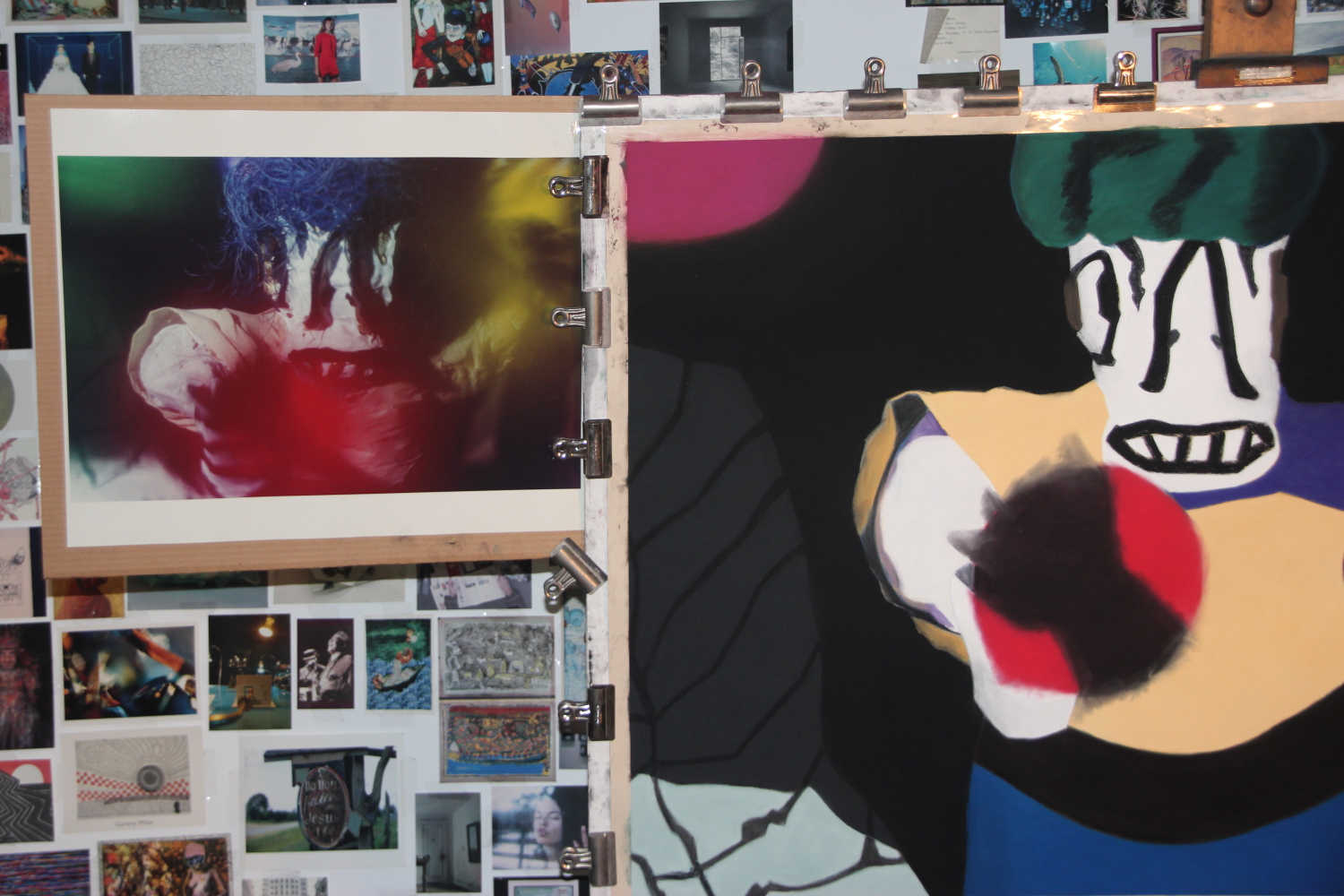
Photograph, left, and work in progress
A: Like everything else associated with my studio practice, my use of photographs from which to work has changed considerably. Beginning in the early 1990s all of the paintings in my first series, “Domestic Threats,” started out as elaborately staged, well-lit scenes that either my husband, Bryan, or I photographed with Bryan’s Toyo Omega 4 x 5 view camera using a wide-angle lens. Depending on where I was living at the time, I set up the scenes in one of three places: our house in Alexandria, VA, a six-floor walkup apartment on West 13th Street in New York, or my current Bank Street condominium. Then one of us shot two pieces of 4 x 5 film at different exposures and I’d usually select the more detailed one to be made into a 20″ x 24″ photo to use as a reference.
Just as the imagery in my paintings has simplified and emptied out over the years, my creative process has simplified, too. I often wonder if this is a natural progression that happens as an artist gets older. More recently I have been shooting photos independently of how exactly I will use them in my work. Only later do I decide which ones to make into paintings; sometimes it’s YEARS later. For example, the pastel painting that is on my easel now is based on a relatively old (2002) photograph that I have always liked, but only now felt ready to tackle in pastel.
Comments are welcome!
Q: In light of the realities you discussed last week (see blog post of Aug. 24), what keeps you motivated to make art?

A favorite book
A: In essence it’s that I have always worked much harder for love than for money. I absolutely love my work, my creative process, and my chosen life. I have experienced much tragedy – no doubt there is more to come – but through it all, my journey as an artist is a continual adventure that gives me the ultimate freedom to spend my time on this earth as I want. In my work I make the rules, set my own tasks, and resolve them on my own timetable. What could be better than that?
Furthermore, I know that I have a gift and with that comes a profound responsibility, an obligation to develop and use it to the best of my ability, regardless of what it may cost. And when I say “cost,” I do not mean only money. Art is a calling and all self-respecting artists do whatever is necessary to use and express our gifts.
In “The Gift” Lewis Hyde says, “A gift is a thing we do not get by our own efforts. We cannot buy it, we cannot acquire it through an act of will. It is bestowed upon us. Thus we rightly speak of “talent” as a “gift” for although a talent can be perfected through an act of will, no effort in the world can cause its initial appearance. Mozart, composing on the harpsichord at the age of four, had a gift.”
Comments are welcome!
Q: Have you ever worked outside?

Reproductions of “Cardinal Rule” (top) and “Blue Ego,” originals are soft pastel on sandpaper, 30″ x 38″
A: As a pastel artist I’ve never worked outside – with so many pastels, it’s just not practical – but early on in the “Domestic Threats” series, I created two outdoor setups. Works in the series derived from elaborate scenes that I arranged and then photographed.
I used to take long walks along the Potomac River in Alexandria, VA, and there was a tree stump that was fascinating. It was mostly twisted roots, knotty branches, dark hidden spaces, etc. (top painting in photo). One morning I took several hand puppets and stuffed animals (my subject matter at the time) and carefully arranged them on the tree. Around me people were busy exercising their dogs. Soon I attracted quite a bit of attention – a tall blonde woman playing with puppets on a tree stump! Dogs came over to sniff. Their owners came over, too, and I was pressed into explaining, again and again, that I was an artist, that I was photographing this scene so I could paint it, etc. The interruptions were very annoying.
The second time I tried an outdoor setup was again along the Potomac River, but this time I selected a secluded strip of beach where I was undisturbed. I had forgotten to consider the light and inadvertently chose a cloudy day. I remember being disappointed that the light was flat and lacking shadows. The painting (bottom in photo) turned out to be one of my least favorites.
I resolved from then on to focus on interiors. Alfred Hitchcock famously used rear projection so that he could work in a studio rather than on location. One reason, he said, was that in a studio he had total control. I know what he meant. When I set up an interior scene and position the lights to make interesting shadows, indeed, I have control over the whole look. No aspect is left to chance. The accidents – improvements! – happen later when I work on the painting.
Comments are welcome!


 barbararachkoscoloreddust.com