Category Archives: Bolivianos
Q: What’s on the easel today?
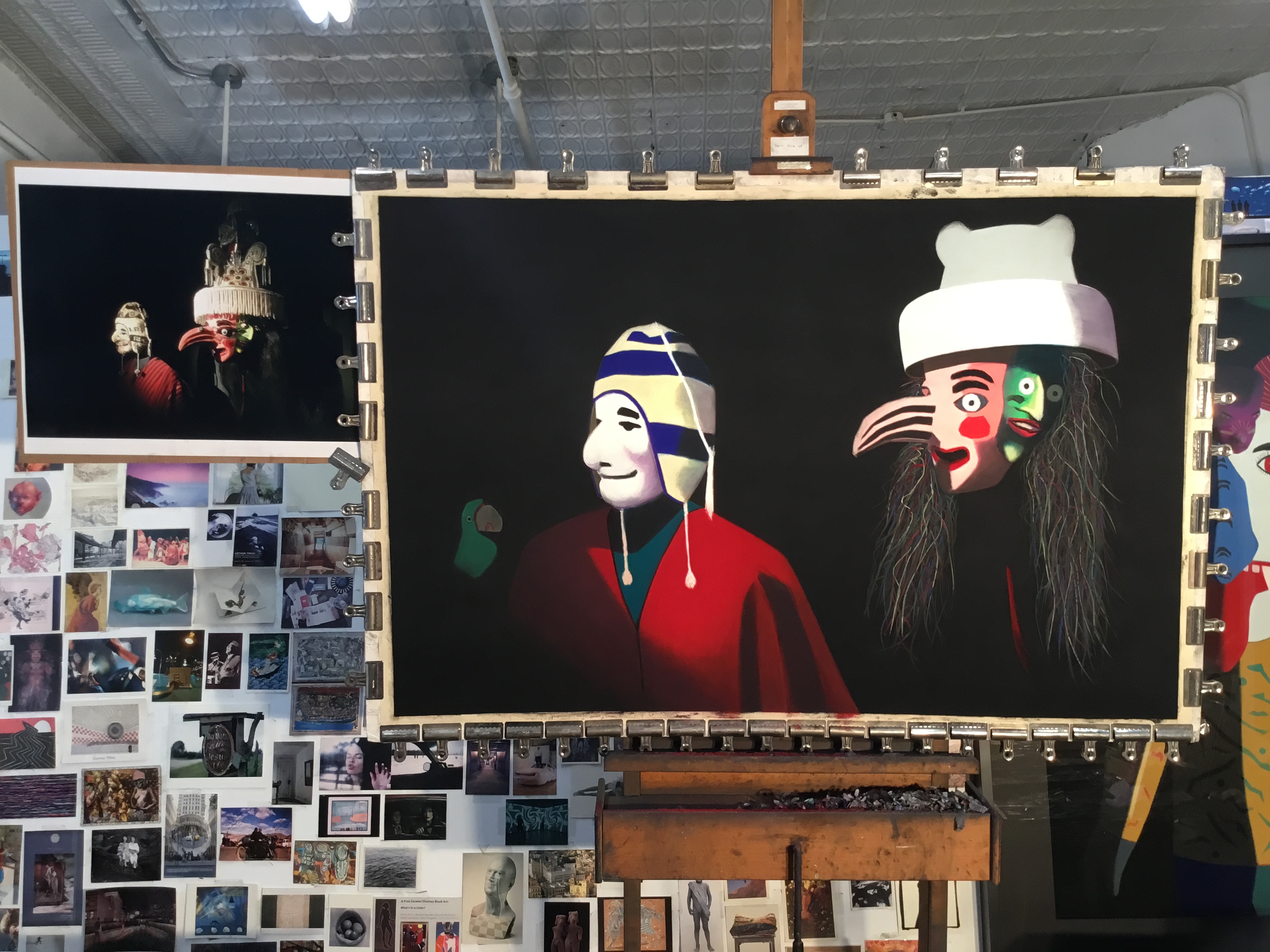
Work in progress
A: I continue working on a large pastel painting based on another of my photographs from La Paz, Bolivia.
Comments are welcome!
Q: You have spoken about your pastel technique, which involves layering pigments on top of each other, up to 25 to 30 layers. When you do this are you putting the same colors on top of each other?

An early version of “Oracle,” soft pastel on sandpaper, 26″ x 20″

Finished
A: I do layer Rembrandt black soft pastels on top of each other to achieve the dark backgrounds in my “Black Paintings” and “Bolivianos” series. Black Rembrandts are the pastels I use most so I order them several dozen at a time. The 400 or 500 grit sandpaper requires at least four layers of pastel just to achieve even coverage. Over the next few months I add many more layers of black pastel to achieve the final rich look.
The figures and shapes in each pastel painting are a different story. Were you to x-ray them, you’d see many different colors underneath the final one. Sometimes subsequent colors are closely related to earlier ones. With each additional layer, I correct, refine, and strengthen my drawing so the objects depicted become more solid and/or three-dimensional.
In addition to the thousands of pastels I have to choose from, I mix and blend new colors directly on the sandpaper. As I proceed, I am searching for the ‘best’ colors, those that make the overall painting more resonant, more alive, and more exciting to look at. Of course, this is wholly subjective.
Comments are welcome!
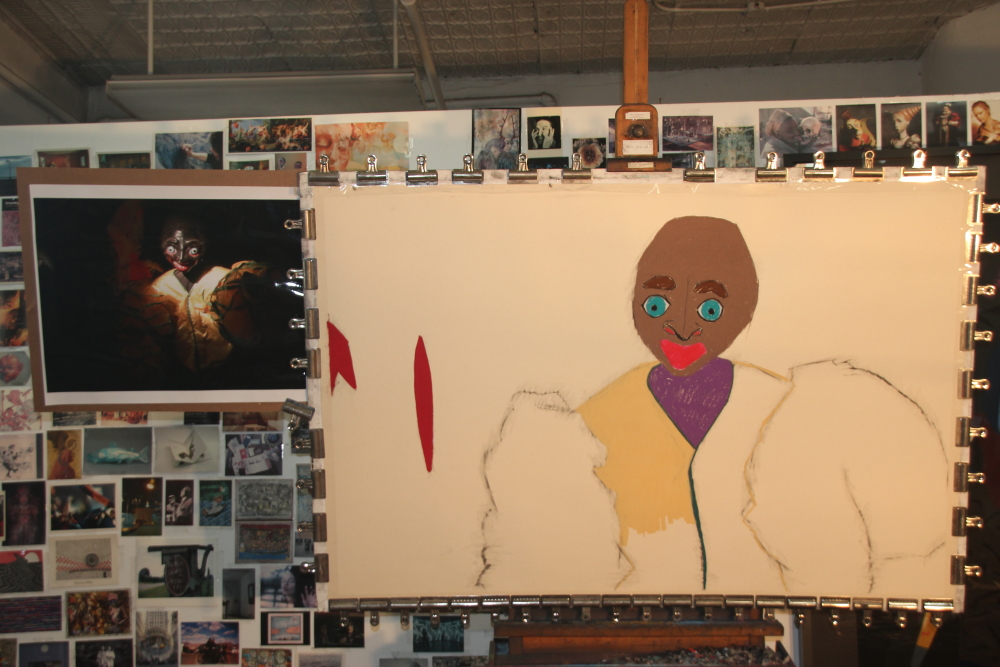
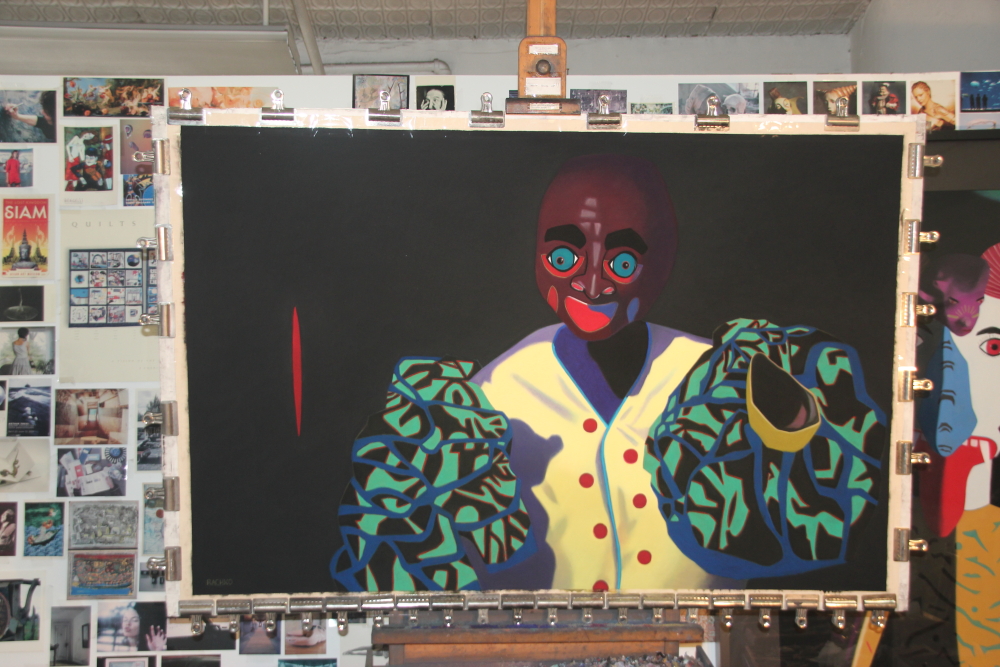
Q: What’s on the easel today?

Ready to begin
A: I’m ready to begin a large – 38” x 58” – pastel-on-sandpaper painting, the sixth in my “Bolivianos” series. I love beginnings because I am looking at something new on my easel and there are so many possibilities!
Comments are welcome!
Q: (Part II) Would you share your story of how creating art enabled you to heal after losing your husband on 9/11?

“The Champ,” soft pastel on sandpaper, 35” x 28.5” framed. The first of my “Bolivianos”.
A: Continued from last Saturday’s post…
Because I use reference photos for my pastel paintings, the first challenge was to learn how to use Bryan’s 4 x 5 view camera. At that time I was not a photographer. Always Bryan had taken reference photos for me.
In July 2002 I enrolled in a view camera workshop at New York’s International Center of Photography. Much to my surprise I had already absorbed quite a lot from watching Bryan. After the initial workshop, I continued more formal studies of photography for a few years. In 2009, I am proud to say, I was invited to present a solo photography exhibition at a New York gallery!
In 2003 I resumed making my “Domestic Threats” series of pastel paintings, something that had seemed impossible after Bryan’s death. The first large pastel painting that I created using a reference photograph taken by me confirmed that my life’s work could continue. The title of that painting, “She Embraced It and Grew Stronger,” was autobiographical. “She” is me, and “it” meant continuing on without Bryan and living life for both of us.
Having had a long successful run, the “Domestic Threats” series finally ended in early 2007. Around that time I was feeling happier and had come to better terms with losing Bryan. While this is a tragedy I will never truly be at peace with, dealing with the loss became easier with time.
Then in 2007 I suddenly became blocked and did not know where to take my work next. I had never experienced creative block and for a full-time professional artist, this was a painful few months. Still, I continued to go to the studio every day and eventually, thanks to a confluence of favorable circumstances, the block ended.
My next pastel painting series was called, “Black Paintings.” I viewed the black background as literally, the very dark place that I was emerging from, exactly like the figures emerging in these paintings. The figures themselves were wildly colorful and full of life, but that black background is always there.
Still the work continues to evolve. Recently I began my third pastel painting series called, “Bolivianos,” based on a mask exhibition encountered in La Paz at the Museum of Ethnography and Folklore. Many people have proclaimed this to be my most bold, daring, and exciting pastel painting series yet. And I think they may be right! Continuing on the journey I began 30+ years ago, I am looking forward to creating many new, striking pastel paintings!
Comments are welcome!
Pearls from artists* # 294

Barbara at work
*an ongoing series of quotations – mostly from artists, to artists – that offers wisdom, inspiration, and advice for the sometimes lonely road we are on.
Interviewer: Well, to begin – do you feel that you were born in a place and a time, and to a family all of which combined favorably to shape you for what you were to do?
Wilder: Comparisons of one’s lot with others’ teaches us nothing and enfeebles the will. Many born in an environment of poverty, disease, and stupidity, in an age of chaos, have put us in their debt. By the standards of many people, and by my own, these dispositions were favorable – but what are our judgments in such matters? Everyone is born with an array of handicaps – even Mozart, even Sophocles – and acquires new ones. In a famous passage, Shakespeare ruefully complains that he was not endowed with another’s “scope”! We are all equally distant from the sun, but we all have a share in it. The most valuable thing I inherited was a temperament that does not revolt against Necessity and that is constantly renewed in Hope. (I am alluding to Goethe’s great poem about the problem of each man’s “lot” – the Orphische Worte).
Thornton Wilder in Writers at Work: The Paris Review Interviews First Series, edited, and with an introduction by Malcolm Crowley
Comments are welcome!
Pearls from artists* # 293
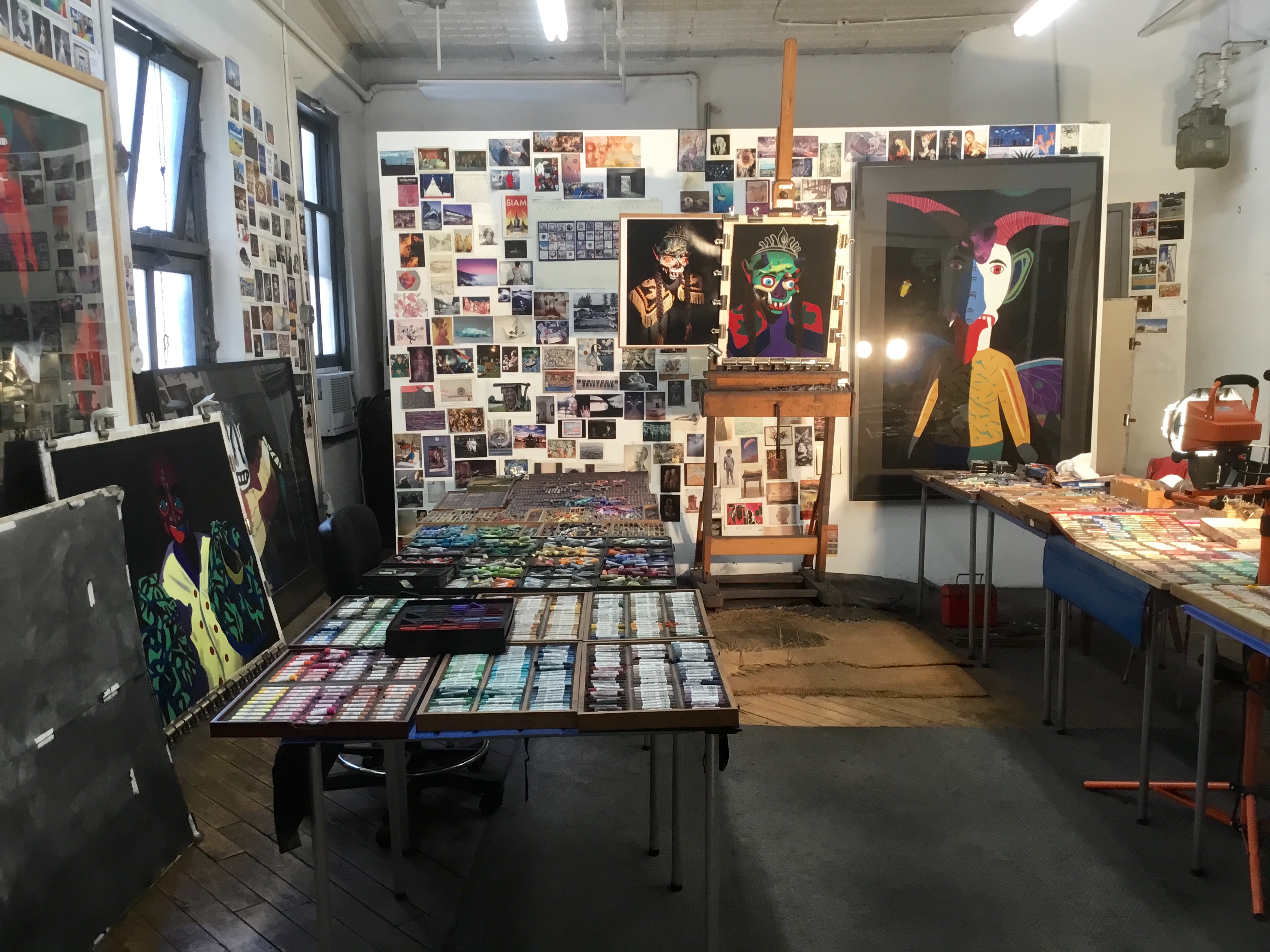
Studio with works in progress
*an ongoing series of quotations – mostly from artists, to artists – that offers wisdom, inspiration, and advice for the sometimes lonely road we are on.
Works of art specify no immediate action or limited use. They are like gateways, where the visitor can enter the space of the painter, or the time of the poet, to experience whatever rich domain the artist has fashioned. But the visitor must come prepared: if he brings a vacant mind or deficient sensibility, he will see nothing. Adherent meaning is therefore largely a matter of conventional shared experience, which it is the artist’s privilege to rearrange and enrich under certain limitations.
George Kubler in The Shape of Time: Remarks on the History of Things
Comments are welcome!
Q: What’s on the easel today?
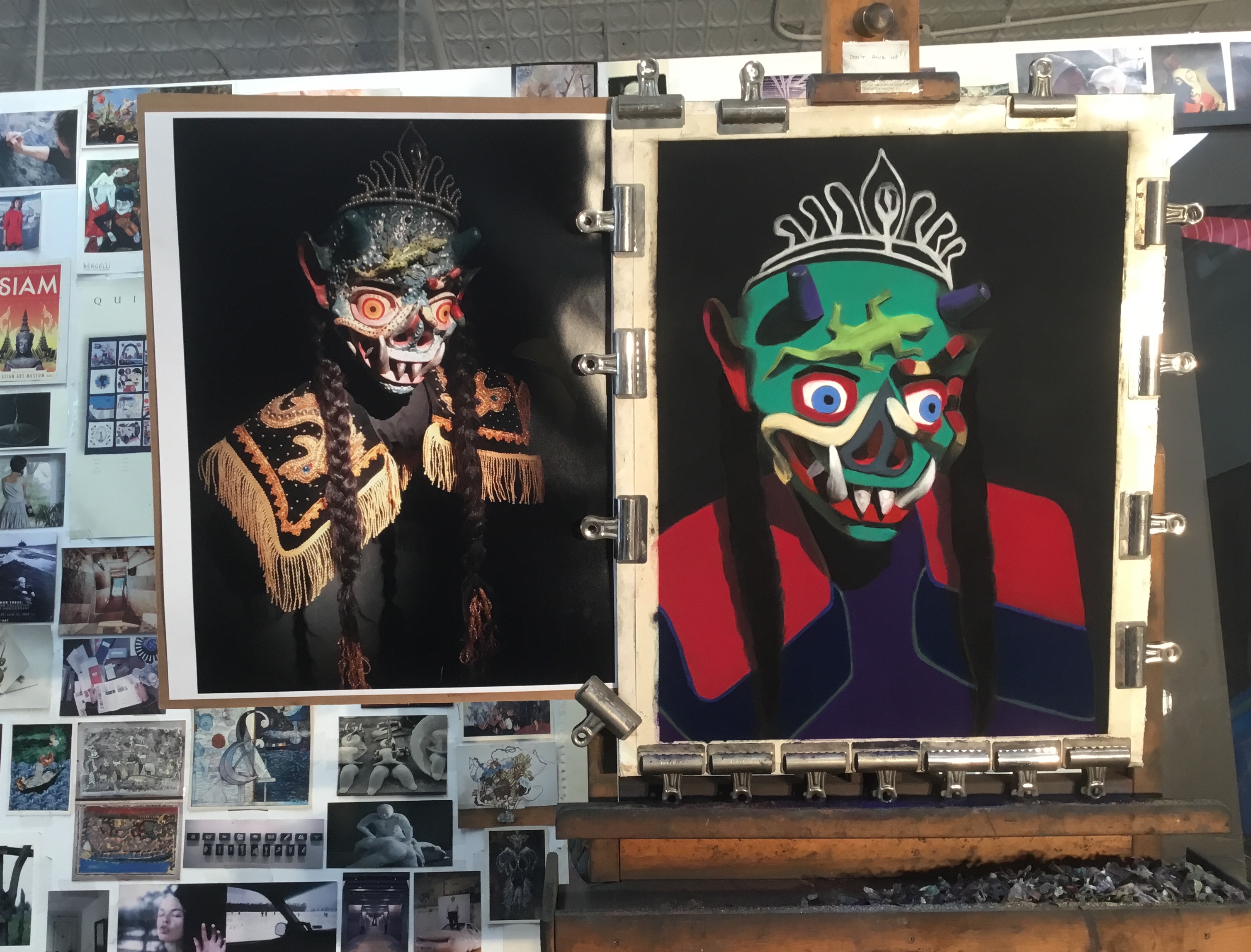
Work in progress
A: I continue slowly working on “Shaman,” soft pastel on sandpaper, 26” x 20”. A long-time aficionado of psychological thrillers, horror, and sci-fi films, I have a high tolerance for the macabre. However, I admit that this one is a little creepy, considering those are snakes curling around the eyes. On a deep level this piece is about facing my own fears. The snakes have become metaphors.
Comments are welcome!
Q: Please speak about how the three pastel paintings series that you have created interrelate.

“The Orator,” soft pastel on sandpaper, 38″ x 58″
A: The Black Paintings series of pastel-on-sandpaper paintings grew directly from an earlier series, Domestic Threats. While both use cultural objects as surrogates for human beings acting in mysterious, highly-charged narratives, in the Black Paintings I replaced all background details of my actual setup (furniture, rugs, etc.) with lush black pastel. In this work the ‘actors’ are front and center.
While traveling in Bolivia last spring, I visited a mask exhibition at the National Museum of Ethnography and Folklore in La Paz. The masks were presented against black walls, were spot-lit, and looked eerily like 3D versions of my Black Paintings. I immediately knew I had stumbled upon a gift. So far I have completed three pastel paintings in the Bolivianos series. Two more are in progress now.
All of my pastel paintings are an example of a style called “contemporary conceptual realism” in which things are not quite as innocent as they seem. Each painting is a Trojan horse. There is plenty of backstory to my images, although I usually prefer not to over-explain them. Much is to be said for mystery in art.
The world I depict is that of the imagination and this realm owes little debt to the natural world. Recently, at an art talk I was reminded how fascinating it is to learn how others respond to my work. As New York art critic Gerrit Henry once remarked, “What we bring to a Rachko… we get back, bountifully.”
Comments are welcome!




