Category Archives: 2025
Pearls from artists* # 665

*an ongoing series of quotations – mostly from artists, to artists – that offers wisdom, inspiration, and advice for the sometimes lonely road we are on.
We are wordlessly persuaded and taught outright to hide so much of what we have unearthed in our lives. But artists throughout the centuries have described the power of using anguish as a catalyst to fuel their creativity. In Greek epic poetry, ‘Kleos’ refers to immortal renown. Unlike present-day fame, this term referred exclusively to heroes who had surmounted a great obstacle or persevered through tremendous difficulties. There is a certain authority that comes from those who have endured hardship. They have earned the depth of their work.
Darkness contains a great deal of energy. We can use it for destruction or creativity. Only those who tolerate it are able to illuminate the shadowy corners, revealing the nefariousness that hopes to stay hidden. We cannot change our past, or any hell that we have been through. But art provides the means to exorcise the pain that has taken up residence in our body and fashion it into a form outside ourselves, in an infinitely affirmative gesture. The darkness we have passed through was not endured in vain if we mold it into a vision that lights the way out… for us, and for all the other souls who undoubtedly need it.
Kate Kretz in Art From Your Core: A Holistic Guide to Visual Voice
Comments are welcome!
Q: Why do you have so many pastels?

Barbara’s Studio
A: Our eyes can see infinitely more colors than the relative few that are made into pastels. When I layer pigments onto the sandpaper substrate, I mix new colors directly on the paper. The short answer is, I need lots of pastels so that I can make new colors.
I have been working exclusively with soft pastel for 40 years. Whenever I feel myself getting into a rut in how I select and use my colors, I look around for new materials to try. Fortunately, new brands of soft pastels are continually coming onto the market. There are pastels that are handmade by artists – I love discovering these – and new colors manufactured by well-known pastel companies. Some sticks of soft pastel are oily, some are buttery, some more powdery, some crumble easily, some are more durable. Each one feels distinct in my hand.
Furthermore, they each have unique mixing properties. It’s an under-appreciated science that I stumbled upon (or maybe I invented it, I’m not sure since I cannot know how other pastel painters work). In this respect soft pastel is very different from other paint media. Oil painters, for example, need only a few tubes of paint to make any color in the world. I don’t go in much for studying color theory as a formal discipline. If you want to really understand and learn how to use color, try soft pastel and spend 10,000+ hours (the amount of time Malcolm Gladwell says, in his book, “Outliers,” that it takes to master a skill) figuring it all out for yourself!
Comments are welcome.
Pearls from artists* # 664

*an ongoing series of quotations – mostly from artists, to artists – that offers wisdom, inspiration, and advice for the sometimes lonely road we are on.
Throughout history, geniuses have attributed their breakthroughs to the time they spent alone, deep in thought. Frank Kafka assures us,
‘You need not leave your room. Remain sitting at your table and listen. You need not even listen, simply wait. You need not even wait, just learn to become quiet, and still, and solitary. The world will freely offer itself to you to be unmasked. It has no choice; it will roll in ecstasy at your feet.’
Artists have a special relationship with the passing hours. Our work is tangible evidence of how we mark and give value to time. We have a finite, unknown number of hours on Earth, so we will only leave behind so many pieces. Our artistic legacy is literally tied to our ability to steal time and maintain silence.
And yet, we exist in a time and place with a tremendous aversion to peace. We must fight both ourselves and others to acquire it. No one asked us if this is the kind of environment we want to inhabit. Corporations inundate every square inch of space with uninvited visual and auditory interference, designed to light up the addiction pleasure centers in our brains. Our ancestors would have found this environment assaulting and maddening. It is certainly causing damage to our mental health, happiness, and creativity. But, it is so ubiquitous that there is pressure to simply accept the anxiety-producing ‘new normal’: we have collectively surrendered our brain space to the colonization.
Kate Kretz in Art From Your Core: A Holistic Guide to Visual Voice
Comments are welcome!
Q: Do you have any rituals that you do in the mornings before you begin working?

Art From Your Core by Kate Kretz
A: When I arrive at the studio in the morning it’s rare for me to immediately start working. Usually I read something art-related. At the moment I’m rereading Art From Your Core: A Holistic Guide to Visual Voice by Kate Kretz. This is a fabulous book for visual artists. It is a must-read and has become my current art bible! As usual I am struggling to understand aspects of the art business and figure out what’s next to get my work appreciated and collected by a new audience. Art From Your Core reminds why I decided to make art in the first place and what I need to do to continue to improve. It helps reconnect with forgotten parts of myself and is a much-needed reminder of what I love most about being an artist.
Balancing the creative and business aspects of my art practice is an ongoing struggle. I imagine this is true for most artists. Both jobs are so important. An artist needs an appreciative audience – very few artists devote their lives to art-making so that the work will remain in a closet – but I also believe this (from a note hand-written years ago that I tacked to the studio wall): “Just make the work. None of the rest matters.”
Comments are welcome.
Pearls from artists* # 663

*an ongoing series of quotations – mostly from artists, to artists – that offers wisdom, inspiration, and advice for the sometimes lonely road we are on.
”No one has made a list of places where the extraordinary may happen and where it may not. Still, there are indications. Among crowds, in drawing rooms, among easements and comforts and pleasures, it is seldom seen. It is more likely to stick to the risk-taker than the ticket-taker. It isn’t that it would disparage comforts, or the set routines of the world, but that its concern is directed to another place. Its concern is the edge, and a making of a form out of the formlessness that is beyond the edge.”
– Mary Oliver
…Mary Oliver was right. Masterpieces are not conceived at cocktail parties, clubs, or on crowded beaches. If you want to summon your muse and set the stage for astonishing things to happen, silence is the most essential prerequisite. It is where the real alchemy of art happens. You need to calm yourself in that fragile place that exists parallel to this one. When some intruder from the underworld of quotidian life smashes through, demanding our focus, all the glittering magic scatters, and flies away.
Kate Kretz in Art From Your Core: A Holistic Guide to Visual Voice
Comments are welcome!
Travel photo of the month*

*favorite travel photos that have not yet appeared in this blog
Comments are welcome!
Pearls from artists* # 662

“Harbinger,” soft pastel on sandpaper, 26” x 20”
*an ongoing series of quotations – mostly from artists, to artists – that offers wisdom, inspiration, and advice for the sometimes lonely road we are on.
The main thing is that you follow your work. Follow it as truthfully as you can. You know, even when you get into ditches and stuff like that, rather than holding an idea of what you want it to be, rather than trying to manipulate your life to be a particular way […] let your life just unfold itself.
Kiki Smith quoted in Art From Your Core: A Holistic Guide to Visual Voice by Kate Kretz
Comments are welcome!
Q: What’s on the easel today?

“Showman,” almost finished!
A: I’m putting finishing touches on “Showman,” soft pastel on sandpaper, 26” x 20”.
Comments are welcome!
Pearls from artists* # 661

*an ongoing series of quotations – mostly from artists, to artists – that offers wisdom, inspiration, and advice for the sometimes lonely road we are on.
Curiosity and wonder are essential to the art life. Curiosity drives us to look beneath the rocks that others pass by. Wonder helps us recognize the infinite potential of what we find there, so we might spin it into something remarkable. The concepts and visuals that attract me will likely not grab you, but therein lies the beauty. Your job is to keep excavating the things that intrigue you, feeding your head with new ideas. The objective is to build a singular mental stockpile of elements that make up your visual voice. Your brain then makes connections that others would never make because they have assembled a vastly different stockpile of ideas, images, experiences, concepts, beliefs, and concerns.
Kate Kretz in Art From Your Core: A Holistic Guide to Visual Voice
Comments are welcome!
In celebration of the 13th anniversary of my blog three days from now, I am republishing the very first post from July 15, 2012. Q: What does it take to be an artist, especially one living and working in New York?
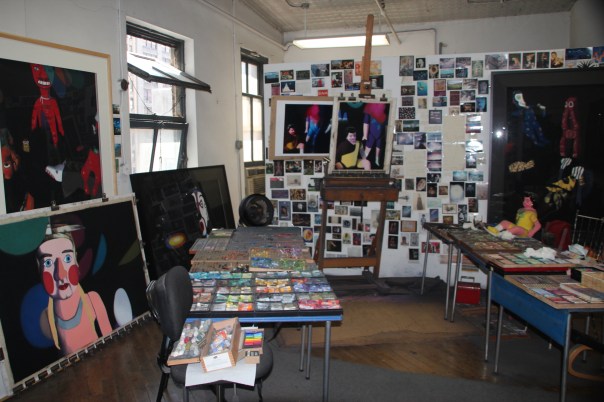
Barbara’s Studio (in 2012) with works in progress.
A: The three Big P’s – Patience, Persistence, and Passion. Without all three you will not have the stamina to work tirelessly for very little external reward. You can expect help from no one.
There are so many obstacles to art-making and countless reasons to just give up. When you really think about it, it’s amazing that great art gets made at all. So why do we do it? Above all it’s about making our time on earth matter, about devotion to our innate gifts and love of our hard-fought creative process.
And, my God, it even gets harder as we get older! So what do we do? We dig in that much deeper. It’s a most noble and sacred calling – you know when you have it – and that’s what separates those of us who are in it for the long haul from the wimps, fakers, and hangers-on. I say to my fellow artists who continue to work despite the endless challenges, we are all true heroes!
These words still ring true and it’s good, even for me, to occasionally be reminded.
Most importantly, THANK YOU to my 222,000+ subscribers for taking this journey with me. When I began this blog in 2012, I had no idea it would prove to be so popular… WOW!
Comments are welcome!


 barbararachkoscoloreddust.com