Blog Archives
Q: You seem very disciplined. Do you ever have a day when you just can’t get excited about going to the studio to work?
Posted by barbararachkoscoloreddust

Signing “Narcissist”
A: That happens occasionally, but I usually still go to the studio to work. You know the expression, “99% of life is just showing up”? Well, of course I have to show up at my studio to accomplish anything so I still try to keep fairly regular studio hours – 6 to 7 hours a day, 4 or 5 days a week. And that’s not to mention all the other work – answering email, checking social media, writing blog posts, etc. – which I tend to do at lunchtime, in the evenings, and on my days off from the studio.
When you are an artist there is always work to do and for some of it, no one else can do it because no one else knows the work from the inside the way the maker does. I like what Twyla Tharp says in her book, “The Creative Habit.” In order to progress an artist needs good work habits that become a daily routine. And Chuck Close used to say, “Inspiration is for amateurs,” meaning a professional works whether she’s in the mood or not. I completely agree so I keep working and slowly moving ahead.
As Tchaikovsky wrote in a letter to a friend:
We must always work, and a self-respecting artist must not fold his hands on the pretext that he is not in the mood. If we wait for the mood, without endeavoring to meet it halfway, we easily become indolent and apathetic. We must be patient, and believe that inspiration will come to those who can master their disinclination. A few days ago I told you I was working every day without any real inspiration. Had I given way to my disinclination, undoubtedly I should have drifted into a long period of idleness. But my patience and faith did not fail me, and today I felt that inexplicable glow of inspiration of which I told you; thanks to which I know beforehand that whatever I write today will have power to make an impression, and to touch the hearts of those who hear it.
Quoted in Eric Maisel’s A Life in the Arts: Practical Guidance and Inspiration for Creative and Performing Artists.
Comments are welcome!
Share this:
- Click to share on Facebook (Opens in new window) Facebook
- Click to share on X (Opens in new window) X
- Click to share on Tumblr (Opens in new window) Tumblr
- Click to share on Pinterest (Opens in new window) Pinterest
- Click to share on LinkedIn (Opens in new window) LinkedIn
- Click to share on Reddit (Opens in new window) Reddit
- Click to email a link to a friend (Opens in new window) Email
- Click to print (Opens in new window) Print
Posted in 2024, An Artist's Life, Creative Process, Inspiration, Studio
Comments Off on Q: You seem very disciplined. Do you ever have a day when you just can’t get excited about going to the studio to work?
Tags: accomplish, always, answering, anything, apathetic, artist, ”A Life in the Arts: Practical Guidance and Inspiration for Creative and Performing Artists” Artists, ”Inspiration is for amateurs.”, ”The Creative Habit”, become, beforehand, believe, blog posts, checking, Chuck Close, completely, course, daily routine, disciplined, disinclination, drifted, easily, endeavoring, Eric Maisel, evenings, excited, expression, fairly, friend, halfway, happens, hearts, idleness, impression, indolent, inexplicable, inside, inspiration, letter, lunchtime, master, meaning, mention, moving, occassionally, other, patient, period, pretext, prgress, professional, quoted, regular, self-respecting, signing, social media, Studio, Tchaikovsky, Twyla Tharp, undoubtedly, usually, whatever, work habits, working, Writing
Pearls from artists* # 17
Posted by barbararachkoscoloreddust
* an ongoing series of quotations – mostly from artists, to artists – that offers wisdom, inspiration, and advice for the sometimes lonely road we are on.
The better you know yourself, the more you will know when you are playing to your strengths and when you are sticking your neck out. Venturing out of your comfort zone may be dangerous, yet you do it anyway because our ability to grow is directly proportional to an ability to entertain the uncomfortable.
… Another thing about knowing who you are is that you know what you should not be doing, which can save you a lot of heartaches and false starts if you catch it early on.
I was giving a lecture to students at Vassar not long ago. Working with the students’ autobiographies, I invited a dance student, a music student who brought his saxophone, and an art student to join me on stage. I asked the dancer to improvise some movement from a tuck position on the floor. I asked the saxophone player to accompany the dancer. And I asked the art student to assign colors to what they were doing. I admit I was constructing a three-ring circus in the lecture hall. But my goal was to bring the three students together by forcing them to work off the same page, and also to free them to discover how far they could go improvising on this simple assignment.
When I asked the art student to read out loud his color impressions, everyone in the hall was taken aback. He droned on and on about himself, feelings he’d had, stories about friends. Not a word about color. Finally I heard “limpid blue” come out of his mouth. I waved my arms, signaling him to stop reading.
“Do you realize,” I said, “that you’ve just recited about five hundred words in an assignment about color? You’ve covered everything under the sun, and ‘limpid blue’ is the first time you’ve mentioned a color. I’m not convinced you want to be a painter.”
As far as I was concerned, this young man was in “DNA denial.” I gave him a painterly exercise and he gave me a text heavy response. A young man with painting in his genes would be rattling off colors immediately. Instead, his vivid use of language – limpid blue does not come in tubes – suggested that he really ought to be a writer.
It would be presumptious of me to think I had him pegged for a writer, not a painter, after that brief encounter. But if I got him to reexamine what he’s built for, then he was a step or two ahead of most people.
Twyla Tharp, The Creative Habit: Learn it and Use it for Life
Comments are welcome.

Share this:
- Click to share on Facebook (Opens in new window) Facebook
- Click to share on X (Opens in new window) X
- Click to share on Tumblr (Opens in new window) Tumblr
- Click to share on Pinterest (Opens in new window) Pinterest
- Click to share on LinkedIn (Opens in new window) LinkedIn
- Click to share on Reddit (Opens in new window) Reddit
- Click to email a link to a friend (Opens in new window) Email
- Click to print (Opens in new window) Print
Posted in 2012, An Artist's Life, Creative Process, Pearls from Artists, Quotes, Working methods
Tags: "The Creative Habit: Learn It and Use It for Life", accompany, arms, art student, assignment, autobiographies, boat, colors, comfort zone, dance, discover, DNA denial, exercise, false starts, feelings, floor, friends, goal, grow, heartaches, impressions, improvise, know yourself, language, lecture, lecture hall, limpid blue, mouth, movement, music, page, painter, playing to your strengths, presumptious, reading, reexamine, saxophone, stage, sticking your neck out, stories, students, text, three-ring circus, tubes, tuck position, Twyla Tharp, uncomfortable, Vassar, what you should not be doing, writer
Pearls from artists* # 15
Posted by barbararachkoscoloreddust
* an ongoing series of quotations – mostly from artists, to artists – that offers wisdom, inspiration, and advice for the sometimes lonely road we are on.
The first steps of a creative act are like groping in the dark: random and chaotic, feverish, and fearful, a lot of busy-ness with no apparent or definable end in sight. There is nothing yet to research. For me, these moments are not pretty. I look like a desperate woman, tortured by the simple message thumping away in my head: “You need an idea.” It’s not enough for me to walk into a studio and start dancing, hoping that something good will come of my aimless cavorting on the floor. Creativity doesn’t generally work that way for me. (The rare times when it has stand out like April blizzards). You can’t just dance or paint or write or sculpt. Those are just verbs. You need a tangible idea to get you going. The idea, however miniscule, is what turns the verb into a noun – paint into painting, sculpt into sculpture, write into writing, dance into a dance.
… I’m often asked, “Where do you get your ideas?” This happens to anyone who is willing to stand in front of an audience and talk about his or her work. The short answer is: everywhere. It’s like asking, “Where do you find the air you breathe?” Ideas are all around you.
I hesitate to wax eloquent about the omnipresence of ideas and how everything we need to make something out of nothing – tell a story, design a building, hum a melody – already resides within us in our experience, memories, taste, judgment, critical demeanor, humanity, purpose, and humor. I hesitate because it is so blindingly obvious. If I’m going to be a cheerleader for the creative urge, let it be for something other than the oft-repeated notion that ideas are everywhere.
What people are really asking, I suppose, is not, “Where do you get your ideas?” but “How do you get them?”
To answer that, you first have to appreciate what an idea is.
Ideas take many forms. There are good ideas and bad ideas. Big ideas and little ideas.
A good idea is one that turns you on rather than shuts you off. It keeps generating more ides and they improve one another. A bad idea closes doors instead of opening them. It’s confining and restrictive. The line between good and bad ideas is very thin. A bad idea in the hands of the right person can easily be tweaked into a good idea.
Twyla Tharp, The Creative Habit: Learn it and Use it for Life: A Practical Guide
Comments are welcome.
Share this:
- Click to share on Facebook (Opens in new window) Facebook
- Click to share on X (Opens in new window) X
- Click to share on Tumblr (Opens in new window) Tumblr
- Click to share on Pinterest (Opens in new window) Pinterest
- Click to share on LinkedIn (Opens in new window) LinkedIn
- Click to share on Reddit (Opens in new window) Reddit
- Click to email a link to a friend (Opens in new window) Email
- Click to print (Opens in new window) Print
Posted in 2012, An Artist's Life, Art in general, Creative Process, Guatemala, Inspiration, Pearls from Artists, Quotes
Comments Off on Pearls from artists* # 15
Tags: "The Cretauve Habit: Learn it and Use it for life: A Practical Guide"", air, April, asking, audience, bad ideas, big ideas, blizzard, breathe, building, cavorting, chaotic, cheerleader, closing doors, creative act, creative urge, creativity, dance, dancing, dark, demeanor, design, desperate woman, Donna Tang, everywhere, experience, fearful, floor, good ideas, Guatemala, hum, humanity, humor, idea, judgment, little ideas, melody, memories, message, no end in sight, nothing, noun, obvious, omnipresence, onfining, opening doors, paint, painting, people, pretty, purpose, pyramid, random, research, restrictive, sculpt, sculpture, shut off, something, steps, story, Studio, taste, tell, Twyla Tharp, verb, walk, work, write, Writing
Q: You seem very disciplined. Do you ever have a day when you just can’t get excited about working?
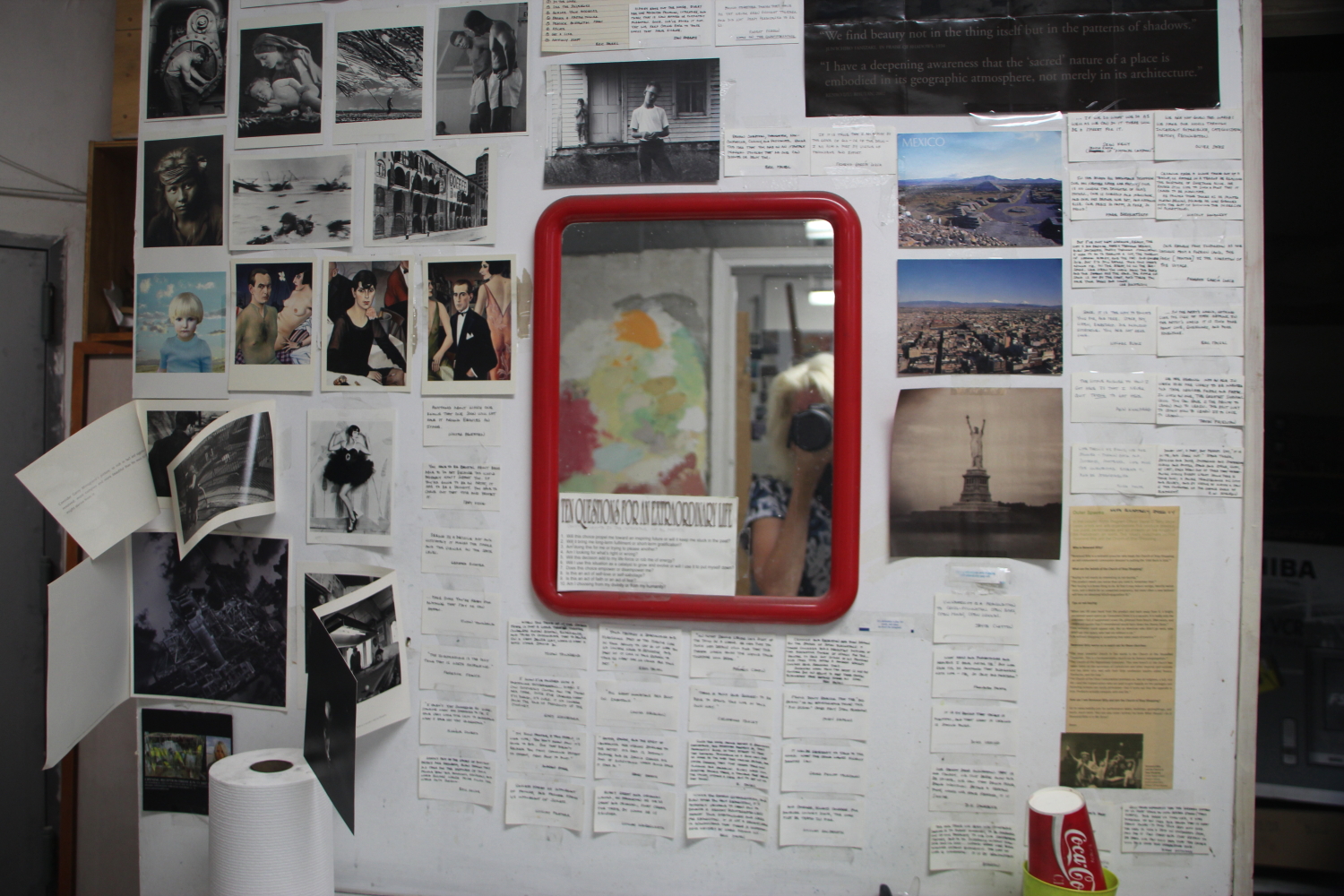
Posted by barbararachkoscoloreddust
A: That happens occassionaly, but I still go to the studio to work. You know the expression, “99% of life is just showing up”? Well, of course I have to show up at my studio to accomplish anything so I keep fairly regular studio hours – 7 to 8 hours a day, 4 or 5 days a week. In the evening I spend another hour or two answering email, sending out applications, organizing jpegs, etc. When you are an artist there is always work to do and for some of it, no one else can do it. That’s because no one else knows the work from the inside the way the maker does. I like what Twyla Tharp says in her book, “The Creative Habit.” In order to progress an artist needs good work habits that become a daily routine. And Chuck Close likes to say, “Inspiration is for amateurs,” meaning a professional works whether she’s in the mood or not. I completely agree so I keep working and slowly moving ahead.
As Tchaikovsky wrote in a letter to a friend:
We must always work, and a self-respecting artist must not fold his hands on the pretext that he is not in the mood. If we wait for the mood, without endeavoring to meet it halfway, we easily become indolent and apathetic. We must be patient, and believe that inspiration will come to those who can master their disinclination. A few days ago I told you I was working every day without any real inspiration. Had I given way to my disinclination, undoubtedly I should have drifted into a long period of idleness. But my patience and faith did not fail me, and today I felt that inexplicable glow of inspiration of which I told you; thanks to which I know beforehand that whatever I write today will have power to make an impression, and to touch the hearts of those who hear it.
Quoted in Eric Maisel’s A Life in the Arts.
Comments are welcome.

Share this:
- Click to share on Facebook (Opens in new window) Facebook
- Click to share on X (Opens in new window) X
- Click to share on Tumblr (Opens in new window) Tumblr
- Click to share on Pinterest (Opens in new window) Pinterest
- Click to share on LinkedIn (Opens in new window) LinkedIn
- Click to share on Reddit (Opens in new window) Reddit
- Click to email a link to a friend (Opens in new window) Email
- Click to print (Opens in new window) Print
Posted in 2012, An Artist's Life, Art in general, Creative Process, Inspiration, Quotes, Studio
Tags: "99% of life is just showing up", "A LIfe in the Arts", "The Creative Habit", amateurs, apathetic, artist, believe, Chuck Close, Eric Maisel, faith, idleness, indolent, inspiration, mood, patience, self portrait, Studio, Tchaikovsky, touching hearts, Twyla Tharp, work, working every day, Writing


