Blog Archives

Q: In light of the realities you discussed last week (see blog post of Aug. 24), what keeps you motivated to make art?

A favorite book

A favorite book

A:  In essence it’s that I have always worked much harder for love than for money.  I absolutely love my work, my creative process, and my chosen life.  I have experienced much tragedy –  no doubt there is more to come – but through it all, my journey as an artist is a continual adventure that gives me the ultimate freedom to spend my time on this earth as I want.  In my work I make the rules, set my own tasks, and resolve them on my own timetable.  What could be better than that? 

Furthermore, I know that I have a gift and with that comes a profound responsibility, an obligation to develop and use it to the best of my ability, regardless of what it may cost.  And when I say “cost,” I do not mean only money.   Art is a calling and all self-respecting artists do whatever is necessary to use and express our gifts.  

In “The Gift” Lewis Hyde says, “A gift is a thing we do not get by our own efforts.  We cannot buy it, we cannot acquire it through an act of will.  It is bestowed upon us.  Thus we rightly speak of “talent” as a “gift” for although a talent can be perfected through an act of will, no effort in the world can cause its initial appearance.  Mozart, composing on the harpsichord at the age of four, had a gift.”

Comments are welcome!   
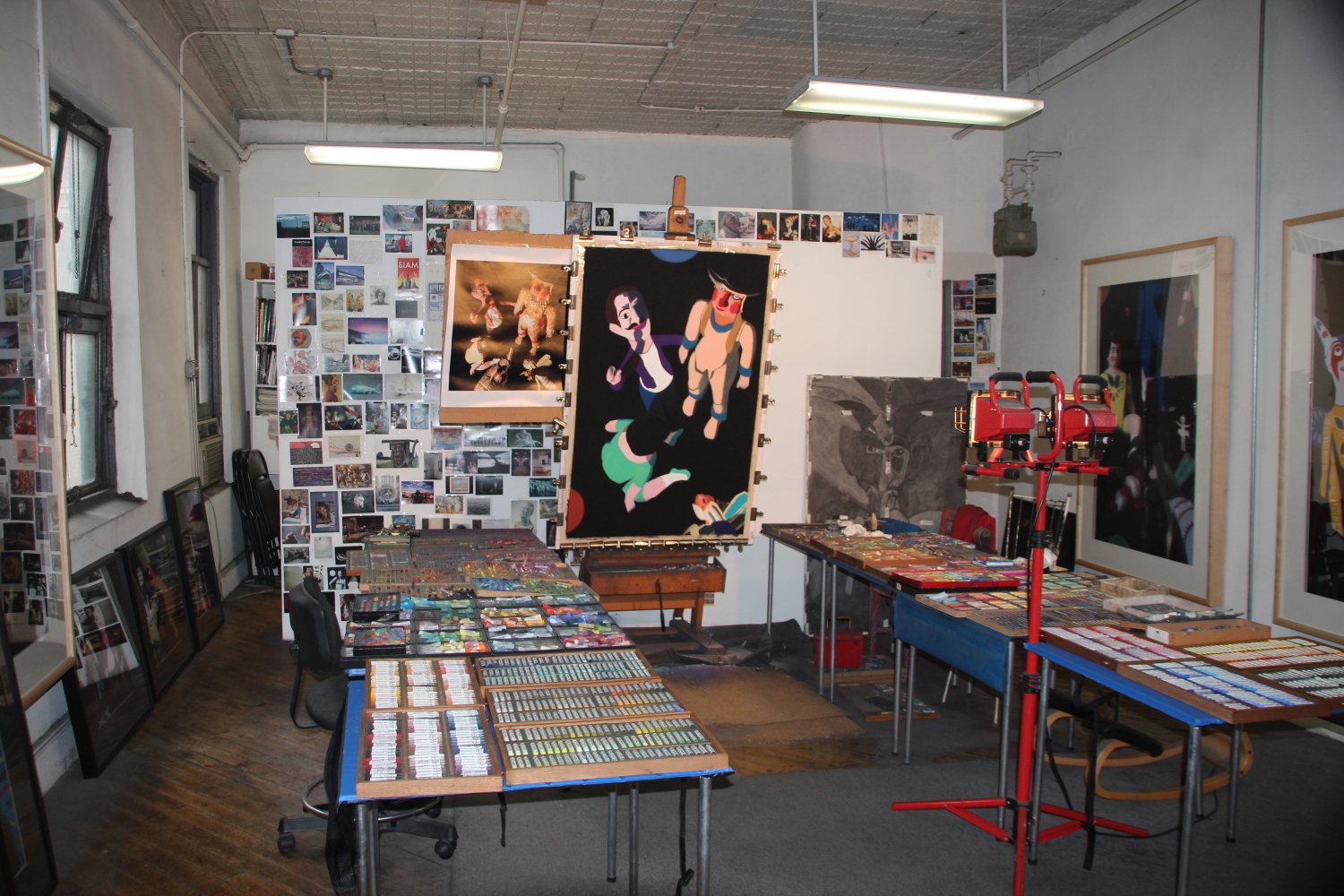
Q: To be a professional visual artist is to have two full-time jobs because an artist must continually balance the creative and the business sides of things. How do you manage to be so productive?

No computer in sight

No computer in sight

A:  With social media and other new ways of doing business, managing it all is getting more difficult every day.  Bear in mind that I say this as someone who does not have the extra time commitment of a day job, nor do I have children or other family members to care for.  I have no idea how other visual artists, who may have these responsibilities and more, keep up with all the tasks that need to be done.  In The Artist’s Guide:  How to Make A Living Doing What You Love, Jackie Battenfield lists a few of them (believe me, there are others):

…being an artist isn’t just about making art.  You have many other responsibilities –  managing a studio, looking for opportunities, identifying an audience for your work, caring for and protecting what you have created, and securing money, time, and space – in addition to whatever is  happening in your personal life.

To begin with I try to maintain regular studio hours.  I generally work on Mondays, Tuesdays, Thursdays, Fridays, and Saturdays, and once I’m at the studio I stay there for a minimum of 7 hours.  To paint I need daylight so in the spring and summer my work day tends to be longer.  My pastel-on-sandpaper paintings are extremely labor-intensive.  I need to put in sufficient hours in order to accomplish anything.  When I was younger I used to work in my studio 6 days a week, 9 hours or more a day.  I have more commitments now, and can no longer work 60+ hours a  week, but I still try to stick to a schedule.  And once I’m at the studio I concentrate on doing the creative work, period.

I am productive when I keep the business and creative sides physically separate., ie., no computers, iPads, etc. are allowed into the studio.  Recently I tried an experiment.  I brought my iPad to the studio, thinking, “Surely I am disciplined enough to use it only during my lunch break.”  But no, I wasted so much time checking email, responding to messages on Facebook, etc., when I should have been focusing on solving problems with the painting that was on my easel.  I learned a good lesson that day and won’t bring my iPad to the studio again.

As has long  been my practice, I concentrate on business tasks when I get home in the evening and on my, so called, days off.  After a day spent working in the studio, I generally spend a minimum of two to three hours more to answer email, apply for exhibitions, work on my blog, email images to people who need them, etc.  At present I  have part-time help with social media – the talented Barbra Drizin, of Start from Scratch Social Media – although my time commitment there is growing, too, as more details need my attention.

No one ever said it would be easy being a professional artist, but then again, I would not choose to spend my days any other way.  As I often say, “Being an artist is a calling.  Contrary to popular belief, it is NOT a life for wimps… or slackers.”

Comments are welcome!

Pearls from artists* # 12

Grand Falls, AZ

Grand Falls, AZ

* an ongoing series of quotations – mostly from artists, to artists – that offers wisdom, inspiration, and advice for the sometimes lonely road we are on.

People who set their sails into art tend to work very hard.  They train themselves in school; they practice and they read and they think and they talk.  But for most of them there seems to be a more or less conscious cutoff point.  It can be a point in time:  “I will work until I am twenty-one (twenty-five, thirty, or forty).”  Or a point in effort:  “I will work three hours a day (or eight or ten).” Or  a point in pleasure:  “I will work unless…” and here the “enemies of promise” harry the result.  These are personal decisions, more or less of individual will.  They depend on the scale of values according to which artists organize their lives.  Artists have a modicum of control.  Their development is open-ended.  As the pressure of their work demands more and more of them. they can stretch to meet it.  They can be open to themselves, and as brave as they can be to see who they are, what their work is teaching them.  This is never easy.  Every step forward is a clearing through a thicket of reluctance and habit and natural indolence.  And all the while they are at the mercy of events.  They may have a crippling accident, or may find themselves yanked into a lifelong responsibility such as the necessity to support themselves and their families.  Or a war may wipe out the cultural context on which they depend. Even the most fortunate have to adjust the demands of a personal obsession to the demands of daily life.

Anne Truitt, Daybook: The Journal of an Artist

Comments are welcome.
