Blog Archives
Q: Your new work explores relationships to figures through the medium of soft pastel. What prompted this departure from photography?
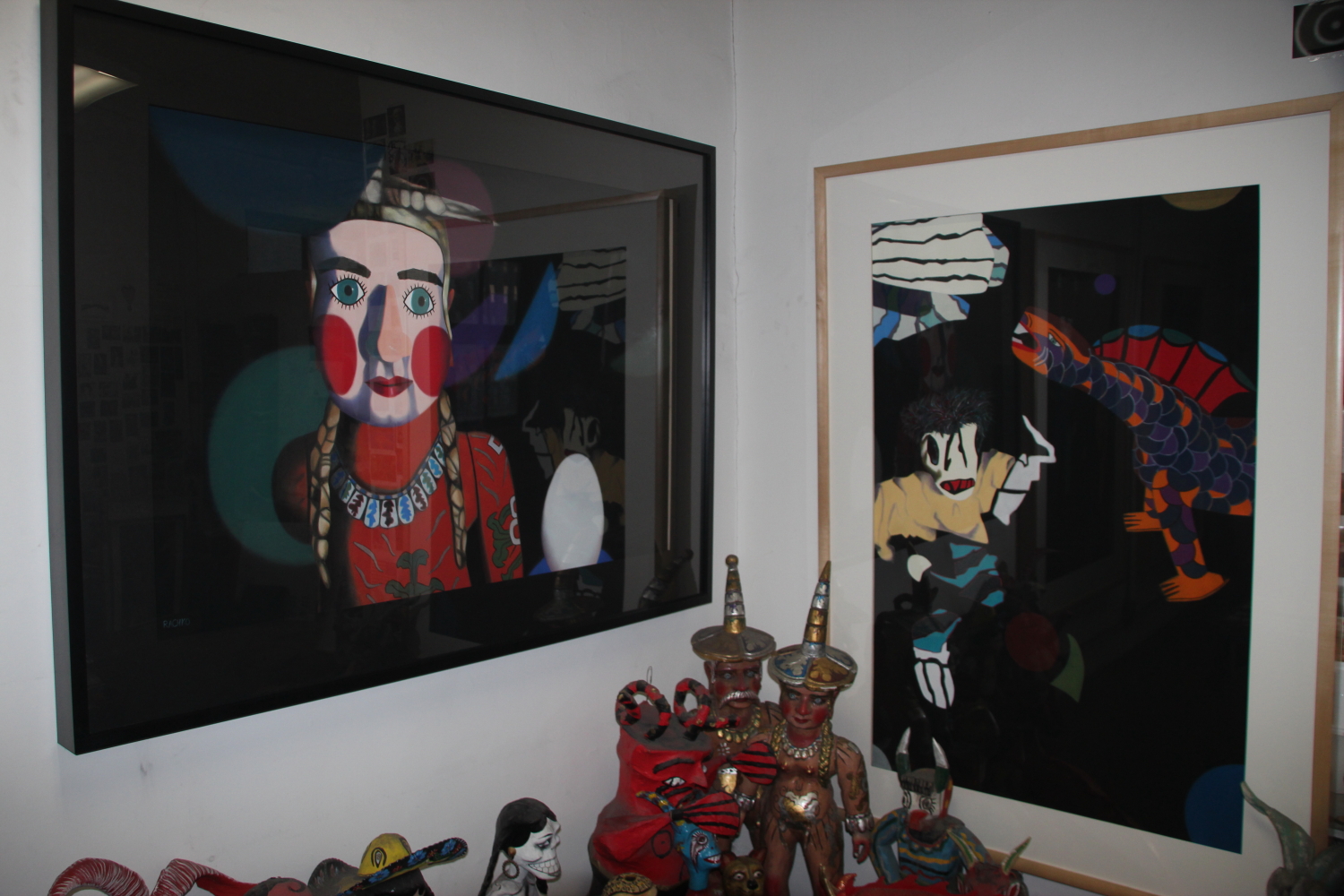
A corner of the studio
A: Actually it was the other way around. As I’ve mentioned, I was a maker of pastel-on-sandpaper paintings long before I became a photographer (1986 vs. 2002). However, the photos in the “Gods and Monsters” series were meant to be photographs in their own right, i.e., they were not made to be reference material for paintings. in an interesting turn of events, in 2007 I started a new series, “Black Paintings,” which uses the “Gods and Monsters” photographs as source material. Collectors who have been following my work for years tell me the new series is the strongest yet. For now I’m enjoying where this work is leading. The last three paintings are the most minimal yet and I’ve begun thinking of them as the “Big Heads.” There is usually a single figure (“Stalemate” has two) that is much larger than life size. “Epiphany” (above, left) is an example. All of them are quite dramatic when seen in person, especially with their black wooden frames and mats.
Comments are welcome!
Q: Please speak about your background as a Naval officer and aviator and how that has informed your sensibility as an artist.
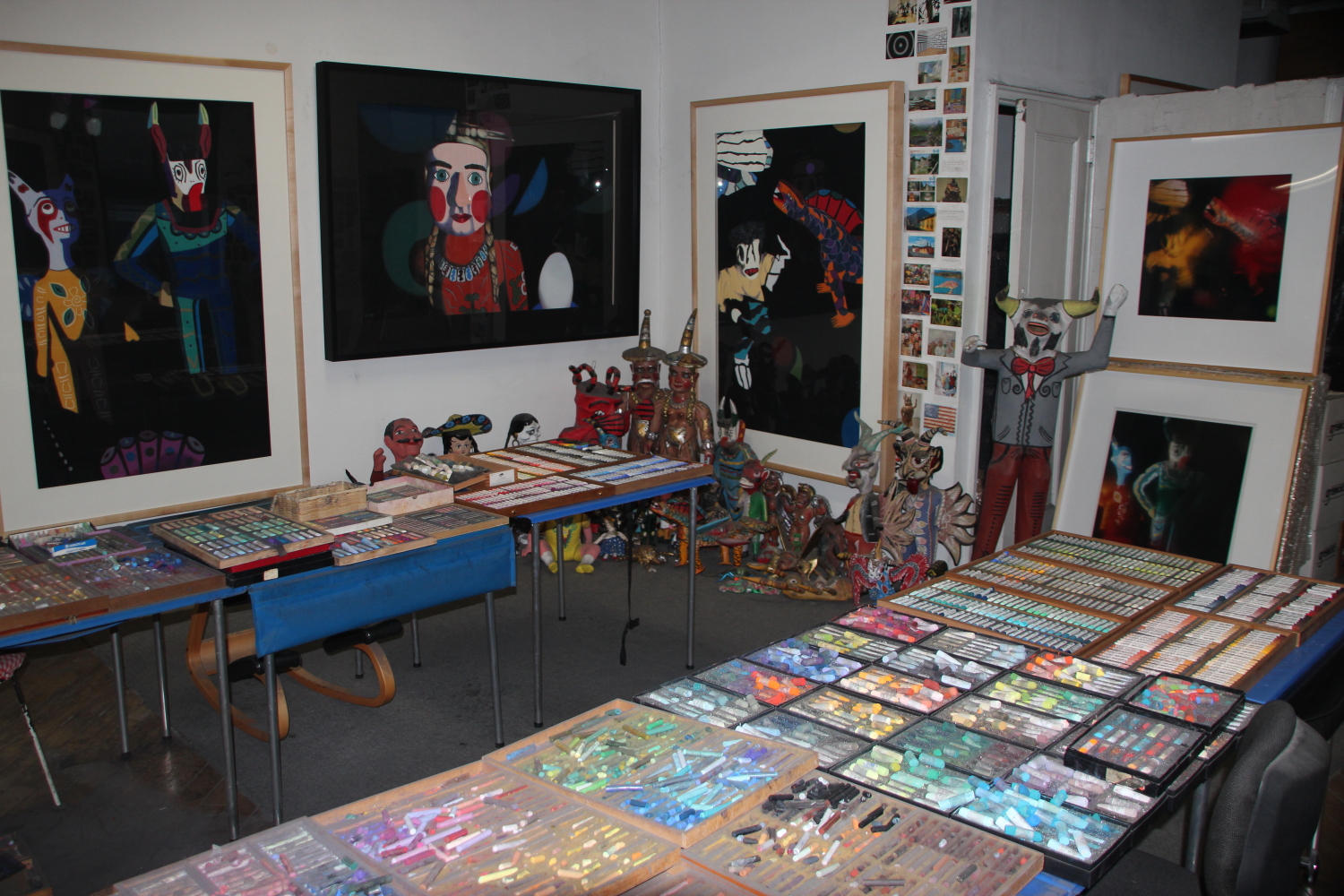
The studio yesterday
A: At the age of 25 I got my private pilot’s license before spending the next two years amassing thousands of hours of flight time as I earned every flying license and rating I could, ending with a Boeing-727 flight engineer certificate. I joined the Navy when I was 29. I used to think that the 7 years I spent on active duty were wasted – during those 7 years I should have been working on my art – but I see things differently now. The Navy taught me to be disciplined, to be goal-oriented and focused, to love challenges, and in everything I do, to pay attention to the details. Trying to make it as an artist in New York is nothing BUT challenges so these qualities serve me well, whether I’m creating paintings, shooting and printing photographs, or trying to understand the art business and keep up with social media. I enjoy spending long solitary hours working to become a better artist. I am meticulous about craft and will not let a work out of my studio or out of the darkroom until it is as good as I can make it.
Comments are welcome!
Q: When you set up your figures to photograph, do you create a story?
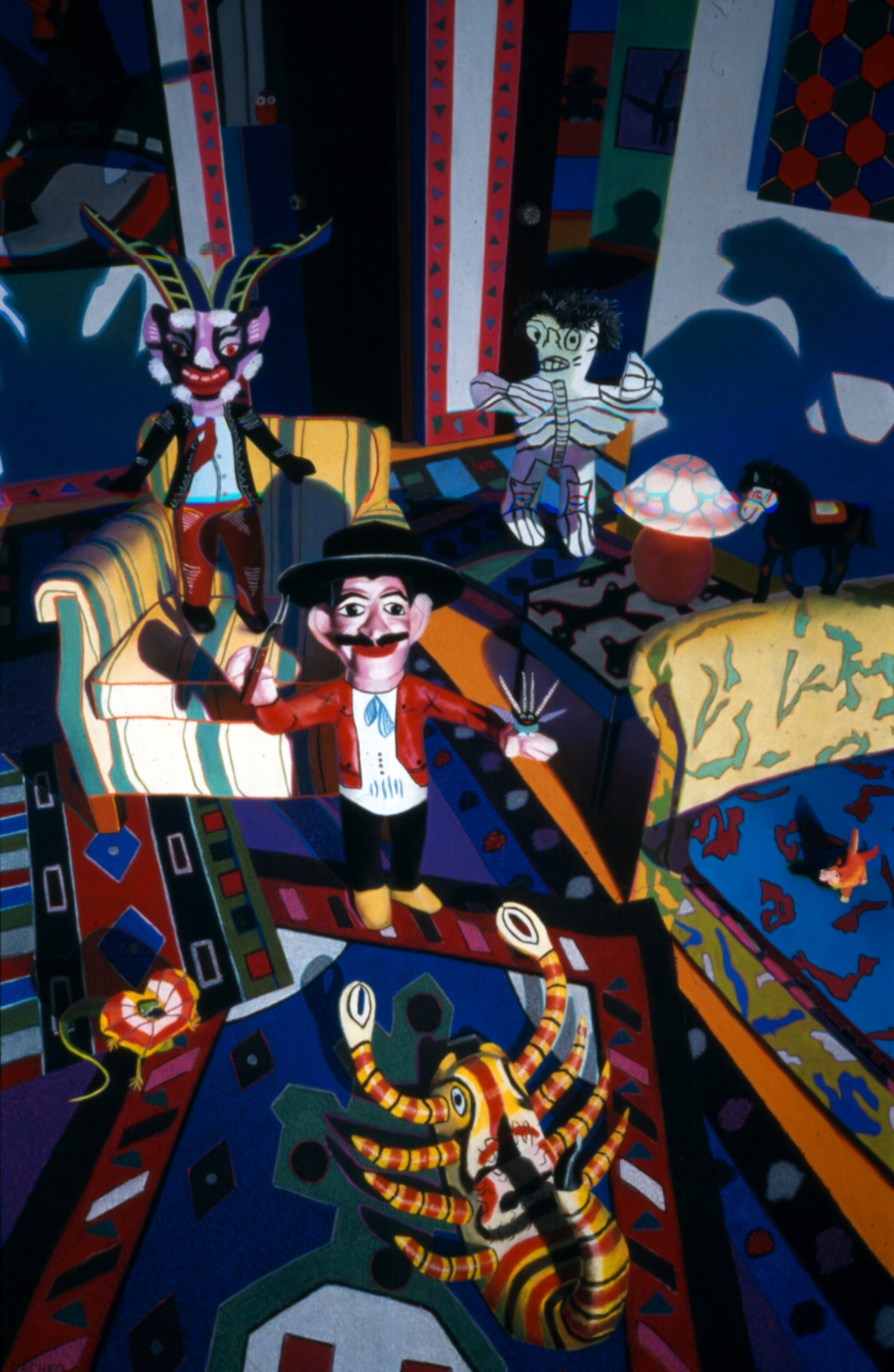
“He Just Stood There Grinning,” soft pastel on sandpaper, ” 58″ x 38″
A: I always did so with my “Domestic Threats” paintings, but not with my current work. As I set up a group of figures to photograph, I would make up a story about what was happening between them: what the Day of the Dead skeleton I bought in Mexico City was saying to the frog/fish/human mask from Guerrero, for example. I was a big kid playing with my favorite toys! The stories were the spark to get me started on a new project, but I usually forgot about them afterwards. They were necessary, yet incidental to my creative process, which is probably why I have never written them down.
Years ago I had the experience of being at one of my solo shows when a group of elementary school children came along with their teacher. The teacher asked them to act out one of the stories in a particular painting. Ever curious about how people relate to my work, I didn’t introduce myself as the creator of the pieces hanging on the walls. I no longer remember the details, but their interpretations soon had me laughing. It is a constant surprise to hear from people encountering my work for the first time what they see in it, especially when those people are young kids with wild imaginations!
Comments are welcome!
Pearls from artists* # 7
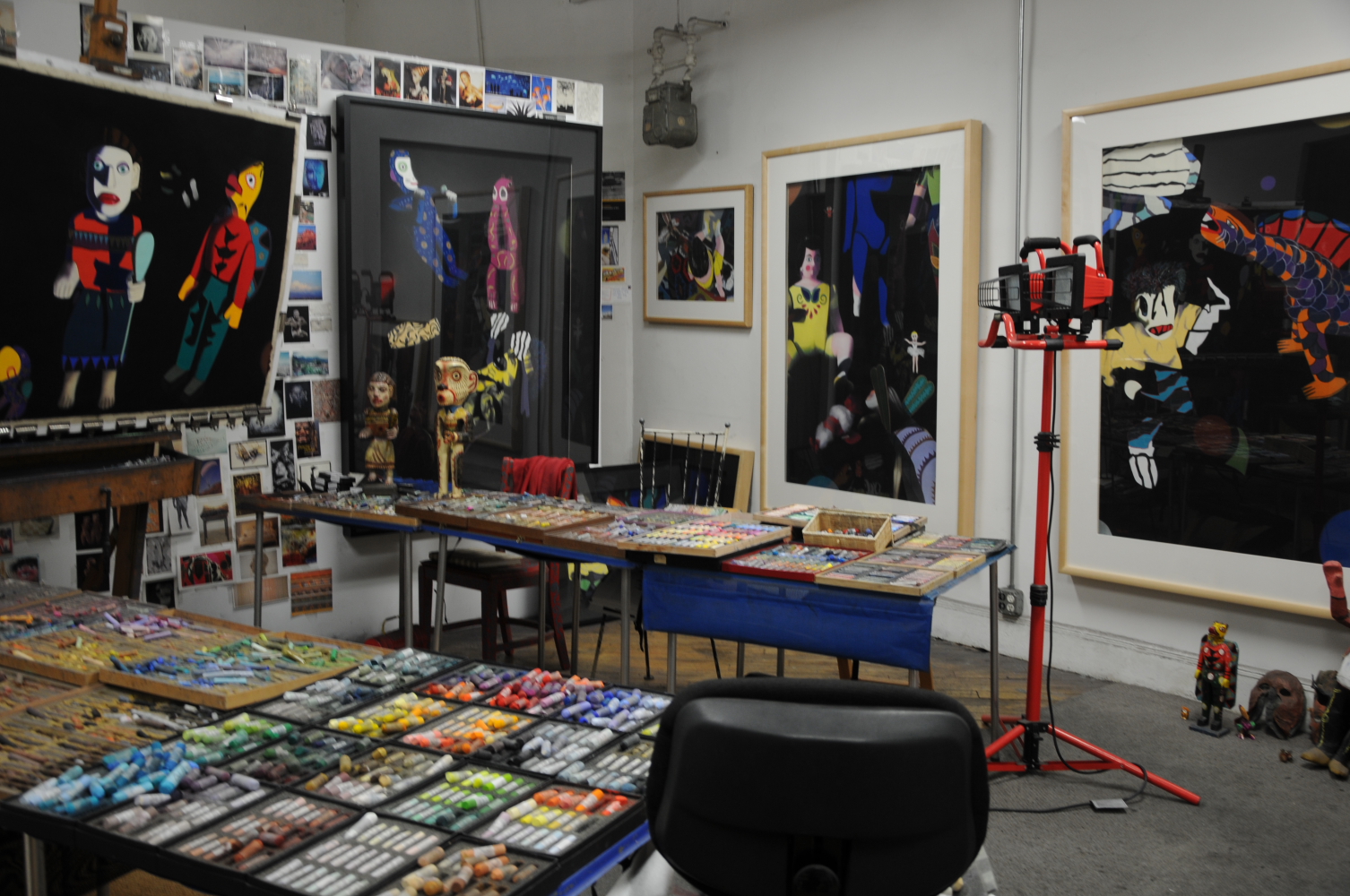
Barbara’s studio
* an ongoing series of quotations – mostly from artists, to artists – that offers wisdom, inspiration, and advice for the sometimes lonely road we are on.
It’s painful to think of the number of paintings that don’t work, not only my own, but also what I see in galleries and museums. Such failures may be adequately painted but they don’t sing. They left the studio but they aren’t happy about it. It’s simple and inevitable: there’s work we artists do that doesn’t come together. And for each of us there’s only one solution to this problem. You just continue to make paintings, and you make more paintings, and then for no particular reason all of a sudden you start to click and all the pieces that you’ve been working with, the direction you’ve been perceiving “as if through a glass darkly” is now open and clear, in all its glory. We paint and everything falls into place. That expression of “being in the zone” expresses the experience perfectly. There is a momentum you’ve built up which was essential to this work. If you had been waiting for inspiration, waiting for that flow to begin, it would have caught you too flat-footed to notice. It arrived out of the readiness that all the previous work created in you. Regardless of how sluggish that process may have seemed at the time, things were lining up in preparation, ideas were formulating.
Ian Roberts, Creative Authenticity: 16 Principles to Deepen Your Artistic Vision
Comments are welcome.
Q: Can you elaborate on the series title, “Domestic Threats?”
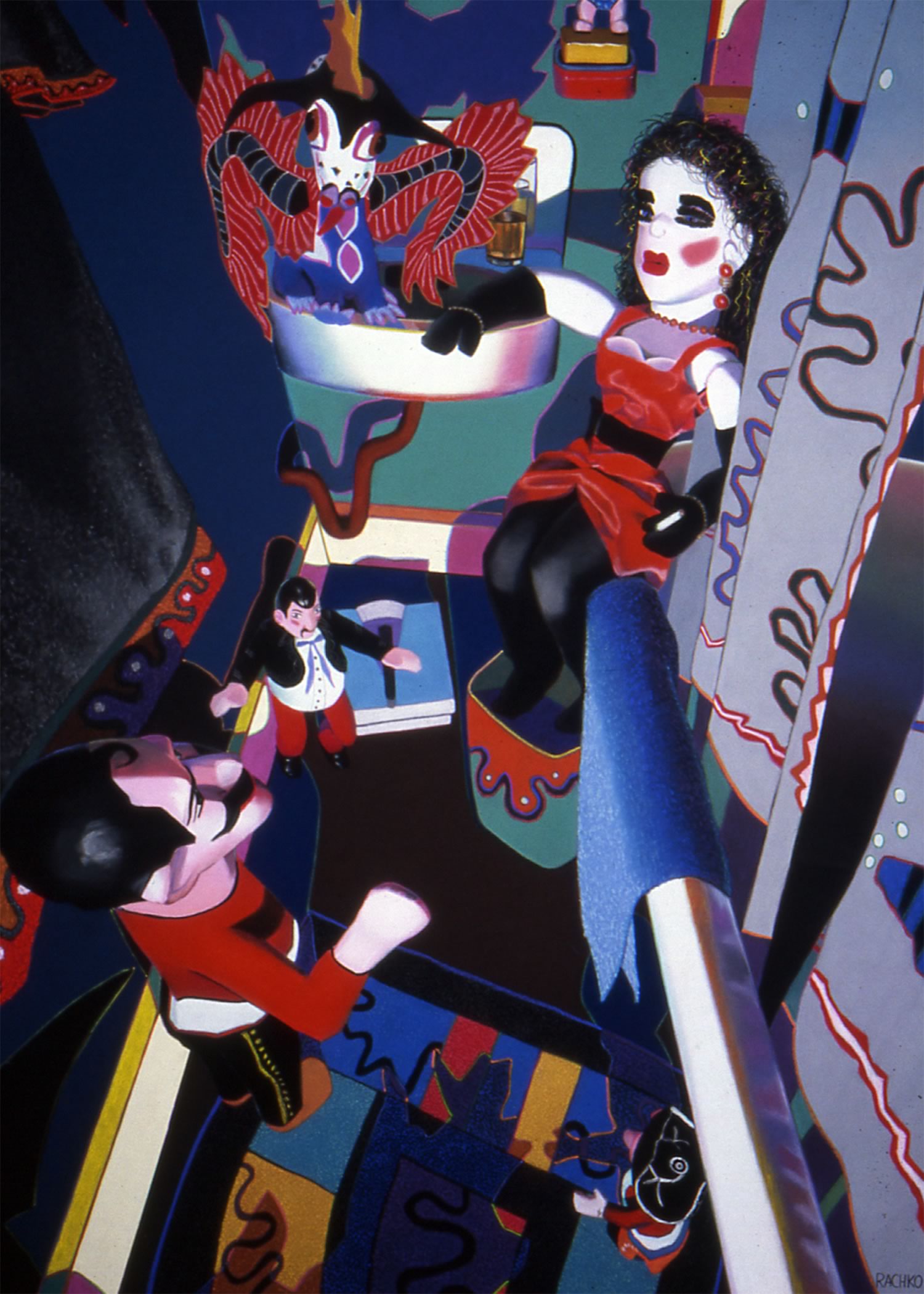
“He Urged Her To Abdicate,” soft pastel on sandpaper
A: All of the paintings in this series are set in places where I reside or used to live, either a Virginia house or New York apartments, i.e., domestic environments. Each painting typically contains a conflict of some sort, at least one figure who is being menaced or threatened by a group of figures. So I named the series “Domestic Threats.” Depending on what is going on in the country at a particular moment in time, however, people have seen political associations in my work. Since my husband was killed on 9/11, many people thought the title, “Domestic Threats,” was prescient. They have ascribed all kinds of domestic terrorism associations to it, but that is not really what I had in mind. For a time some thought I was hinting at scenes of domestic violence, but that also is not what I had intended. “Domestic Threats” seems to be fraught with associations that I never considered, but it’s an apt title for this work.
Q: How do you think your time in Bali will affect your work?
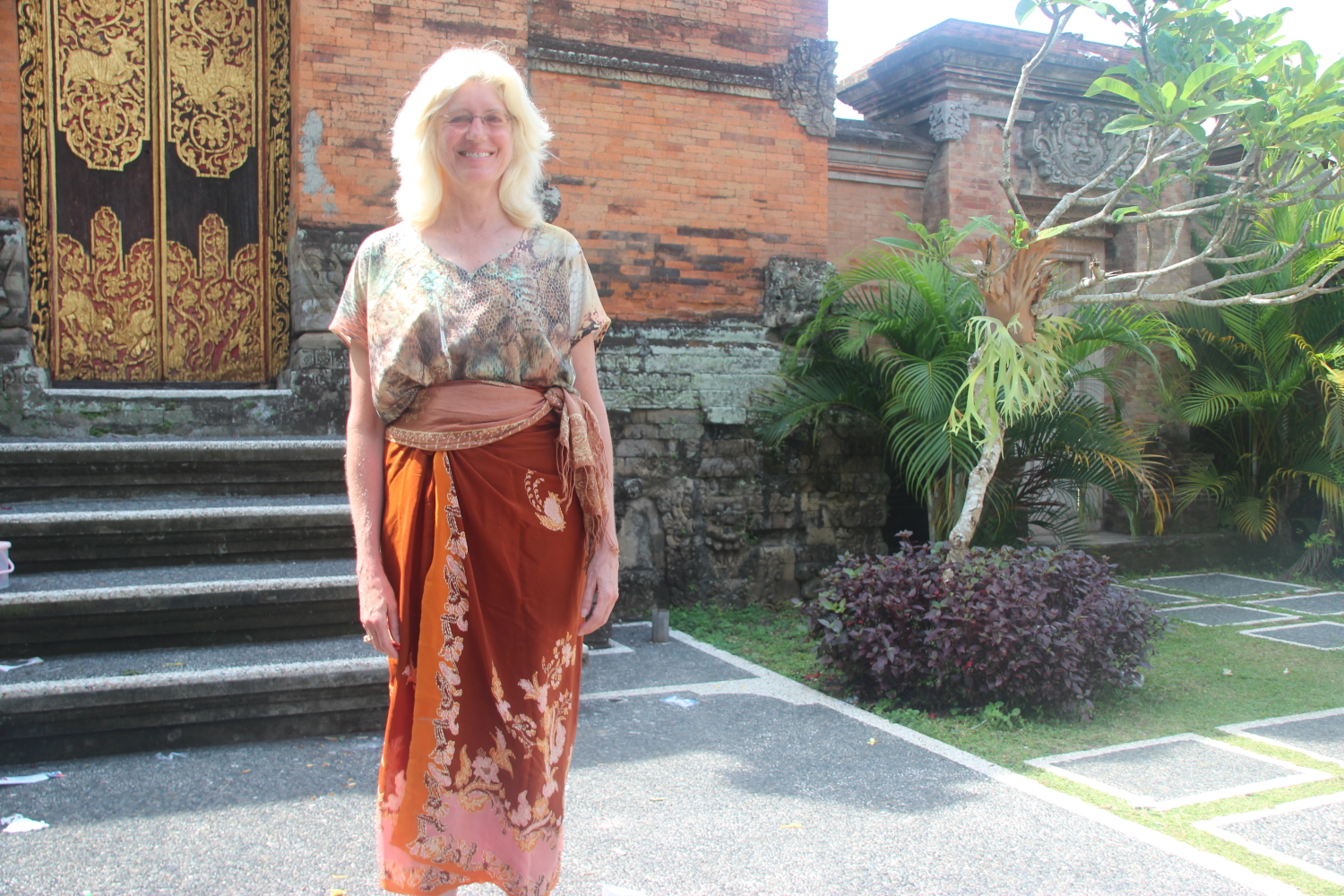
Barbara in her favorite sarong; photo by Donna Tang
A: There is always a long gestation period as I reflect on the new experiences, sights, sounds, etc. after a trip. Bali is a fascinating place – the only Hindu outpost in the world’s most populous Muslim country – so I’m reading everything I can find. I’ve finished an historical novel, Love and Death in Bali, about the 1906 mass suicide of the royal family during the Dutch invasion. I’m slowly making my way through Bali: Sekala and Niskala, a densely packed book about the intricacies of Hinduism, rituals, and art, written with the help of our guide, Budi. In the short term I’m using more green pastels in my paintings. Amidst all of the tropical lushness, I must have seen thousands of shades of green. The volcano shapes in “Absence,” a pastel painting completed last week (see post of JUL 20), resulted from this trip. Other, more pronounced effects will probably show up later.


 barbararachkoscoloreddust.com