Blog Archives
Pearls from artists* # 29

“He Just Stood There Grinning,” soft pastel on sandpaper, 58″ x 38″
* an ongoing series of quotations – mostly from artists, to artists – that offers wisdom, inspiration, and advice for the sometimes lonely road we are on.
And all the spaces of our past moments of solitude, the spaces in which we have suffered from our solitude, enjoyed, desired, and compromised solitude, remain indelible within us, and precisely because the human being wants them to remain so. He knows instinctively that this space identified with his solitude is creative; that even when it is forever expunged with the present, when, henceforth, it is alien to all the promises of the future, even when we no longer have a garret, when the attic is lost and gone, there remains the fact that we once loved a garret, once lived in an attic. We return to them in our night dreams. These retreats have the value of a shell. And when we reach the very end, the labyrinths of sleep, when we attain to the regions of deep slumber, we may perhaps experience a type of repose that is pre-human; pre-human, in this case, approaching the immemorial. But in the daydream itself, the recollection of moments of confined, simple, shut-in space are experiences of heartwarming space, of a space that does not seek to become extended, but would like above all to be possessed. In the past, the attic may have seemed too small, it may have seemed cold in winter and hot in summer. Now, however, in memory recaptured through daydreams, it is hard to say through what syncretism the attic is at once small and large, warm and cool, always comforting.
Gaston Bachelard in The Poetics of Space
Comments are welcome!
Pearls from artists* # 28

Flower sellers in Chichicastenango, Guatemala
* an ongoing series of quotations – mostly from artists, to artists – that offers wisdom, inspiration, and advice for the sometimes lonely road we are on.
We have talked a good deal about our duty, and how we could attain the right goal, and we came to the conclusion that in the first place our aim must be to find a steady position and a profession to which we can entirely devote ourselves. It is wise to do so, for life is but short and time passes quickly; if one is master of one thing and understands one thing well, one has at the same time insight into and understanding of many things.
One must especially have the end in mind, and the victory one would gain after a whole life of work and effort is better than one that is gained earlier. Whoever lives sincerely and encounters much trouble and disappointment, but is not bowed down by them, is worth more than one who has always sailed before the wind and has only relative prosperity. One must never trust the occasion when one is without difficulties.
Irving Stone with Jean Stone, editors, Dear Theo: The Autobiography of Vincent Van Gogh
Comments are welcome!
Pearls from artists* # 22

Alexandria living room
* an ongoing series of quotations – mostly from artists, to artists – that offers wisdom, inspiration, and advice for the sometimes lonely road we are on.
So inclination you see is not lacking, and yet in all probability I shall have to try right here to clamber in the dark and all alone over the crest of the year, so to speak, for disciplinary reasons. I shall not deserve it otherwise, that is: I have long wanted to be here all alone, strictly alone, to go into my cocoon, to pull myself together, in short, to live by my heart and nothing else. Now since day before yesterday I have really been here all alone inside the old walls – outside, the sea, outside, the Karst, outside, the rain, perhaps tomorrow the storm – now must appear what is within by way of counterweight to such great and fundamental things. So, if something quite unexpected does not come, it may be the right thing to say, to hold out, to hold still with a kind of curiosity toward oneself, don’t you think? That is how things stand, and if I stir now everything will shift again; and then hearts are labeled, like certain medicines: shake before taking; I have been continually shaken in these last years, but never taken, that is why it is better that I should quietly arrive at clarity and precipitation…
Jane Bannard Greene and M.D. Herter Norton, translators, Letters of Rainer Maria Rilke 1910 – 1926
Comments are welcome!
Pearls from artists* # 5
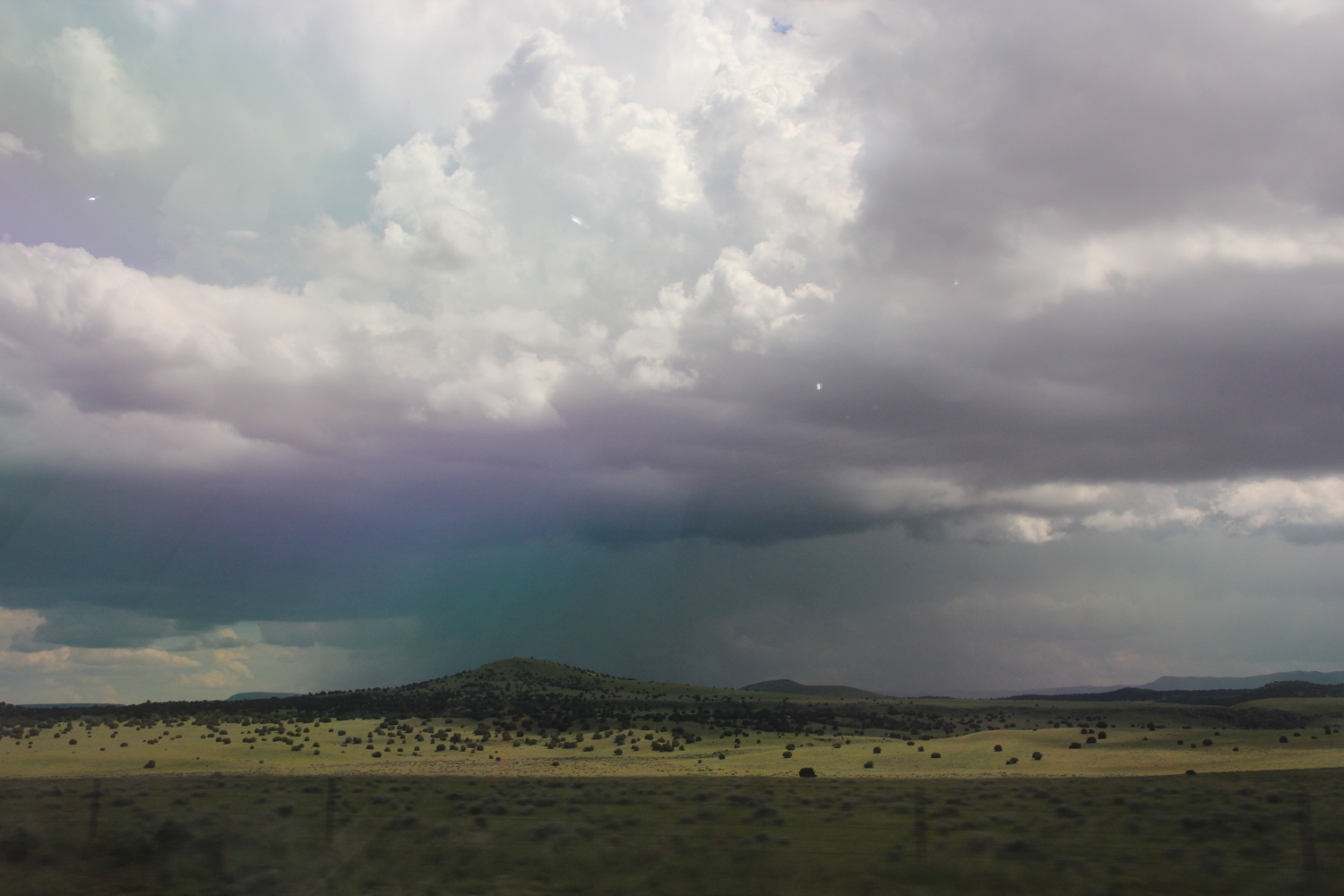
Arizona storm
* an ongoing series of quotations – mostly from artists, to artists – that offers wisdom, inspiration, and advice for the sometimes lonely road we are on.
Flying over the desert yesterday, I found myself lifted out of my preoccupations by noticing suddenly that everything was curved. Seen whole from the air, circumscribed by its global horizon, the earth confronted me bluntly as a context all its own, echoing that grand sweep. I had the startling impression that I was looking at something intelligent. Every delicate pulsation of color was met, matched, challenged, repulsed, embraced by another, none out of proportion, each at its own unique and proper part of the whole. The straight lines with which human beings have marked the land are impositions of a different intelligence, abstract in this area of the natural. Looking down at these facts, I began to see my life as somewhere between these two orders of the natural and the abstract, belonging entirely neither to one nor to the other.
In my work as an artist I m accustomed to sustaining such tensions: A familiar position between my senses, which are natural, and my intuition of an order they both mask and illuminate. When I draw a straight line or conceive of an arrangement of tangible elements all my own, I inevitably impose my own order on matter. I actualize this order, rendering it accessible to my senses. It is not so accessible until actualized.
An eye for this order is crucial for an artist. I notice that as I live from day to day, observing and feeling what goes on both inside and outside myself, certain aspects of what is happening adhere to me, as if magnetized by a center of psychic gravity. I have learned to trust this center, to rely on its acuity and to go along with its choices although the center itself remains mysterious to me. I sometimes feel as if I recognize my own experience. It is a feeling akin to that of unexpectedly meeting a friend in a strange place, of being at once startled and satisfied – startled to find outside myself what feels native to me, satisfied to be so met. It is exhilarating.
I have found that this process of selection, over which I have virtually no control, isolates those aspects of my experience that are most essential to me in my work because they echo my own attunement to what life presents me. It is as if there are external equivalents for truths which I already in some mysterious way know. In order to catch these equivalents, I have to stay “turned on” all the time, to keep my receptivity to what is around me totally open. Preconception is fatal to this process. Vulnerability is implicit in it; pain, inevitable.
Anne Truitt, Daybook: The Journal of an Artist
Comments are welcome.


 barbararachkoscoloreddust.com