Blog Archives
Q: How do you decide when a pastel painting is finished?

Signing “Apparition,” soft pastel on sandpaper, 58” x 38”
A: During the several months that I work on a pastel painting, I search for the best, most eye-popping colors, as I build up and blend together as many as 25 to 30 layers of pigment. I am able to complete some areas, like the background, fairly easily – maybe with six or seven layers – but the more realistic parts take more applications because I am continually refining and adding details. Details always take time to perfect.
No matter how many pastel layers I apply, however, I never use fixatives. It is difficult to see this in reproductions of my work, but the finished surfaces achieve a texture akin to velvet. My technique involves blending each layer with my fingers, pushing pastel deep into the tooth of the sandpaper. The paper holds plenty of pigment and because the pastel doesn’t flake off, there is no need for fixatives.
I consider a given painting complete when it is as good as I can make it, when adding or subtracting anything would diminish what is there. I know my abilities and I know what each individual stick of pastel can do. I continually try to push myself and my materials to their limits.
Comments are welcome.
Pearls from artists* # 569
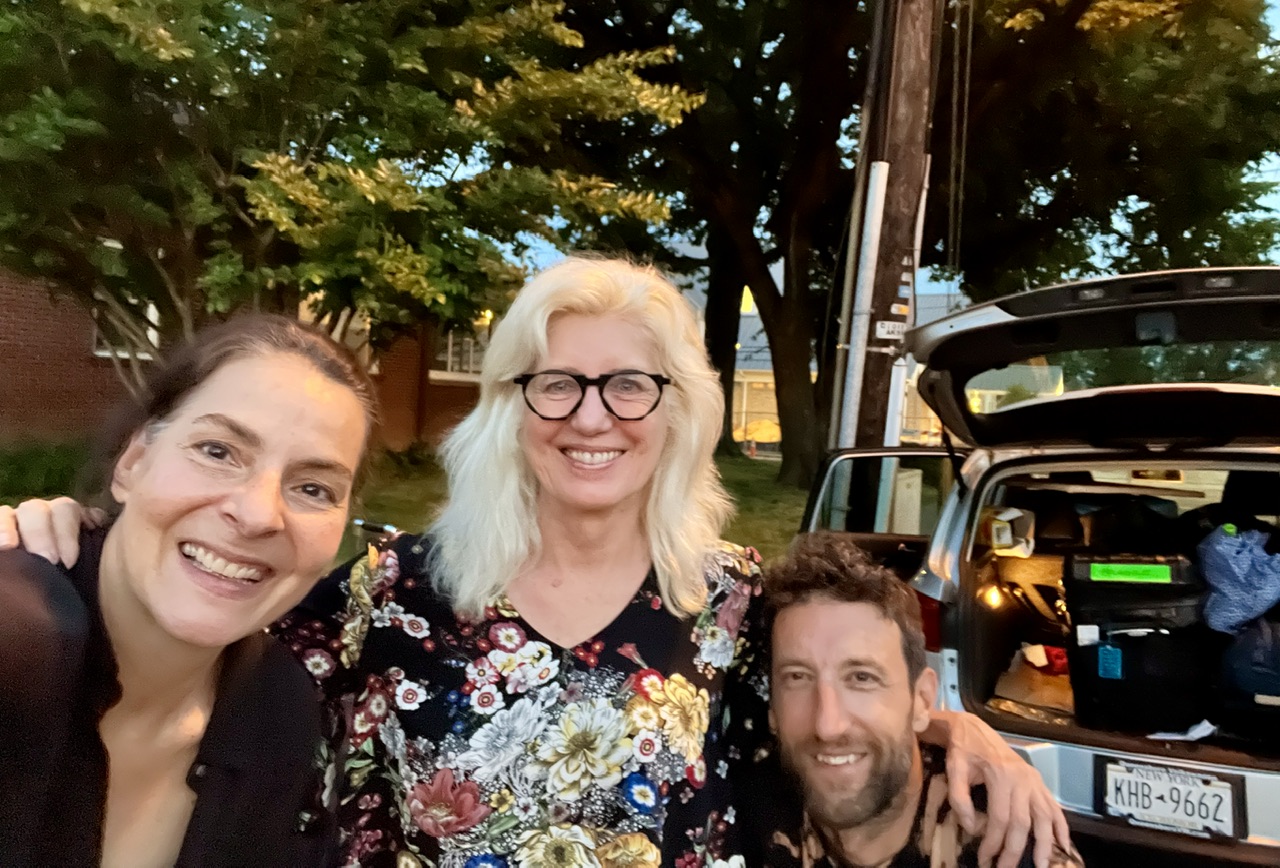
With Jennifer and Dmitri after our film shoot in Alexandria, VA
*an ongoing series of quotations – mostly from artists, to artists – that offers wisdom, inspiration, and advice for the sometimes lonely road we are on.
Artists consider themselves to be independent people. But the artist’s independent, rebellious, nonconforming nature, coupled with his introspective habits of mind, also make him wary of social interactions. Whereas the fireman, for example, has no reason to believe keeping company with other firemen will diminish his ability to fight fires, the artist, keenly aware that his journey is a personal and independent one, often fears that contact with his peers will slow him down, detour him, limit him, or unduly influence him.
Eric Maisel in A Life in the Arts: Practical Guidance and Inspiration for Creative and Performing Artists
Comments are welcome!
Pearls from artists* # 483

*an ongoing series of quotations – mostly from artists, to artists – that offers wisdom, inspiration, and advice for the sometimes lonely road we are on.
The editor has a unique relationship with the actors. I never try to go on to the set to see the actors out of costume or out of character – and also just not to see the set. I only want to see what there is on screen. Ultimately, that’s all the audience is ever going to see. Everyone else working on the film at that stage is party to everything going on around the filmed scene: how cold it was when that scene was shot; who was mad at whom; who is in love with whom; how quickly something was done; what was standing just to the left of the frame. An editor particularly has to be careful that those things don’t exert a hidden influence on the way the film is constructed, can (and should in my view) remain ignorant of all that stuff – in order to find value where others might not see value, and on the other hand, to diminish the value of certain things that other people see as too important. It’s one o the crucial functions of the editor. To take, as far as it is possible, the view of the audience, who is seeing the film without any knowledge of all the things that went into its construction.
On Editing Actors, by Walter Murch in The Conversations: Walter Murch and the Art of Editing Film, by Michael Ondaatje
Comments are welcome!


 barbararachkoscoloreddust.com