Blog Archives
Pearls from artists* # 582

*an ongoing series of quotations – mostly from artists, to artists – that offers wisdom, inspiration, and advice for the sometimes lonely road we are on.
Strange, but the artist has never made a fuss about being denied those estimable virtues other men would not do without: intellectuality, good judgment, a knowledge of the world, and rational conduct. It may be charged, that he has even fostered the myth. In his intimate journals Vollard tells us that Degas feigned deafness to escape disputations and harangues concerning things he considered false and distasteful. If the speaker or subject changed, his hearing immediately improved. We must marvel at his wisdom since he must have only surmised what we know definitely today: tThat the constant repetition of falsehood is more convincing than the demonstration of truth. It is understandable, then, how the artist might actually cultivate this moronic appearance, this deafness, this inarticulateness, in an effort to evade the million irrelevancies which daily accumulate concerning his work. For, while the authority of the doctor or plumber is never questioned, everyone deems himself a good judge and an adequate arbiter of what a work of art should be and how it should be done.
Mark Rothko in The Artist’s Reality: Philosophies of Art, edited by Christopher Rothko
Comments are welcome!
Pearls from artists* # 474

*an ongoing series of quotations – mostly from artists, to artists – that offers wisdom, inspiration, and advice for the sometimes lonely road we are on.
If ever an artist needed a degree of protection against his public, surely it is Vincent van Gogh. Reproductions of his most emblematic paintings, especially the gyrating nightscapes and the blazing series of sunflower studies made in his late years, adorn countless bedrooms, living rooms, and bathrooms all across what used to be known as the developed world. The popularity of the works executed in the great flowering of this last period, which began around the time of his revelatory visit in the autumn of 1885 to the newly completed Rijksmuseum, in Amsterdam, and ended when he died less than five years later at the age of thirty-seven, is unparalleled. Of the great ones among his contemporaries, and there were many, only Degas can come near to rivaling him as a mainstay of interior decoration.
John Banville in His Own Worst Enemy, The New York Review of Books, May 13, 2021
Comments are welcome!
Q: You use an impressive assortment of soft pastels to create your pastel paintings. Which are your favorite?
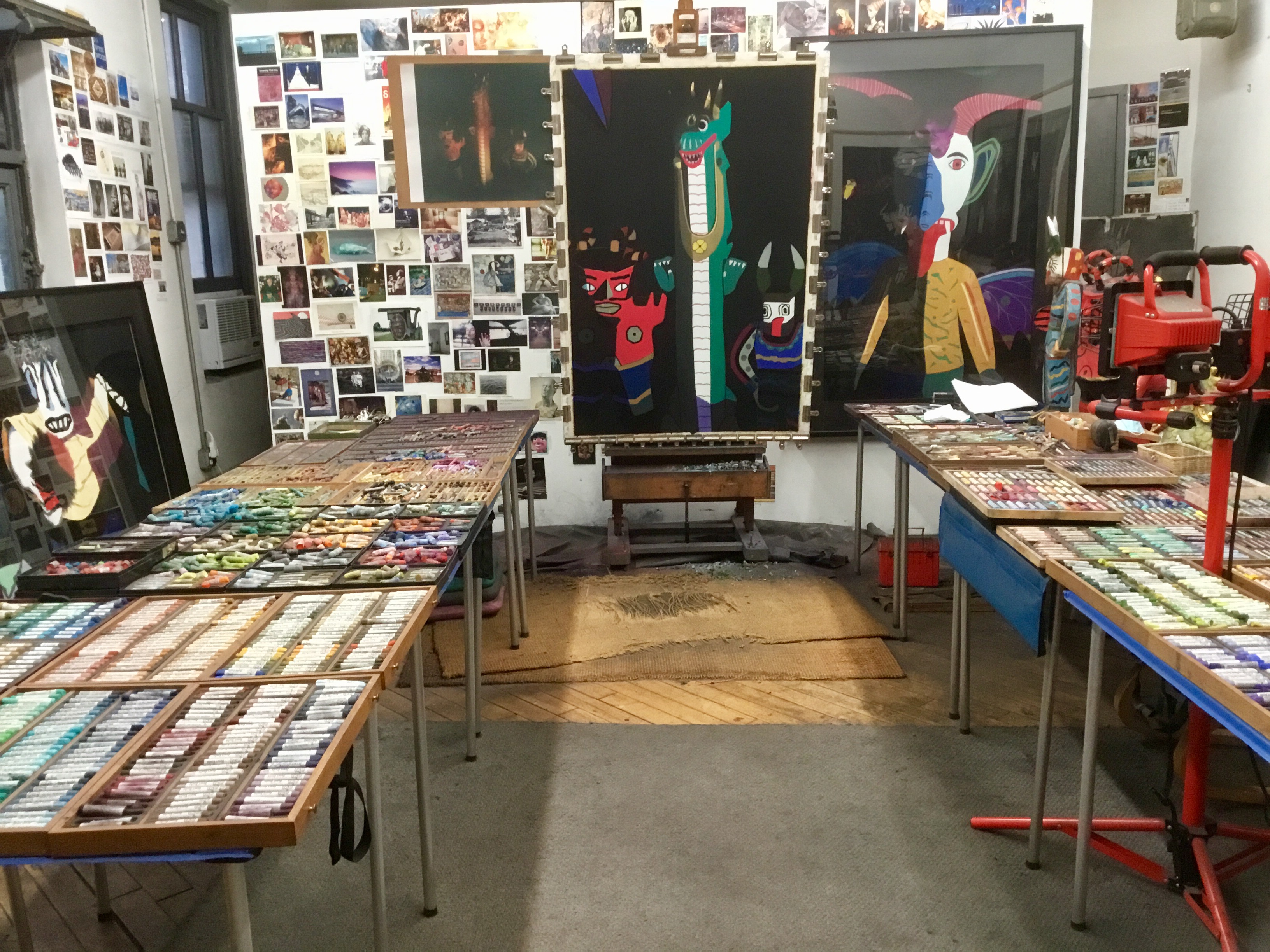
Barbara’s studio
A: My favorite brand of soft pastels is Henri Roché. They offer subtle variations in color and hue since they make more colors than any other company.
As a birthday present a few years ago, I treated myself to a full 750-color set. I mainly use them for finishing touches, rather than letting them get buried under pastel. At nearly $20 a stick, I also don’t want see them reduced to colored dust on the floor beneath my easel. One of my peers calls them, “the Maserati of pastels!”
Isobel Roché told me that her goal is to reach 1000 colors in time for the company’s 300th anniversary in 2020! I hope she makes it.
These pastels have been around so long that Degas and other artists of the era used them. It’s humbling to know that I am working with the same materials and following a long and prestigious art tradition of using soft pastel.
Comments are welcome!


 barbararachkoscoloreddust.com