Blog Archives
Pearls from artists* # 679
*an ongoing series of quotations – mostly from artists, to artists – that offers wisdom, inspiration, and advice for the sometimes lonely road we are on.
PC: In your painting, you’ve always kept this speed of movement. One senses that you work something out slowly, deep down, that it’s hard work, but there’s always something fresh about its expression
HM: That’s because I revise my notion several times over. People often add or superimpose completing things without changing their plan, whereas I rework my plan every time. I always start again, working from the previous state. I try to work in a contemplative state, which is very difficult: contemplation is inaction and I act in contemplation.
In all the studies I’ve made from my own ideas, there’s never been a faux pas because I’ve always unconsciously had a feeling for the goal; I’ve made my way toward it the way one heads north, following the compass. What I’ve done, I’ve done by instinct, always with my sights on a goal I still hope to reach today. I’ve completed my apprenticeship now. All I ask is four or five years to realize the goal.
PC: Delacroix said that too. Great artists never look back.
HM: Delacroix also said – ten years after he’d left the place – “I’m just beginning to see Morocco.” He needed the perspective. Rodin said to an artist, “You need to stand back a long way for sculpture.” To which the student replied, “Master, my studio is only ten meters wide.”
Chatting With Henri Matisse: The Lost 1941 Interview, Henri Matisse with Pierre Courthion, edited by Serge Guilbaut
Comments are welcome!
Pearls from artists* # 402
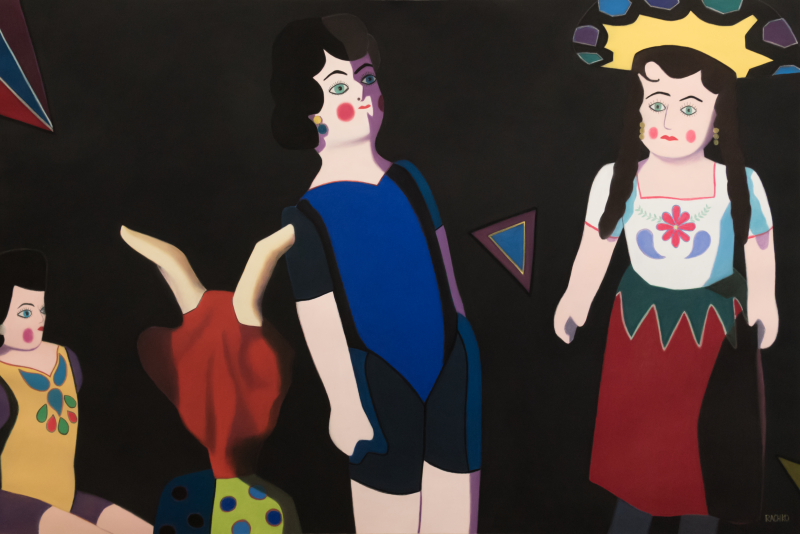
“Conundrum,” soft pastel on sandpaper, 38″ x 58″
*an ongoing series of quotations – mostly from artists, to artists – that offers wisdom, inspiration, and advice for the sometimes lonely road we are on.
Rodin was lonely before his fame, and perhaps after the fame that came to him still lonelier. For fame is actually only the sum of all the misunderstandings that gather around a new name.
Rainer Maria Rilke quoted in Mary Gabriel in Ninth Street Women
Comments are welcome!
Pearls from artists* # 326

“Acolytes,” soft pastel on sandpaper, 38″ x 58″
*an ongoing series of quotations – mostly from artists, to artists – that offers wisdom, inspiration, and advice for the sometimes lonely road we are on.
Art is… a longest road through life, and when I think how slight and beginnerish what I have done till now is, I am not surprised that this production (which resembles a strip or half-tilled field a foot wide) does not sustain me. For plans bear no fruit, and seed prematurely sown does not sprout. But patience and work are real and can at any moment be transformed into bread. ‘Il faut toujours travailler,’ Rodin said whenever I attempted to complain to him about the schism in daily life; he knew no other solution, and this of course had been his… To stick to my work and have every confidence in it, this I am learning from his great and greatly given example, as I learn patience from him: it is true, my experience tells me over and over that I haven’t much strength to reckon with, for which reason I shall, so long as it is in any way possible, not do two things, not separate livelihood and work, rather try to find both in the one concentrated effort: only thus can my life become something good and necessary and heal together out of the tattered state for which heredity and immaturity have been responsible, into one bearing trunk.
Therefore I shall determine my next place of abode, all else aside, from the point of view of my work and that only. I want this the more, since I feel myself in the midst of developments and transitions (changes that affect observation and creation equally), which may slowly lead to that toujours travailler with which all outer and inner difficulties, dangers and confusions would really be in a certain sense overcome.. for whoever can always work, can live too, must be able to.
Rainer Maria Rilke, Letters to a Young Poet, Translation by M.D. Herter Norton
Comments are welcome!


 barbararachkoscoloreddust.com