Blog Archives
Q: You take 3-4 months to complete one artwork. How do you plan a series such as Bolivianos over a year’s timeline and over the years? (Question from Vedica Art Studios and Gallery)

A: Bolivianos is my third series, and like the previous two, it naturally evolves from one painting to the next. There wasn’t a long-term plan involved, and I doubt such detailed planning would even be practical. Many artists likely work this way—finishing one project and then beginning another. As with Bolivianos, I typically have ideas for the next two or three paintings, but little concept beyond that.
The main impetus for Bolivianos was to continue work I began in the early 1990s. During a visit to La Paz, I captured a series of stunning photographs, inspiring me to translate them into a major pastel series. Each painting leads to ideas about the next, guiding the entire series’ evolution and shaping my understanding of its meaning. Both the series and my insights deepen as I engage further with the subject matter. The Bolivian Carnival masks I photographed provided the starting point for a long and continuing intellectual journey.
Comments are welcome!
Q: How do you feel about the fact that more people view an artist’s work online than ever see it in person?

A: This has been a dilemma for decades. Don’t get me wrong. Artists are indeed fortunate to have alternative ways to share our art, such as on the internet, but there is just no substitute for seeing art in person! I remember friends telling me about a review of a Nan Goldin exhibition that said, “All of the pleasure circuits are fired in looking.” That rarely happens when you view art online. Yet this is how most people experience our work – at a remove and on a small screen.
Nowadays, a global audience will see art on their phones instead of in our studios or in a gallery or museum. My pastel paintings are quite large and very detailed so when people finally see them in person, they are often surprised. They had gotten used to seeing them in a much smaller scale online, where very few of the meticulous and subtle details I incorporate into them are visible.
Comments are welcome!
Q: How do you select a photograph to use as reference material to make a pastel painting?
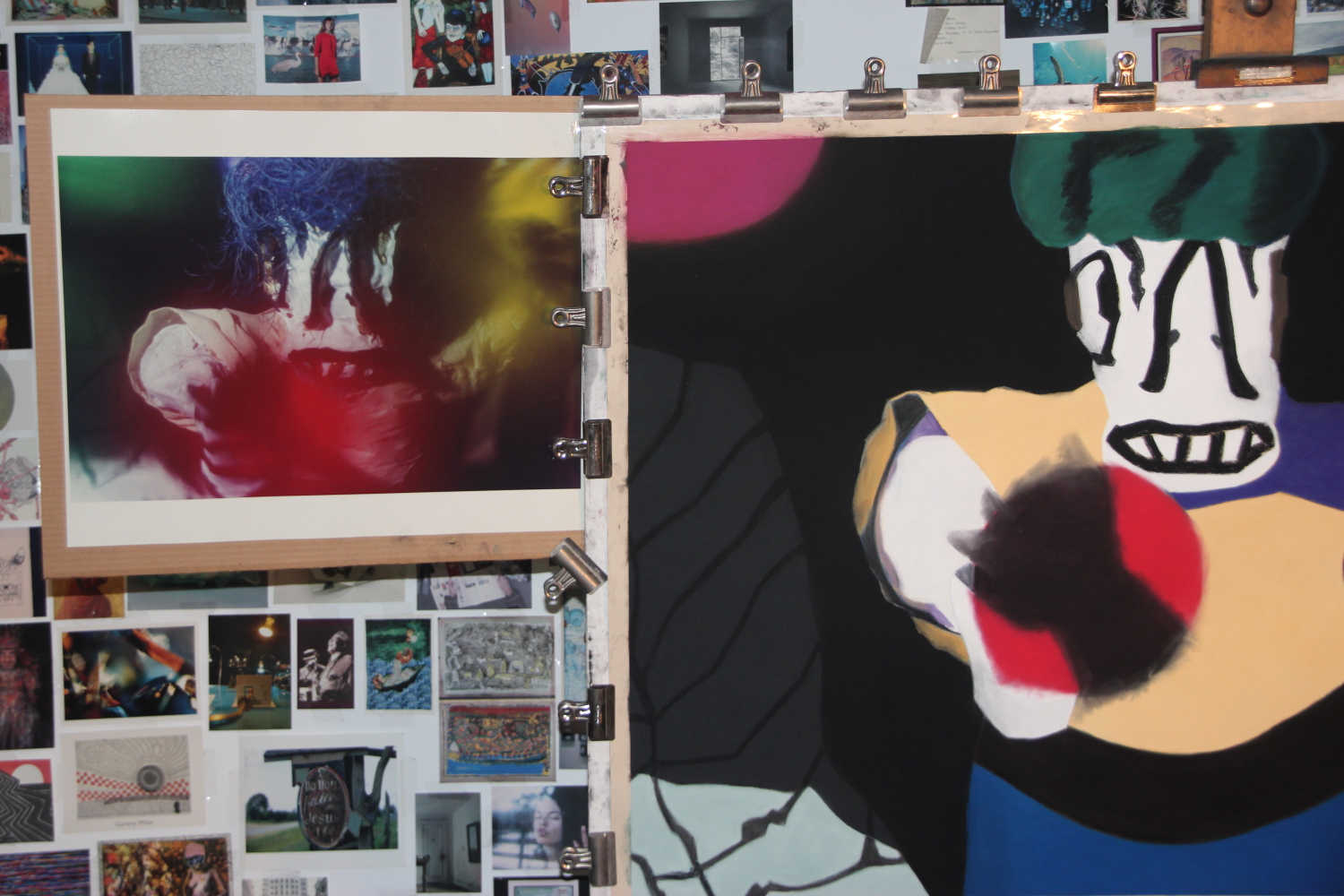
Photograph, left, and work in progress
A: Like everything else associated with my studio practice, my use of photographs from which to work has changed considerably. Beginning in the early 1990s all of the paintings in my first series, “Domestic Threats,” started out as elaborately staged, well-lit scenes that either my husband, Bryan, or I photographed with Bryan’s Toyo Omega 4 x 5 view camera using a wide-angle lens. Depending on where I was living at the time, I set up the scenes in one of three places: our house in Alexandria, VA, a six-floor walkup apartment on West 13th Street in New York, or my current Bank Street condominium. Then one of us shot two pieces of 4 x 5 film at different exposures and I’d usually select the more detailed one to be made into a 20″ x 24″ photo to use as a reference.
Just as the imagery in my paintings has simplified and emptied out over the years, my creative process has simplified, too. I often wonder if this is a natural progression that happens as an artist gets older. More recently I have been shooting photos independently of how exactly I will use them in my work. Only later do I decide which ones to make into paintings; sometimes it’s YEARS later. For example, the pastel painting that is on my easel now is based on a relatively old (2002) photograph that I have always liked, but only now felt ready to tackle in pastel.
Comments are welcome!


 barbararachkoscoloreddust.com