Blog Archives
Pearls from artists* # 605

*an ongoing series of quotations – mostly from artists, to artists – that offers wisdom, inspiration, and advice for the sometimes lonely road we are on.
At first the concept of the unconscious was limited to denoting the state of repressed or forgotten contents. Even with Freud, who makes the unconscious – at least metaphorically – take the stage as the acting subject, it is really nothing but the gathering place of forgotten and repressed contents, and has a functional significance thanks only to these. For Freud, accordingly, the unconscious is of an exclusively personal nature, although he was aware of its archaic and mythological thought forms.
A more or less superficial layer of the unconscious is undoubtedly personal. I call it the personal unconscious. But this personal unconscious rests upon a deeper layer, which does not derive from personal experience and is not a personal acquisition but is inborn. This deeper layer I call the collective unconscious. I have chosen the term “collective” because this part of the unconscious is not individual but universal; in contrast to the personal psyche, it has contents and modes of behavior that are more or less the same everywhere and in all individuals. It is, in other words, identical in all men and thus constitutes a common psychic substrate of a suprapersonal nature which is present in every one of us.
Carl Jung in The Archetypes and the Collective Unconscious, translated by RFC Hull
Comments are welcome!
Pearls from artists* # 197
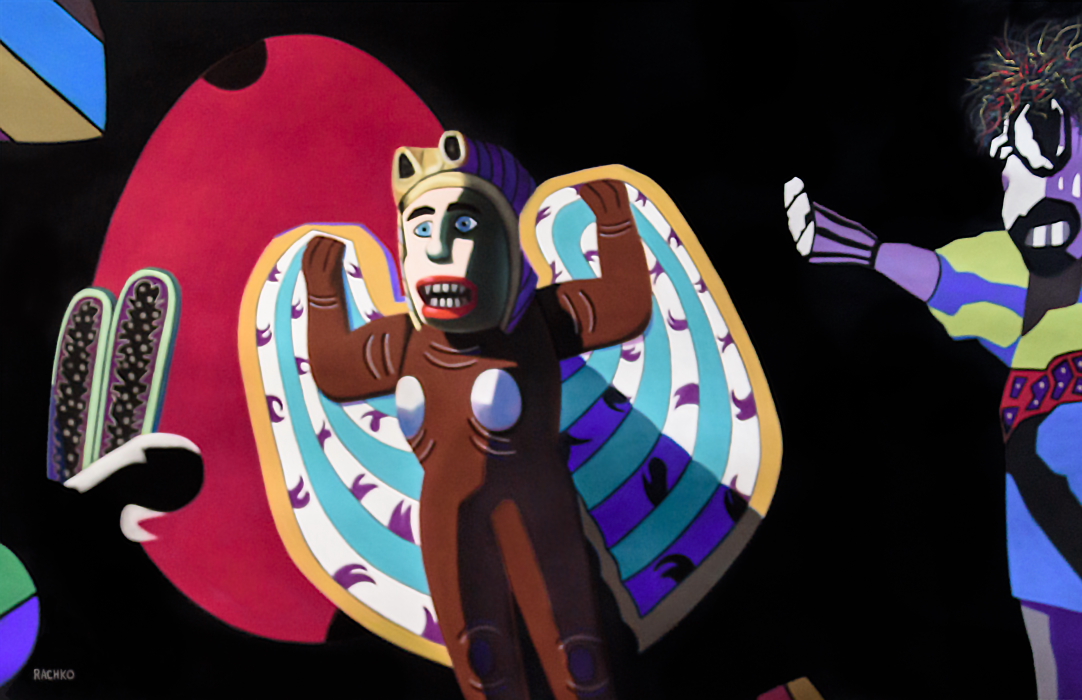
“Charade,” soft pastel on sandpaper, 38″ x 58″
* an ongoing series of quotations – mostly from artists, to artists – that offers wisdom, inspiration, and advice for the sometimes lonely road we are on.
As Kenneth Burke says in ‘Counter-Statement:’ “[Great] artists feel as opportunity what others feel as menace. This ability does not, I believe, derive from exceptional strength, it probably arises purely from professional interest the artist may take in his difficulties.”
Marianne Moore in Writers at Work: The Paris Review Interviews Second Series, edited by George Plimpton
Comments are welcome!
Pearls from artists* # 26

Borobudur, Java
* an ongoing series of quotations – mostly from artists, to artists – that offers wisdom, inspiration, and advice for the sometimes lonely road we are on.
Beauty is made up of relationships. It derives its prestige from a specific metaphysical truth, expressed through a host of balances, imbalances, waverings, surges, halts, meanderings, and straight lines, the peculiar quality of which, as a whole, add up to a marvelous number, apparently born without pain. Its distinguishing mark is that it judges those who judge it, or imagine that they possess power to do so. Critics have no hold over it. They would have to know the minutest details of how it works, and this they cannot do, because the mechanics of beauty are secret. Hence the soil of an age is strewn with a litter of cogs that criticism dismantles in the same way as Charlie Chaplin dismantles an alarm clock after opening it like a tin can. Criticism dismantles the cogs. Unable to put them back together or understand the relationships that give them life, it discards them and goes on to something else. And beauty ticks on. Critics cannot hear it because the roar of current events clogs the ears of their souls.
Jean Cocteau in Andre Bernard and Claude Gauteur, editors, Jean Cocteau: The Art of Cinema
Comments are welcome!


 barbararachkoscoloreddust.com