Blog Archives
Q: What does your creative process look like when you are ready to begin a new painting?

Preliminary sketch
A: My working methods have changed dramatically over the years with my current process being a much-simplified version of how I used to work. In other words as I pared down my imagery in the “Black Paintings,” my process quite naturally pared down, too.
One constant is that I have always worked in series with each pastel painting leading quite logically to the next. Another is that I always have set up a scene, lit and photographed it, and worked with a 20″ x 24″ photograph as the primary reference material. In the “Domestic Threats” series I shot with a 4″ x 5″ view camera. Nowadays the first step is to decide which photo I want to make into a painting (currently I have a backlog of images to choose from) and to order a 19 1/2″ x 19 1/2″ image (my Mamiya 6 shoots square images and uses film) printed on 20″ x 24″ paper. I get the print made at Manhattan Photo on West 20th Street in New York. Typically I have in mind the next two or three paintings that I want to create.
Once I have the reference photograph in hand, I make a preliminary tonal charcoal sketch on a piece of white drawing paper. The sketch helps me think about how to proceed and points out potential problem areas ahead. For example, in the photograph above I had originally thought about creating a vertical painting, but changed to horizontal format after discovering spatial problems in my sketch.
Also, I decided to make a small painting now because it has been two years since I last worked in a smaller (than my usual 38″ x 58″) size. I am re-using the photograph on which “Epiphany” is based. Using a photograph a second time lets me see how my working methods have evolved over time.
Comments are welcome!
Q: When was the last time you flew? Do you ever miss it?
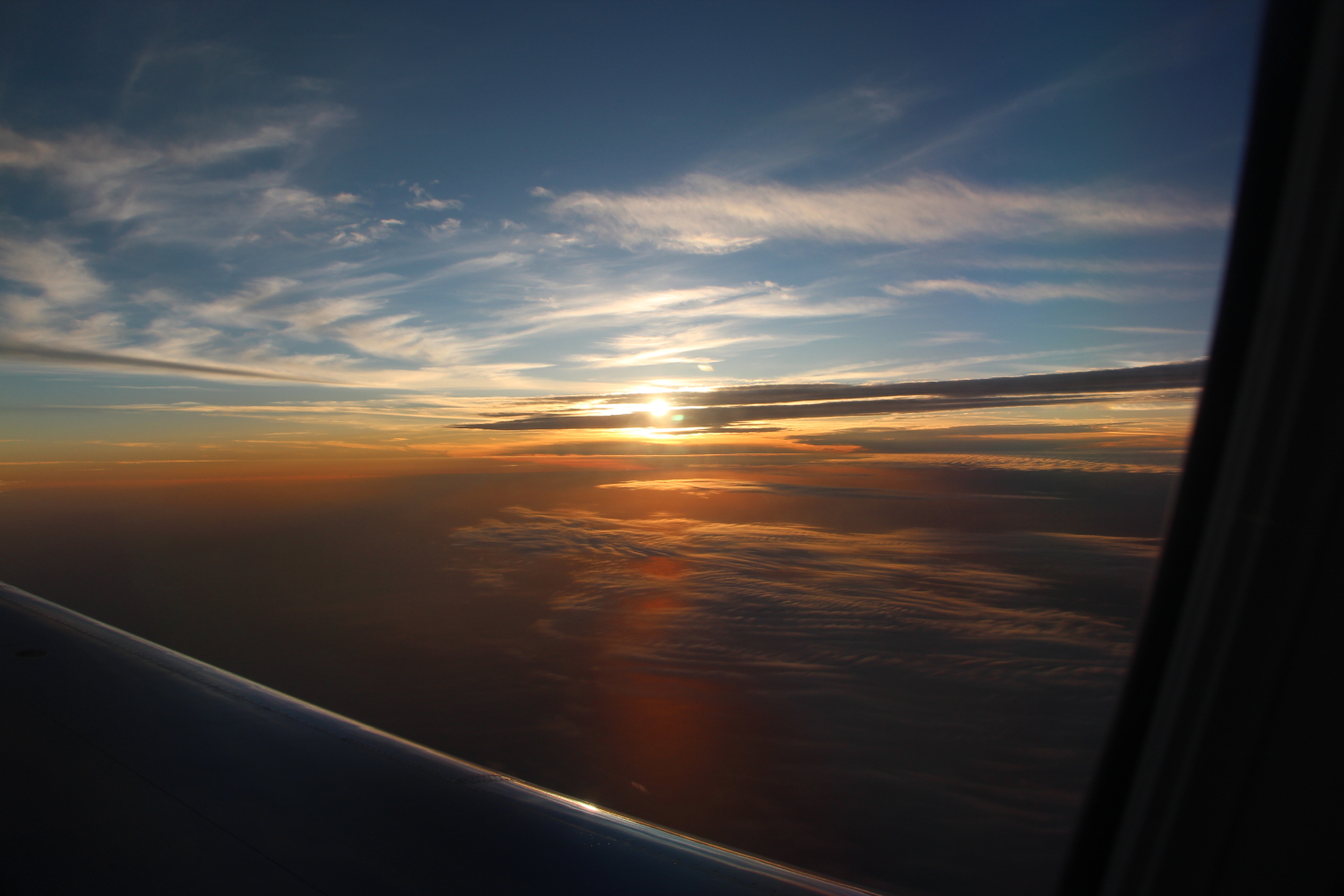
Over the Gulf of Mexico
A: I last piloted a plane out of Andrews Air Force Base in suburban Maryland, some years after I moved to Alexandria, Virginia. It was in the mid-1990s.
Now and then I miss flying, but my interests have changed considerably and I am much more passionate about art than aviation. I still love physically being in the air – on an airliner, in a helicopter, etc. – and sometimes I dream about taking a few lessons to become reacquainted with flying small planes again, but I haven’t taken any action.
Comments are welcome!
Q: How do you select a photograph to use as reference material to make a pastel painting?
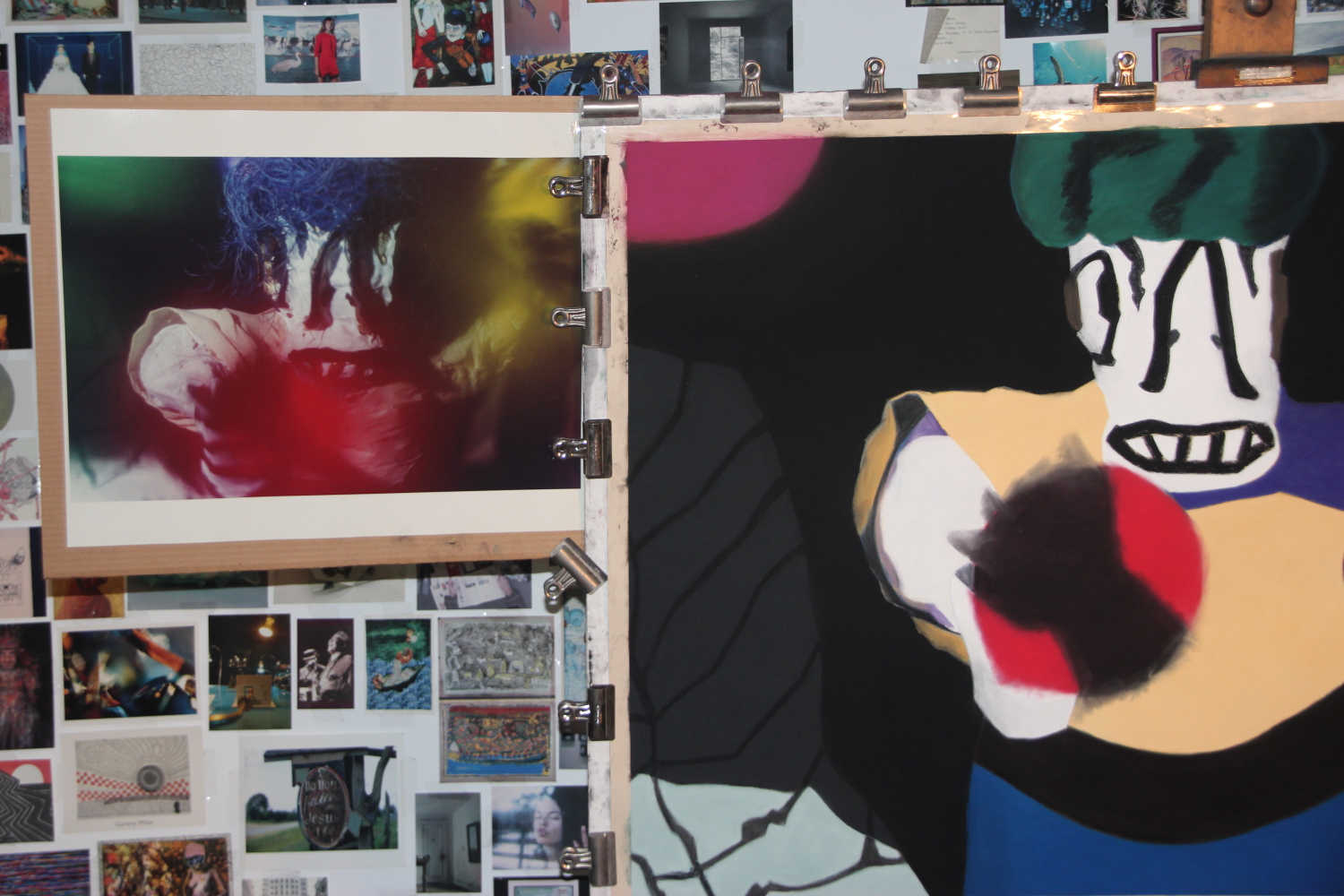
Photograph, left, and work in progress
A: Like everything else associated with my studio practice, my use of photographs from which to work has changed considerably. Beginning in the early 1990s all of the paintings in my first series, “Domestic Threats,” started out as elaborately staged, well-lit scenes that either my husband, Bryan, or I photographed with Bryan’s Toyo Omega 4 x 5 view camera using a wide-angle lens. Depending on where I was living at the time, I set up the scenes in one of three places: our house in Alexandria, VA, a six-floor walkup apartment on West 13th Street in New York, or my current Bank Street condominium. Then one of us shot two pieces of 4 x 5 film at different exposures and I’d usually select the more detailed one to be made into a 20″ x 24″ photo to use as a reference.
Just as the imagery in my paintings has simplified and emptied out over the years, my creative process has simplified, too. I often wonder if this is a natural progression that happens as an artist gets older. More recently I have been shooting photos independently of how exactly I will use them in my work. Only later do I decide which ones to make into paintings; sometimes it’s YEARS later. For example, the pastel painting that is on my easel now is based on a relatively old (2002) photograph that I have always liked, but only now felt ready to tackle in pastel.
Comments are welcome!


 barbararachkoscoloreddust.com