Blog Archives
Pearls from artists* # 52

Boat hull
* an ongoing series of quotations – mostly from artists, to artists – that offers wisdom, inspiration, and advice for the sometimes lonely road we are on.
The modern way of seeing is to see in fragments. It is felt that reality is essentially unlimited, and knowledge is open-ended. It follows that all boundaries, all unifying ideas have to be misleading, demagogic; at best, provisional; almost always, in the long run, untrue. To see reality in the light of certain unifying ideas has the undeniable advantage of giving shape and form to our experience. But it also – so the modern way of seeing instructs us – denies the infinite variety and complexity of the real. Thereby it represses our energy, indeed our right, to remake what we wish to remake – our society, ourselves. What is liberating, we are told, is to notice more and more.
Paolo Dilonardo and Anne Jump, editors, Susan Sontag At the Same Time: Essays and Speeches
Comments are welcome!
Pearls from artists* # 49

Untitled, 24″ x 24″ chromogenic print, edition of 5
* an ongoing series of quotations – mostly from artists, to artists – that offers wisdom, inspiration, and advice for the sometimes lonely road we are on.
The beauty of art is better, “higher,” according to Hegel, than the beauty of nature because it is made by human beings and is the work of the spirit. But the discerning of beauty in nature is also the result of traditions of consciousness, and of culture – in Hegel’s language, of spirit.
The responses to beauty in art and to beauty in nature are interdependent. As Wilde pointed out, art does more than school us on how and what to appreciate in nature. (He was thinking of poetry and painting. Today the standards of beauty in nature are largely set by photography.) What is beautiful reminds us of nature as such – of what lies beyond the human and the made – and thereby stimulates and deepens our sense of the sheer spread and fullness of reality, inanimate as well as pulsing, that surrounds us all.
A happy by-product of this insight, if insight it is: beauty regains its solidity, its inevitability, as a judgment needed to make sense of a large portion of one’s energies, affinities, and admirations; and the usurping notions appear ludicrous.
Imagine saying, “That sunset is interesting.”
Paolo Dilonardo and Anne Jump, editors, Susan Sontag At the Same Time: Essays and Speeches
Comments are welcome!
Pearls from artists* # 31
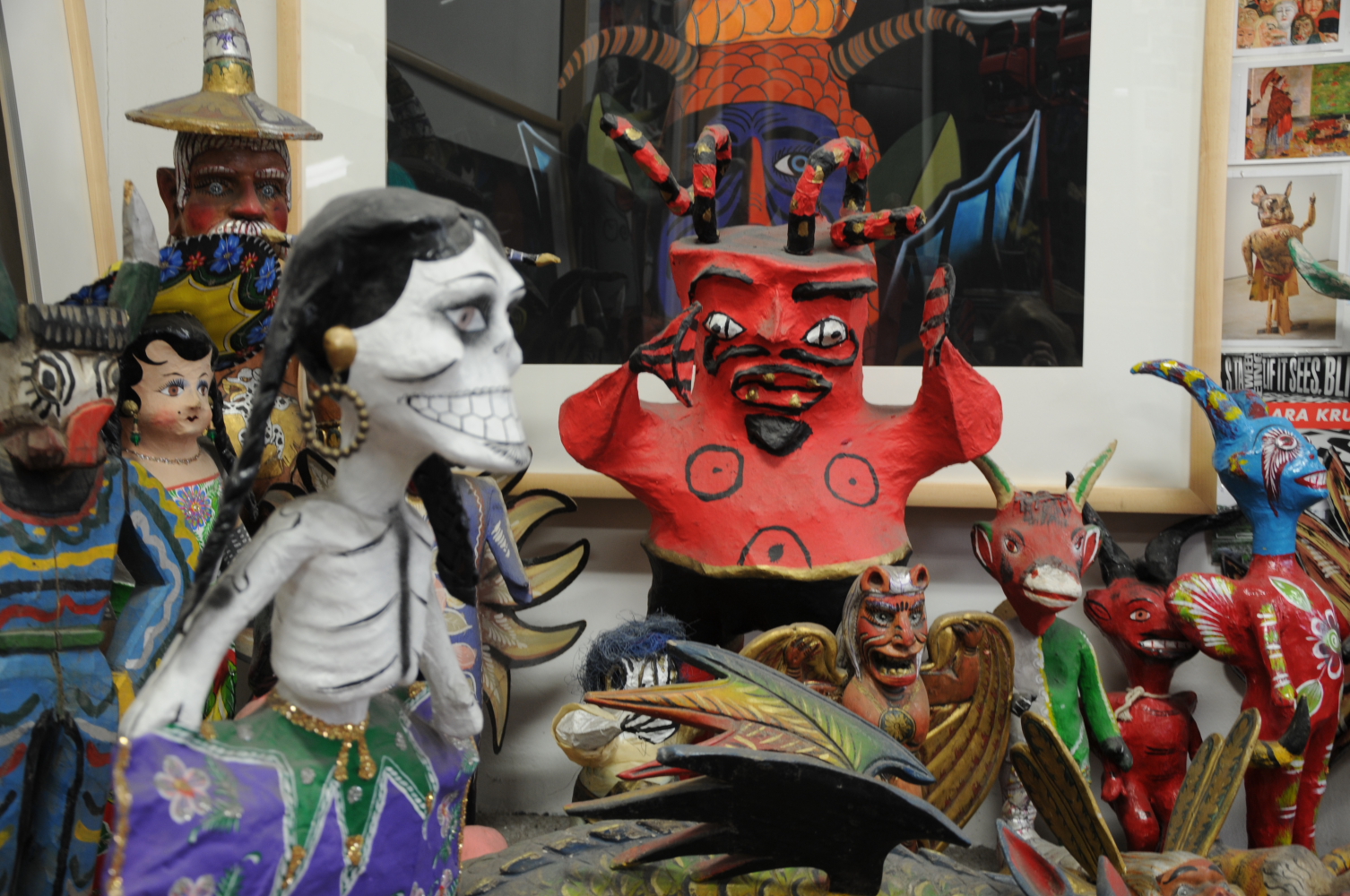
A corner of Barbara’s studio
* an ongoing series of quotations – mostly from artists, to artists – that offers wisdom, inspiration, and advice for the sometimes lonely road we are on.
When we are children we unquestioningly see the objects around us as alive; we speak to them, give them names, breathe life into them. The imagination knows no bounds. As we grow up, we gradually lose this facility, until we finally arrive in an utterly “demystified” world that draws clear boundaries between what is alive and what is not, between subjective and objective perception. According to Sigmund Freud, culture is the only domain in our modern society that gives a measure of legitimacy to the persistence of this infantile desire to see things as animate. In the field of art, imagination is the precondition on which fiction of any sort rests; in art, mental states can be projected onto objects and images, but not in social reality or the sciences.
Dietrich Karner in Animism: Modernity Through the Looking Glass
Comments are welcome!
Q: In your paintings, we occasionally catch a glimpse of a blond-haired female whom I assume is you. Are you also playing a character or do you appear as yourself?

“No Cure for Insomnia,” soft pastel on sandpaper
A: I am playing myself. I like to include myself in a painting now and then. I used to be a portrait artist and this is one way to keep up my technical skills. Beyond that when I’m in the painting it gives another level of reality to the scene depicted. I painted “No Cure for Insomnia” (above) at a time when I was having trouble sleeping. In it I imagined what people who didn’t know me personally, but who only knew my work, might think was keeping me up at night!


 barbararachkoscoloreddust.com