Blog Archives
Pearls from artists* # 612
New York, NY
*an ongoing series of quotations – mostly from artists, to artists – that offers wisdom, inspiration, and advice for the sometimes lonely road we are on.
It is the poet and philosopher who provide the community of objectives in which the artist participates. Their chief preoccupation, like the artist, is the expression in concrete form of their notions of reality. Like him, they deal with verities of time and space, life and death, and the heights of exaltation as well as the depths of despair. The preoccupation with these external problems creates a common ground which transcends the disparity of the means used to achieve them. And it is in the language of the philosopher and poet or, for that matter, of other arts which share the same objective that we must speak if we are to establish some verbal equivalent of the significance of art.
Let us not for a moment conceive that the language of one is interchangeable with that of the other: that one can duplicate the sense of a picture by the sense of words or sounds, or that one can translate the truth of words by means of pictorial delineations. Not all odes of Pindar, framed and embroidered, could duplicate the portrayal by Apelles’ brush of the Hero of the Palaestra. The Pandemonium of Milton or Dante’s Inferno can never replace the vision of the Last Judgment by either Michelangelo or Signorelli. No more so than the Pastoral Symphony of Beethoven can be apprehended through the reading of idyllic poems, augmented by descriptions of woodland and fields, of torrents and streams, the study of ornithological sounds, and the laws of harmonics. Neither books on jurisprudence, nor costume plates, can possibly reconstruct Raphael’s School of Athens. And the man who knows a book or a picture through its critics, whatever his experience, has no experience of the art itself. The truth, the reality of each, is confined within its own boundaries and must be perceived in terms of the means generic to itself.
In speaking of art here, there is no thought of recreating the experience of the picture. If we compare one art to another, it is not with the intention of contrasting their actuality, but to speak rather of the motivations and properties such as are admissible to the world of verbal ideas. And if… we are partial to the philosopher – at the expense of those others who share with the artist his common objectives, it is not because we divine in his effort a greater sympathy to the artist, but because philosophy shares with art it’s preoccupation with ideas in the terms of logic.
Mark Rothko in The Artist’s Reality: Philosophies of Art
Comments are welcome!
Q: What was the first painting you ever sold?
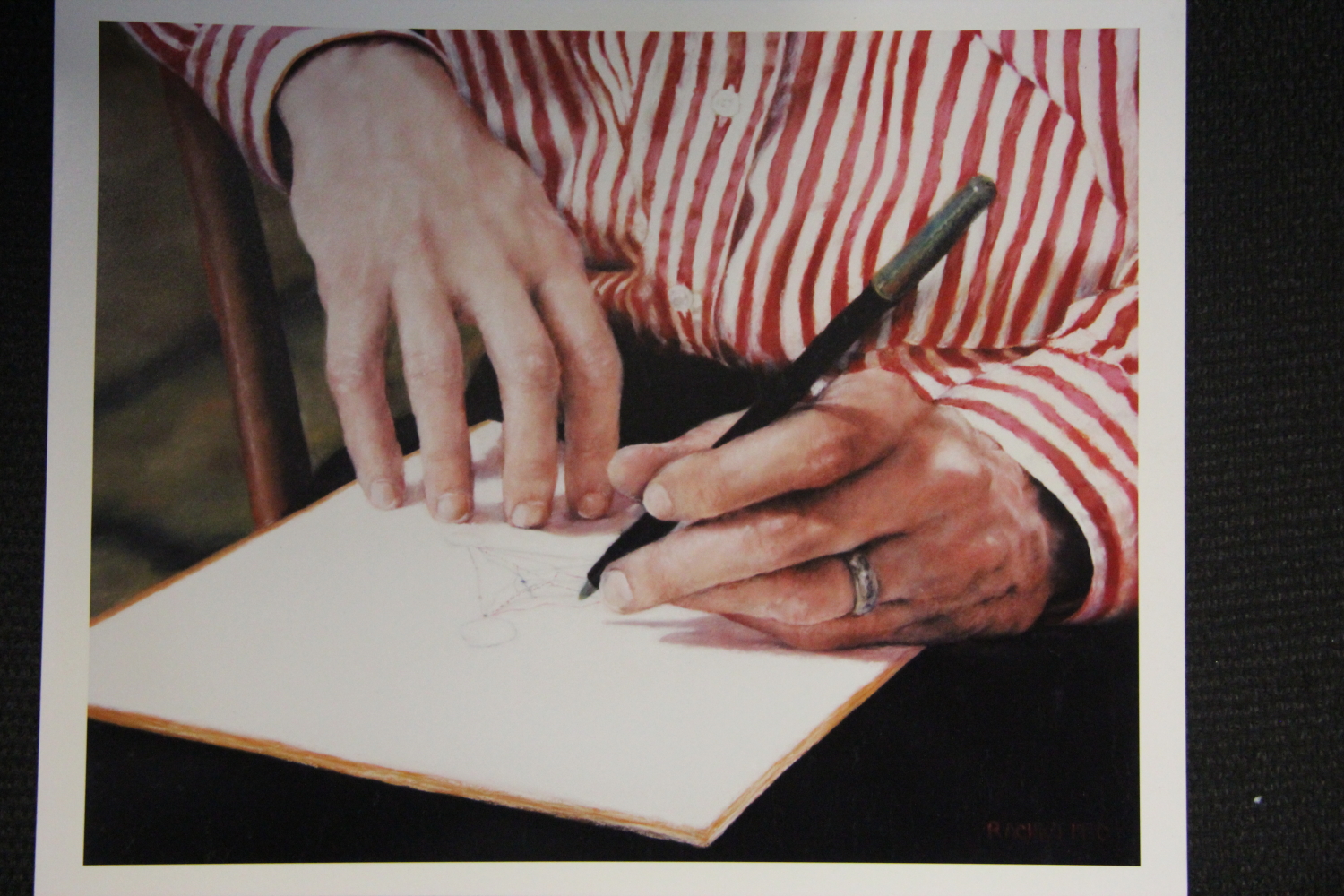
“Bryan’s Ph.D.”, 11″ x 13 1/2″, soft pastel on sandpaper
A: I believe my first sale was “Bryan’s Ph.D.” I made it in 1990 as one of several small paintings created to improve my skills at rendering human hands in pastel. I had recently left the Navy and was building a career as a portrait artist. Bryan, my late husband, was often my model for these studies, not only because it was convenient, but because he had such beautiful hands.
In 1990 Bryan was working on his Ph.D. in economics at the University of Maryland. In this painting he is drawing a diagram that illustrates a theoretical point about “international public goods,” the subject of his research. He was sitting in an old wooden rocking chair in our backyard in Alexandria, VA. I still own the chair and the house. I photographed his hands close-up and then created the painting. I don’t remember which of Bryan’s cameras I used, but it was one that took 35 mm film; perhaps his Nikon F-2. Somewhere I must still have the negative and the original reference photo.
“Bryan’s Ph.D.” is 11″ x 13 1/2″ and it sold for $500 at a monthly juried exhibition at The Art League in Alexandria. I have not seen it since 1990. (Above is a photograph of “Bryan’s Ph.D.” from my portfolio book).
Not long ago the owner contacted me, explaining that she had received the painting as a gift from her now ex-husband. She was selling it because it evoked bitter memories of her divorce. Her phone call was prompted by uncertainty about the painting’s value now. She had a likely buyer and needed to know what price to charge.
I was saddened because I have so many beautiful memories of this particular painting and of an idyllic time in my life with Bryan. He was on a leave of absence from the Pentagon to work on his dissertation, while I was finished with active duty. At last I was a full time artist, busily working in the spare bedroom that we had turned into my first studio.
My conversation with the owner was a reminder that once paintings are let out into the world, they take on associations that have nothing to do with the personal circumstances surrounding their creation. In short, what an artist creates solely out of love, stands a good chance of not being loved or appreciated by others. This is one reason to only sell my work to people I select personally. I ended the telephone conversation hoping that “Bryan’s Ph.D.” fares better in its new home.
Comments are welcome!


 barbararachkoscoloreddust.com