Blog Archives
Q: Many of the world’s cultures have a mask tradition. Is there something special about Bolivian masks that first attracted you to them?

Bolivian Carnival Mask
A: My subject matter emerges directly from my travels. I visited Bolivia in 2017. What I especially liked then – and now – about Bolivian Carnival masks, is that they include additional textures – feathers, fur, costume jewelry, sequins, fabric, etc. that add to their physical presence. Masks from most of the other countries I’ve visited tend to be made of wood and/or paper mache and nothing else. In my view such masks are not as dramatic nor do they offer much expressive potential. They feel dead. They lack a certain “soulfulness.”
Furthermore, textures are challenging to render in soft pastel. For more than three decades I have been striving to improve my pastel techniques. By now I have a vast repertoire from which to select. As was true in my earlier series, with “Bolivianos” an important personal goal is to keep adding to the repertoire.
It takes months to create a pastel painting, which means I need masks that will hold my attention every day over the course of three or four months. I never want to be bored in the studio. If I am bored while making the work, those feelings will be directly transferred and I will make a boring pastel painting, something I hope never to do! The masks need to have a really strong ‘presence.’ Then as I slowly make a pastel painting, one that is exciting to work on from start to finish, I can transform my subject into something surprising and powerful that has never existed before!
Comments are welcome!
Pearls from artists* # 199
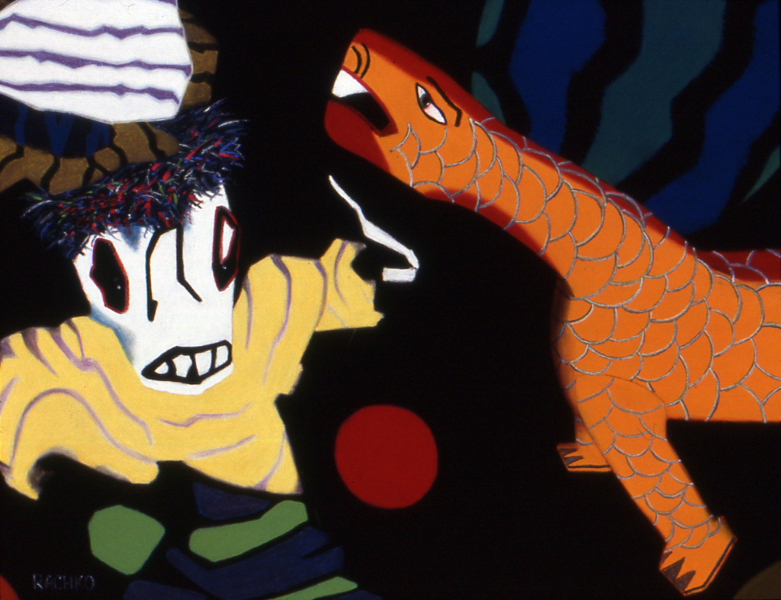
“Trio,” soft pastel on sandpaper, 20″ x 26″
* an ongoing series of quotations – mostly from artists, to artists – that offers wisdom, inspiration, and advice for the sometimes lonely road we are on.
Writers, like all artists, are concerned to represent reality, to create a more absolute and complete reality than reality itself. They must, if they are to accomplish this, assume a moral position, a clearly conceived political, social, and philosophical attitude; in consequence, their beliefs are, of course, going to find their way into their work. What artists believe, however, is of secondary importance, ancillary to the work itself. A writer survives in spite of his beliefs. Lawrence will be read whatever one thinks of his notions on sex. Dante is read in the Soviet Union.
A work of art, on the other hand, has a representative and expressive function. In this representation the author’s ideas, his judgments, the author himself, are engaged with reality.
Alberto Moravia in Writers at Work: The Paris Review Interviews First Series, edited and with an introduction by Malcolm Cowley
Comments are welcome!
Pearls from artists* # 9

Lower Manhattan
* an ongoing series of quotations – mostly from artists, to artists – that offers wisdom, inspiration, and advice for the sometimes lonely road we are on.
ART when really understood is the province of every human being. It is simply a question of doing things, anything, well. It is not an outside, extra thing.
When the artist is alive in any person, whatever his kind of work may be, he becomes an inventive, searching, daring, self-expressing creature. He disturbs, upsets, enlightens, and he opens ways for a better understanding. Where those who are not artists are trying to close the book, he opens it, shows there are still more pages possible.
The world would stagnate without him, and the world would be beautiful with him; for he is interesting to himself and he is interesting to others. He does not have to be a painter or sculptor to be an artist. He can work in any medium. He simply has to find the gain in the work itself, not outside it.
Museums of art will not make a country an art country. But where there is the art spirit there will be precious works to fill museums. Better still, there will be the happiness that is in the making. Art tends toward balance, order, judgment or relative values, the laws of growth, the economy of living – very good things for anyone to be interested in.
Robert Henri, The Art Spirit
Comments are welcome.


 barbararachkoscoloreddust.com