Blog Archives
Pearls from artists* # 632

*an ongoing series of quotations – mostly from artists, to artists – that offers wisdom, inspiration, and advice for the sometimes lonely road we are on.
”The mind once stretched by a new idea, never returns to its original dimensions.” – Ralph Waldo Emerson ((1803 – 1882)
Ralph Waldo Emerson was more prescient than he can ever have realized. It was not until the 1960s that neuroscientist Marian Diamond discovered that exposure to enriched environments increased brain matter, specifically in the brain’s outer cortex. Prior to her landmark research, scientists believed that the brain remained static until it started to decline in older age. Diamond was the first to observe the brain’s neuroplasticity, yet her findings were disputed and rejected for many years. Today she is considered one of the founders of modern neuroscience.
Museums are the ultimate enriched environments, or super-enriched spaces, that are good for body, mind, and soul. Museums are dedicated to arousing our curiosity; engaging us in discovery and learning; and evoking our reflection, wonder, and awe. Artists (and Emerson) have known intuitively what scientists are now proving with rigorous research: aesthetic experiences affect us in extraordinary ways. In short, our brains are wired for art.
The Museum and the Mind by Susan Magsamen in Museum, May/June 2024
Comments are welcome!
Pearls from artists* # 574

Barbara’s Studio
*an ongoing series of quotations – mostly from artists, to artists – that offers wisdom, inspiration, and advice for the sometimes lonely road we are on.
A creative life is risky business. To follow your own course, not patterned on parents, peers, or institutions, involves a delicate balance of tradition and personal freedom, a delicate balance of sticking to your guns and remaining open to change. While on some dimensions living a normal life, you are nevertheless a pioneer, breaking away from the molds and models that inhibit the heart’s desire, creating life as it goes. Being, acting, creating in the moment without props and supports, without security, can be supreme play, and it can also be frightening, the very opposite of play. Stepping into the unknown can lead to delight, poetry, invention, humor, lifetime friendships, self-realization, and occasionally a great creative breakthrough. Stepping into the unknown can also lead to failure, disappointment, rejection, sickness, or death.
Stephen Nachmanovitch in Free Play: Improvisation in Life and Art
Comments are welcome!
Pearls from artists* # 397
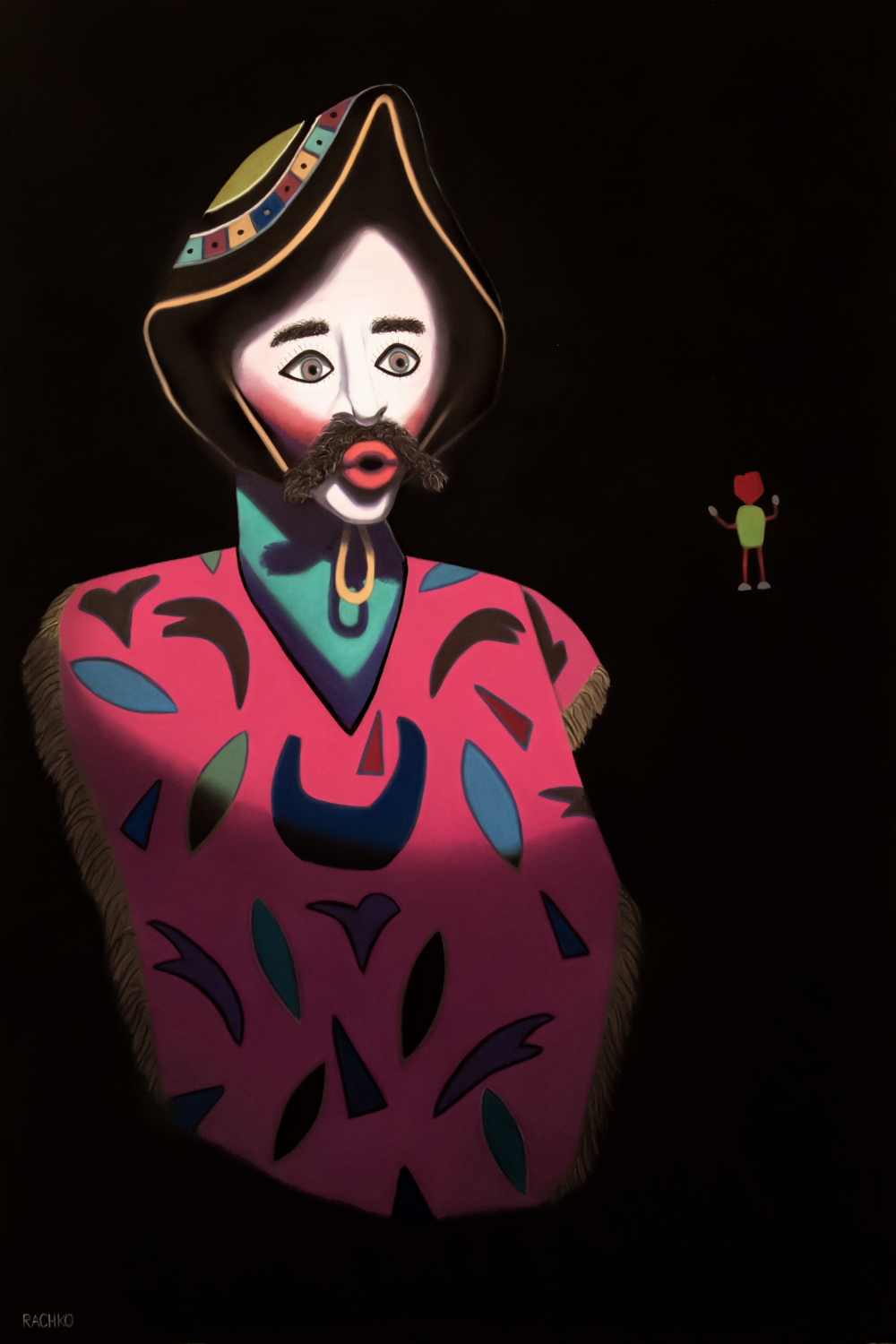
“Prophecy,” soft pastel on sandpaper, 58″ x 38″
* an ongoing series of quotations – mostly from artists, to artists – that offers wisdom, inspiration, and advice for the sometimes lonely road we are on.
Our species requires a greater capacity to see into the Real, not just the outer universe of the senses but also the inner cosmos of the psyche, the normally invisible dimensions. Near the end of his life, Jung said to an English journalist, “The only real danger that exists is man himself… His psyche should be studied because we are the origin of all coming evil.” It is a beautiful statement until the word studied comes up, at which point we are reminded that Jung at bottom was a rationalist: he refused to see that while psychology could talk brilliantly about the soul, it could never descend into its depths. For this we need imagination, madness, prophecy – art. We must understand that creative expression is not a pastime or distraction, but a psychonautic science in its own right. Allowed to operate in freedom, it can illuminate the darkness beyond our field of vision.
J.F. Martel in Reclaiming Art in the Age of Artifice: A Treatise, Critique, and Call to Action
Comments are welcome!


 barbararachkoscoloreddust.com