Blog Archives
Pearls from artists* # 588

Screen shot from “Barbara Rachko: True Grit” Photo: Jennifer Cox
*an ongoing series of quotations – mostly from artists, to artists – that offers wisdom, inspiration, and advice for the sometimes lonely road we are on.
The structure of the hand is not… “just anything;” the fingers have certain characteristic relationships, certain ranges of relative movement, certain kinds of crossing, torquing, jumping, sliding, pressing, releasing movements that guide the music to come out a certain way. Graceful work uses those patterns and instinctively moves through them and out as we find ever-fresh combinations. The shape and size of the human hand brings powerful but subtle laws into every kind of art, craftsmanship, mechanical work, and into our ideas and feelings as well. There is a continuous dialogue between hand and instrument, hand and culture. Artwork is not thought up in consciousness and then, as a separate phase, executed by the hand. The hand surprises us, creates and solves problems on its own. Often enigmas that battle our brains are dealt with easily, unconsciously, by the hand.
Stephen Nachmanovitch in Free Play: Improvisation in Life and Art
Comments are welcome!
Pearls from artists* # 193
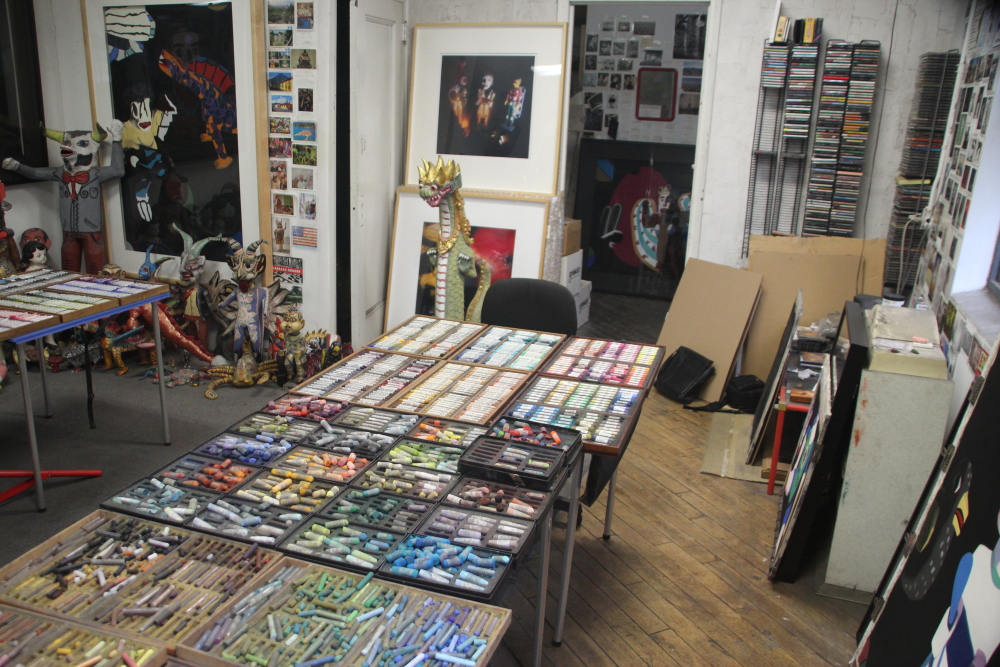
Barbara’s studio
* an ongoing series of quotations – mostly from artists, to artists – that offers wisdom, inspiration, and advice for the sometimes lonely road we are on.
Interviewer: Your work includes a great range of experience, as well as of form. What do you think is the greatest quality a poet can have? Is it formal, or is it a quality of thinking?
Ezra Pound: I don’t know that you can put the needed qualities in hierarchic order, but he must have a continuous curiosity, which of course does not make him a writer. but if he hasn’t got that he will wither. And the question of doing anything about it depends on a persistent energy. A man like Agassiz is never bored, never tired. The transit from the reception of stimuli to the recording, to the correlation, that is what takes the whole energy of a lifetime.
Writers at Work: The Paris Review Interviews Second Series, edited by George Plimpton and introduced by Van Wyck Brooks
Comments are welcome!


 barbararachkoscoloreddust.com