Blog Archives
Q: Why do you have so many pastels?

Barbara’s Studio
A: Our eyes can see infinitely more colors than the relative few that are made into pastels. When I layer pigments onto the sandpaper substrate, I mix new colors directly on the paper. The short answer is, I need lots of pastels so that I can make new colors.
I have been working exclusively with soft pastel for 40 years. Whenever I feel myself getting into a rut in how I select and use my colors, I look around for new materials to try. Fortunately, new brands of soft pastels are continually coming onto the market. There are pastels that are handmade by artists – I love discovering these – and new colors manufactured by well-known pastel companies. Some sticks of soft pastel are oily, some are buttery, some more powdery, some crumble easily, some are more durable. Each one feels distinct in my hand.
Furthermore, they each have unique mixing properties. It’s an under-appreciated science that I stumbled upon (or maybe I invented it, I’m not sure since I cannot know how other pastel painters work). In this respect soft pastel is very different from other paint media. Oil painters, for example, need only a few tubes of paint to make any color in the world. I don’t go in much for studying color theory as a formal discipline. If you want to really understand and learn how to use color, try soft pastel and spend 10,000+ hours (the amount of time Malcolm Gladwell says, in his book, “Outliers,” that it takes to master a skill) figuring it all out for yourself!
Comments are welcome.
Pearls from artists* # 370

Barbara at work on “The Orator.” Photo: Maria Cox
* an ongoing series of quotations – mostly from artists, to artists – that offers wisdom, inspiration, and advice for the sometimes lonely road we are on.
Nothing determines your creative life more than doing it. This is so obvious and fundamental, yet how much energy is wasted on speculation, worry, and doubt without the relief of action. “Success is 90 percent just showing up.” I can’t tell you the number of problems that are solved with this one simple principle, because when you start, it leads to something, anything. And when you have something tangible in front of you, then you can react to it and amend it. And that will lead to something else. In the book, In Search of Excellence by Tom Peters and Robert Waterman Jr., which looked at companies in America that excelled at what they did, one of the guiding principles was, “Do it, mend it, fix it.”
Ian Roberts in Creative Authenticity: 16 Principles to Clarify and Deepen Your Artistic Vision
Comments are welcome!
Pearls from artists* # 148
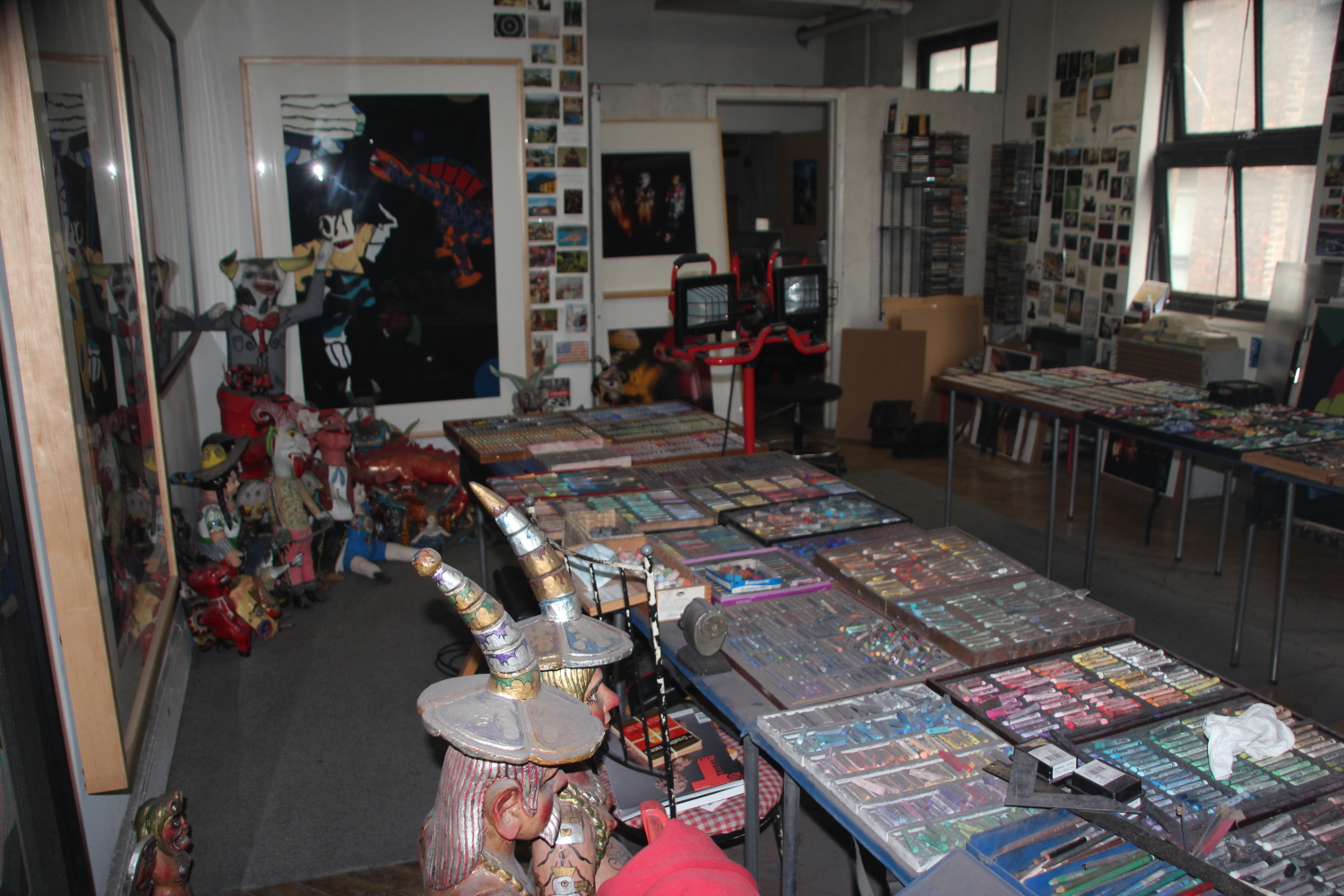
Barbara’s studio
* an ongoing series of quotations – mostly from artists, to artists – that offers wisdom, inspiration, and advice for the sometimes lonely road we are on.
I want Bob Iger, the head of Disney, to invest in my ideas. In fact … one of my ideas is … I love Walt Disney … I feel Disney should have an art fund that completely supports all of the arts. And I feel that there should be a responsibility, recruiters, constantly looking for new thinkers and connecting them directly to companies that already work. Why does the person who has the most genius idea or cultural understanding or can create the best art have to figure out how to become a businessman in order to become successful at expressing himself? I think it’s important for anyone that’s in power to empower.
Kanye West in Choice Quotes from Kanye’s Address at the School of the Art Institute of Chicago, in Hyperallergic, May 12, 2015
Comments are welcome!


 barbararachkoscoloreddust.com