Blog Archives
Q: What would you be if you were not an artist?
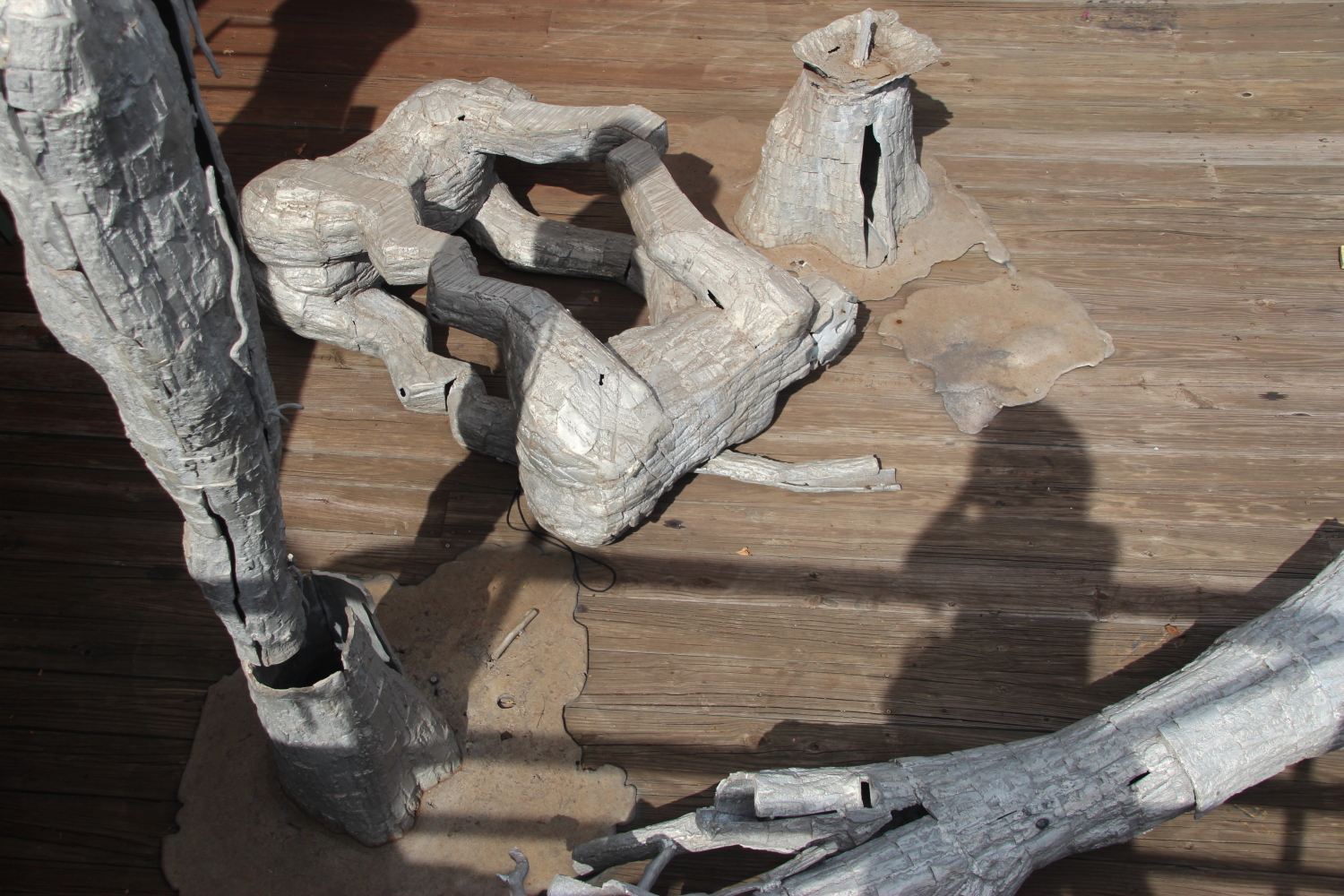
Self-portrait on a Hudson River barge
A: I honestly have no idea, but whatever it might be, there is a good chance that I’d be bored! In my younger days boredom was a strong motivator. I left the active duty Navy out of boredom. I couldn’t bear not being intellectually challenged (most of my jobs consisted of paper-pushing), not using my flying skills (at 27 I was a licensed commercial pilot and Boeing 727 flight engineer), and not developing my artistic talent. In what surely must be a first, by spending a lot of time and money training me for jobs I hated, the Navy turned me into a hard-working artist! And once I left the Navy there was no plan B. There was no time to waste. It was “full speed ahead.”
Art is a calling. You do not need to be told this if you are among those who are called. It’s all about “the work,” that all-consuming focus of an artist’s life. If a particular activity doesn’t make you a better artist, you avoid it. You work hard to nourish and protect your gifts. As artists we invent our own tasks, learn whatever we need in order to progress, and complete projects in our own time. It is life lived at its freest.
My art-making has led me to fascinating places: Mexico, Guatemala, Brazil, Argentina, Uruguay, France, England, Italy, Bali, Java and more; and to in-depth studies of intriguing subjects: drawing, color, composition, art and art history, the art business, film and film history, photography, mythology, literature, music, jazz history, and archaeology, particularly that of ancient Mesoamerica (the Olmec, Zapotec, Mixtec, Aztec, Maya, etc.). And this rich mixture continually grows! For anyone wanting to spend their time on earth learning and meeting new challenges, there is no better life than that of an artist.
I SO agree with this exchange that I read years ago between between Trisha Brown and Mikhail Baryshnikov in the New York Times. I wrote it on a piece of paper and taped it to my studio wall:
Trisha: How do you think we keep going? Are we obsessed?
Mikhail: We do it because there’s nothing better. I’m serious. Because there is nothing more exciting than that. Life is so boring, that’s why we are driven to the mystery of creation.
Comments are welcome.
Pearls from artists* # 9

Lower Manhattan
* an ongoing series of quotations – mostly from artists, to artists – that offers wisdom, inspiration, and advice for the sometimes lonely road we are on.
ART when really understood is the province of every human being. It is simply a question of doing things, anything, well. It is not an outside, extra thing.
When the artist is alive in any person, whatever his kind of work may be, he becomes an inventive, searching, daring, self-expressing creature. He disturbs, upsets, enlightens, and he opens ways for a better understanding. Where those who are not artists are trying to close the book, he opens it, shows there are still more pages possible.
The world would stagnate without him, and the world would be beautiful with him; for he is interesting to himself and he is interesting to others. He does not have to be a painter or sculptor to be an artist. He can work in any medium. He simply has to find the gain in the work itself, not outside it.
Museums of art will not make a country an art country. But where there is the art spirit there will be precious works to fill museums. Better still, there will be the happiness that is in the making. Art tends toward balance, order, judgment or relative values, the laws of growth, the economy of living – very good things for anyone to be interested in.
Robert Henri, The Art Spirit
Comments are welcome.
Pearls from artists* # 6
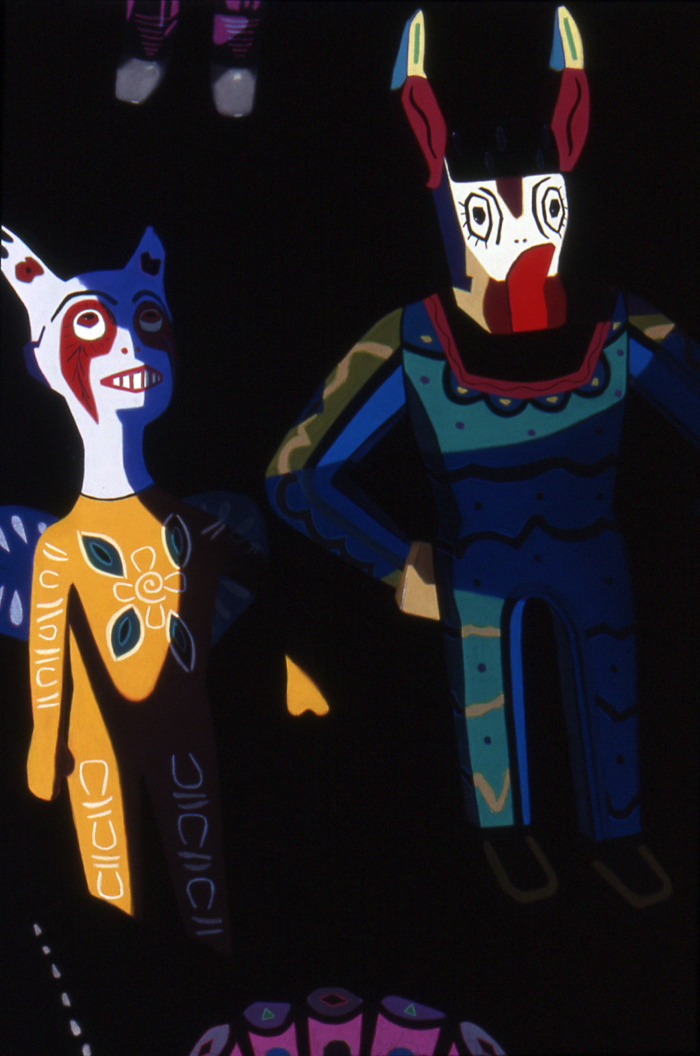
“Quartet,” soft pastel on sandpaper, 58″ x 38″ image, 70″ x 50″ framed
* an ongoing series of quotations – mostly from artists, to artists – that offers wisdom, inspiration, and advice for the sometimes lonely road we are on.
After we have responded to a work of art, we leave it, carrying in our consciousness something which we didn’t have before. This something amounts to more than our memory of the incident represented, and also more than our memory of the shapes and colours and spaces which the artist used and arranged. What we take away with us – on the most profound level – is the memory of the artist’s way of looking at the world. The representation of a recognizable incident (an incident here can simply mean a tree or a head) offers us the chance of relating the artist’s way of looking to our own. The forms he uses are the means by which he expresses his way of looking. The truth of this is confirmed by the fact that we can often recall the experience of a work, having forgotten both its precise subject and its precise formal arrangement.
Yet why should an artist’s way of looking at the world have any meaning for us? Because, I believe, it increases our awareness of our own potentiality. Not of course our awareness of our potentiality as artists ourselves. But a way of looking at the world implies a certain relationship with the world, and every relationship implies action. The kind of actions implied vary a great deal. A classical Greek sculpture increases our awareness of our own potential physical dignity; a Rembrandt of our potential moral courage; a Matisse of our potential sensual awareness. Yet each of these examples is too personal and too narrow to contain the whole truth of the matter. A work can, to some extent, increase an awareness of different potentialities in different people. The important point is that a valid work of art promises in some way or another the possibility of an increase, an improvement. Nor need the work be optimistic to achieve this; indeed, its subject may be tragic. For it is not the subject matter that makes the promise, it is the artist’s way of viewing his subject. Goya’s way of looking at a massacre amounts to the contention that we ought to be able to do without massacres.
John Berger, Selected Essays
Comments are welcome.
Q: You seem very disciplined. Do you ever have a day when you just can’t get excited about working?
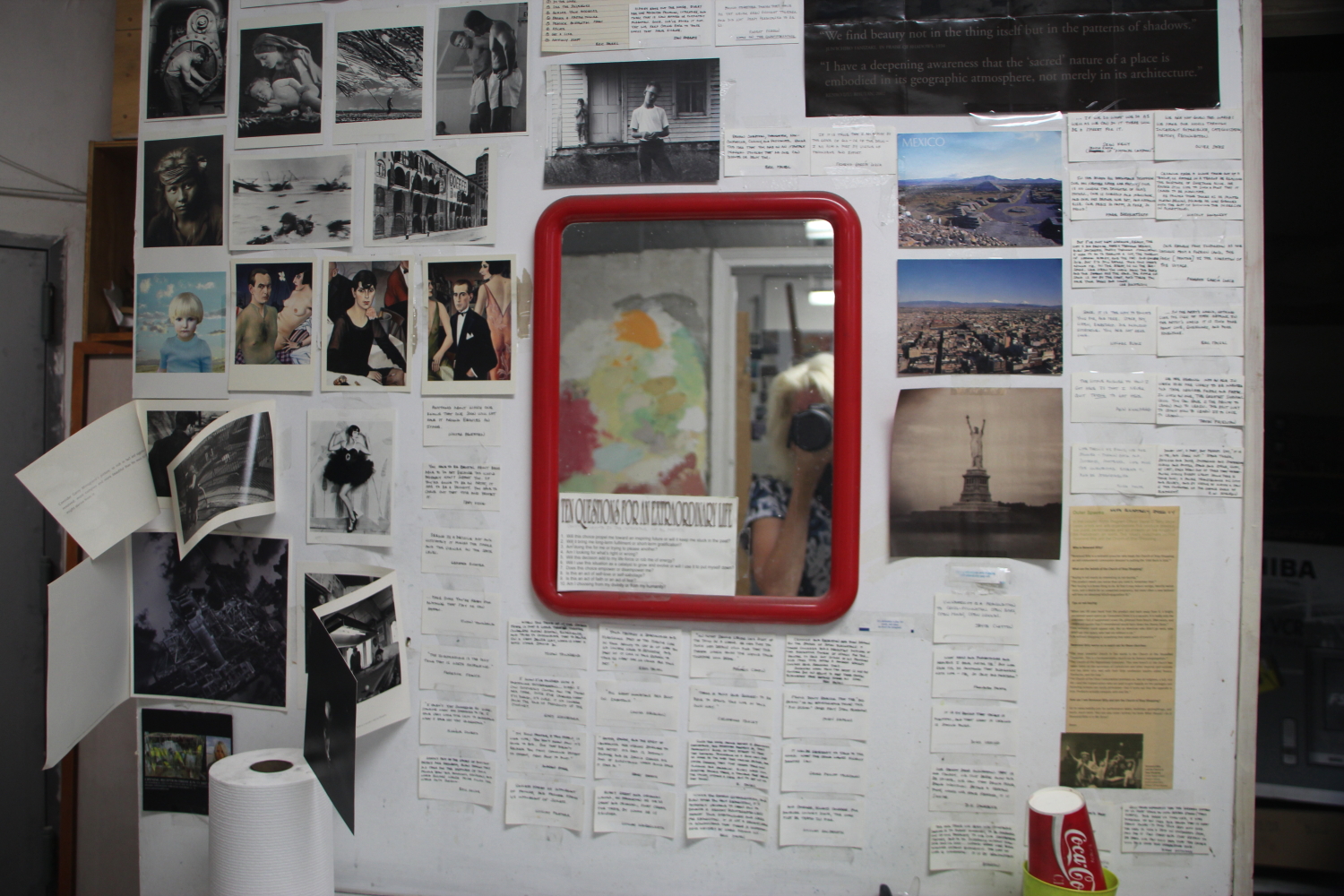
Studio wall with self-portrait
A: That happens occassionaly, but I still go to the studio to work. You know the expression, “99% of life is just showing up”? Well, of course I have to show up at my studio to accomplish anything so I keep fairly regular studio hours – 7 to 8 hours a day, 4 or 5 days a week. In the evening I spend another hour or two answering email, sending out applications, organizing jpegs, etc. When you are an artist there is always work to do and for some of it, no one else can do it. That’s because no one else knows the work from the inside the way the maker does. I like what Twyla Tharp says in her book, “The Creative Habit.” In order to progress an artist needs good work habits that become a daily routine. And Chuck Close likes to say, “Inspiration is for amateurs,” meaning a professional works whether she’s in the mood or not. I completely agree so I keep working and slowly moving ahead.
As Tchaikovsky wrote in a letter to a friend:
We must always work, and a self-respecting artist must not fold his hands on the pretext that he is not in the mood. If we wait for the mood, without endeavoring to meet it halfway, we easily become indolent and apathetic. We must be patient, and believe that inspiration will come to those who can master their disinclination. A few days ago I told you I was working every day without any real inspiration. Had I given way to my disinclination, undoubtedly I should have drifted into a long period of idleness. But my patience and faith did not fail me, and today I felt that inexplicable glow of inspiration of which I told you; thanks to which I know beforehand that whatever I write today will have power to make an impression, and to touch the hearts of those who hear it.
Quoted in Eric Maisel’s A Life in the Arts.
Comments are welcome.
Pearls from artists* # 5
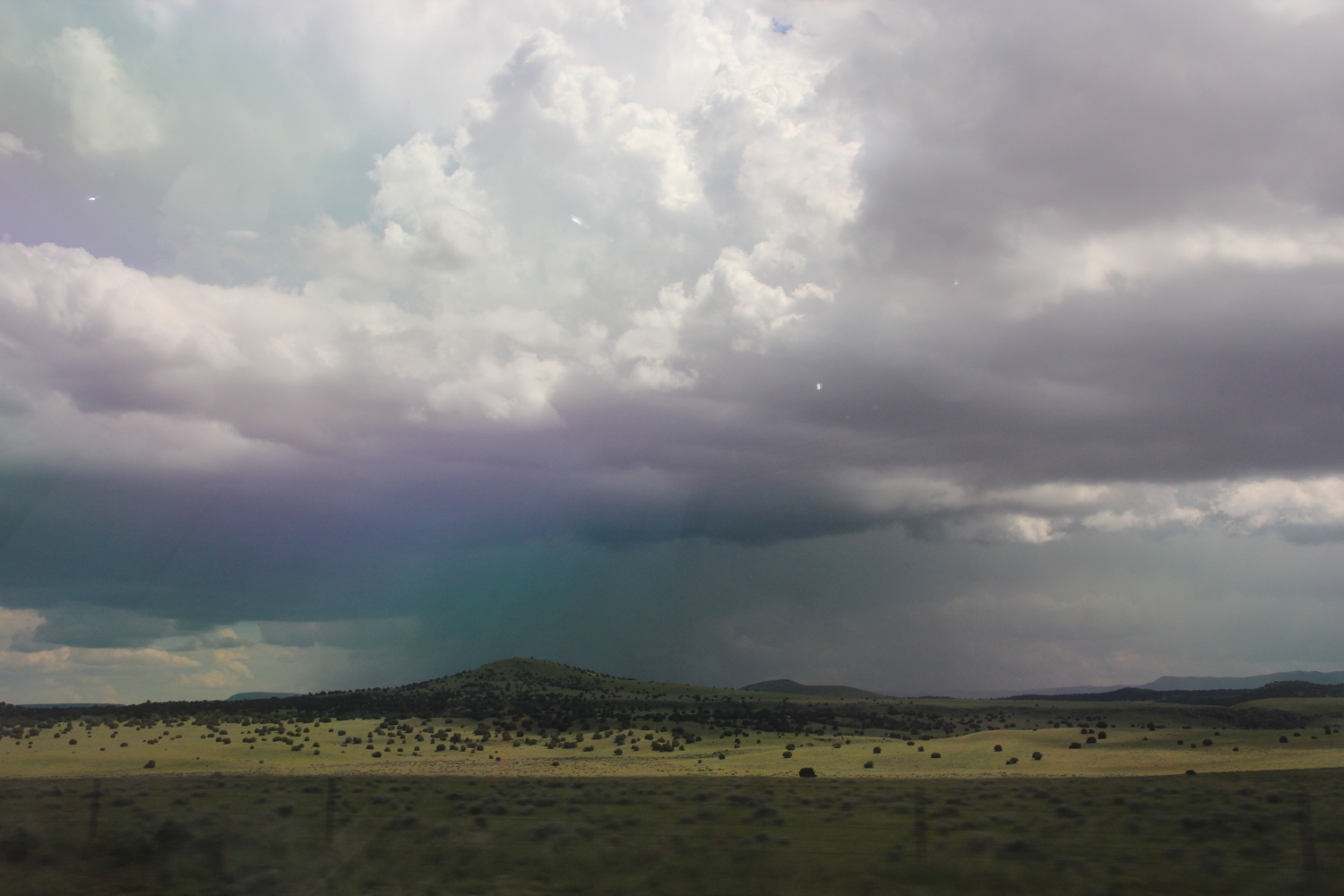
Arizona storm
* an ongoing series of quotations – mostly from artists, to artists – that offers wisdom, inspiration, and advice for the sometimes lonely road we are on.
Flying over the desert yesterday, I found myself lifted out of my preoccupations by noticing suddenly that everything was curved. Seen whole from the air, circumscribed by its global horizon, the earth confronted me bluntly as a context all its own, echoing that grand sweep. I had the startling impression that I was looking at something intelligent. Every delicate pulsation of color was met, matched, challenged, repulsed, embraced by another, none out of proportion, each at its own unique and proper part of the whole. The straight lines with which human beings have marked the land are impositions of a different intelligence, abstract in this area of the natural. Looking down at these facts, I began to see my life as somewhere between these two orders of the natural and the abstract, belonging entirely neither to one nor to the other.
In my work as an artist I m accustomed to sustaining such tensions: A familiar position between my senses, which are natural, and my intuition of an order they both mask and illuminate. When I draw a straight line or conceive of an arrangement of tangible elements all my own, I inevitably impose my own order on matter. I actualize this order, rendering it accessible to my senses. It is not so accessible until actualized.
An eye for this order is crucial for an artist. I notice that as I live from day to day, observing and feeling what goes on both inside and outside myself, certain aspects of what is happening adhere to me, as if magnetized by a center of psychic gravity. I have learned to trust this center, to rely on its acuity and to go along with its choices although the center itself remains mysterious to me. I sometimes feel as if I recognize my own experience. It is a feeling akin to that of unexpectedly meeting a friend in a strange place, of being at once startled and satisfied – startled to find outside myself what feels native to me, satisfied to be so met. It is exhilarating.
I have found that this process of selection, over which I have virtually no control, isolates those aspects of my experience that are most essential to me in my work because they echo my own attunement to what life presents me. It is as if there are external equivalents for truths which I already in some mysterious way know. In order to catch these equivalents, I have to stay “turned on” all the time, to keep my receptivity to what is around me totally open. Preconception is fatal to this process. Vulnerability is implicit in it; pain, inevitable.
Anne Truitt, Daybook: The Journal of an Artist
Comments are welcome.
Pearls from artists* # 2
Tucson, AZ
* an ongoing series of quotations – mostly from artists, to artists – that offers wisdom, inspiration, and advice for the sometimes lonely road we are on.
Ms. Dillard is speaking about writing here, but her comments apply to all the arts.
Push it. Examine all things intensely and relentlessly. Probe and search each object in a piece of art. Do not leave it, do not course over it, as if it were understood, but instead follow it down until you see it in the mystery of its own specificity and strength. Giacometti’s drawings and paintings show his bewilderment and persistence. If he had not acknowledged his bewilderment, he would not have persisted. A twentieth-century master of drawing, Rico Lebrun, taught that “the draftsman must aggress; only by persistent assault will the live image capitulate and give up its secret to an unrelenting line.” Who but an artist fierce to know – not fierce to seem to know – would suppose that a live image possessed a secret? The artist is willing to give all his or her strength and life to probing with blunt instruments those same secrets no one can describe in any way but with those instruments’ faint tracks.
Admire the world for never ending on you – as you would admire an opponent without taking your eyes from him, or walking away.
One of the few things I know about writing is this: spend it all, shoot it, play it, lose it, all, right away, every time. Do not hoard what seems good for a later place in the book, or for another book; give it, give it all, give it now. The impulse to save something good for a better place later is the signal to spend it now. Something else will arise for later, something better. These things fall from behind, from beneath, like well water. Similarly, the impulse to keep to yourself what you have learned is not only shameful, it is destructive. Anything you do not give freely and abundantly becomes lost to you. You open your safe and find ashes.
After Michelangelo died, someone found in his studio a piece of paper on which he had written a note to an apprentice, in the handwriting of his old age: “Draw, Antonio, draw, Antonio, and do not waste time.”
Annie Dillard, The Writing Life
Comments are welcome.


 barbararachkoscoloreddust.com