Blog Archives
Pearls from artists* # 577

In the Studio
*an ongoing series of quotations – mostly from artists, to artists – that offers wisdom, inspiration, and advice for the sometimes lonely road we are on.
What is the popular conception of the artist? Gather a thousand descriptions and the resulting composite is the portrait of a moron: he is held to be childish, irresponsible, and ignorant or stupid in everyday affairs.
The picture does not necessarily involve censure or unkindness. These definitions are attributed to the artist’s preoccupation with his particular kind of fantasy and to the unworldly nature of the fantastic itself. The bantering tolerance granted to the absentminded professor is extended to the artist. Biographers contrast the artless news of his judgments with the high attainment of his art, and while his naïveté or rascality are gossiped about, they are viewed as signs of Simplicity and Inspiration, which are the Handmaidens of Art. And if the artist is inarticulate and lacking in the usual repositories of fact and information, how fortunate, it is said, that nature has contrived to divert him from all worldly distractions so he may be single-minded in regards to his special office.
Mark Rothko in The Artist’s Reality: Philosophies of Art, edited and with an introduction by Christopher Rothko
Comments are welcome!
Pearls from artists* # 166
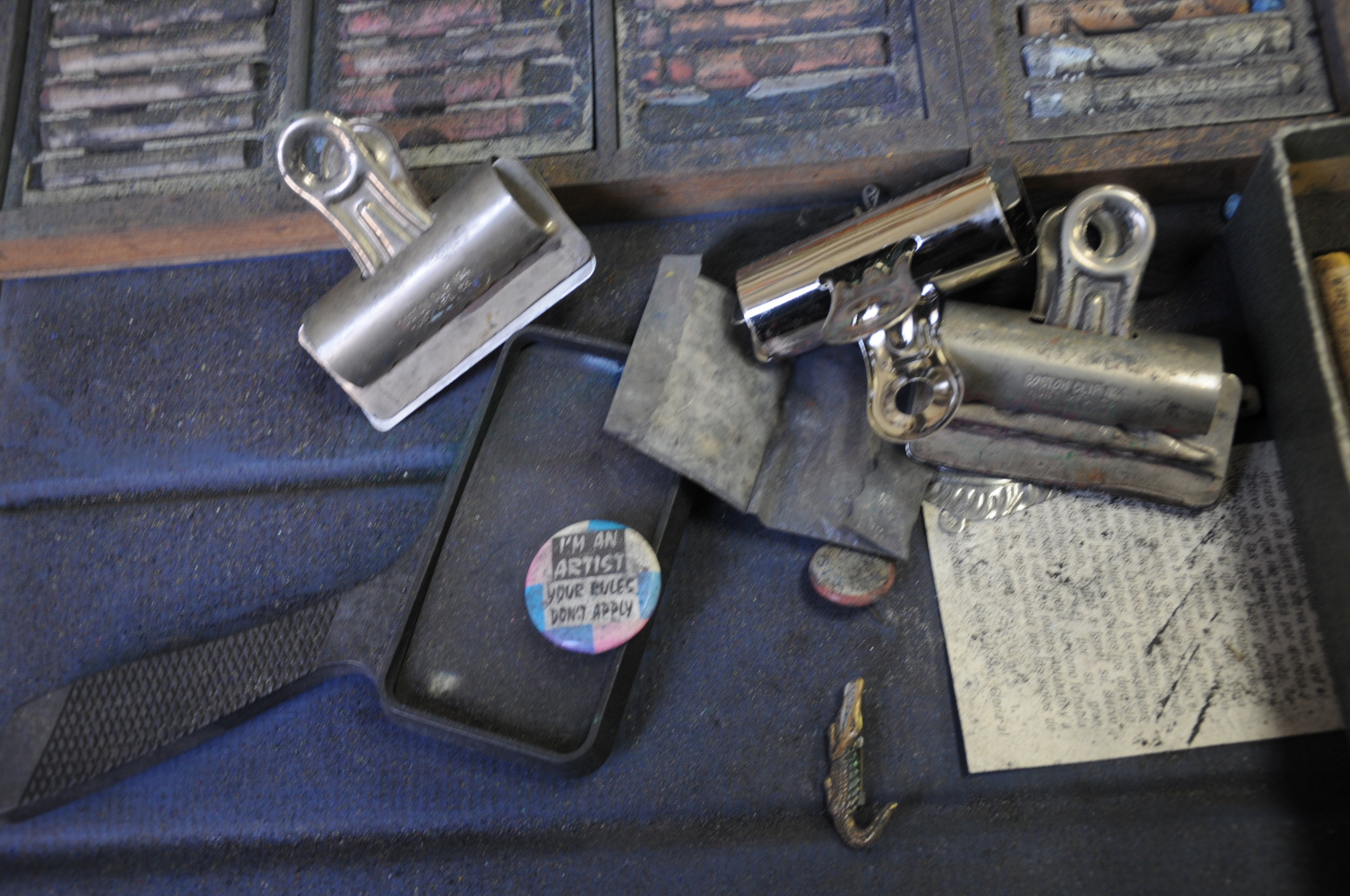
Barbara’s studio
* an ongoing series of quotations – mostly from artists, to artists – that offers wisdom, inspiration, and advice for the sometimes lonely road we are on.
An interesting discussion at Leblond’s about geniuses and outstanding men. Dimier thinks that great passions are the source of all genius! I think that it is imagination alone or, what amounts to the same thing, a delicacy of the senses that makes some men see where others are blind, or rather, makes them see in a different way. I said that even great passions joined to imagination usually lead to a disordered mind. Dufresne made a very true remark. He said that fundamentally, what made a man outstanding was his absolutely personal way of seeing things. He extended this to include great captains, etc. and, in fact, great minds of every kind. Hence, no rules whatsoever for the greatest minds; rules are only for people who merely have talent, which can be acquired. The proof is that genius cannot be transmitted.
The Journal of Eugene Delacroix edited by Hubert Wellington
Comments are welcome!
Q: Were there any other artists in your family?

“The Ancestors,” soft pastel on sandpaper, 58″ x 38,” 2013
A: Unfortunately, I have not been able to reconstruct my family tree further back than two generations. So as far as I can tell, I am the first artist of any sort, whether musician, actor, dancer, writer, etc. in my family.
Both sets of grandparents emigrated to the United States from Europe. On my mother’s side my Polish grandparents died by the time my mother was 16, years before I was born.
My paternal grandparents both lived into their 90s. My father’s mother spoke Czech, but since I did not, it was difficult to communicate. I never heard any stories about the family she left behind. My grandfather spoke English, but I don’t remember him ever talking about his childhood or telling stories about his former life. My most vivid memories of my grandfather are seeing him in the living room watching Westerns on an old-fashioned television.
Sometimes I am envious of artists who had parents, siblings, or extended family who were artists. How I would have loved to grow up with a family member who was an artist and a role model!
Comments are welcome!


 barbararachkoscoloreddust.com