Blog Archives
Pearls from artists* # 672

*an ongoing series of quotations – mostly from artists, to artists – that offers wisdom, inspiration, and advice for the sometimes lonely road we are on.
Let me now, therefore, turn directly to the question of the European individual and, for a start, cite the observations of the Swiss psychologist, Carl G. Jung, throughout whose works the term “individuation” is used to indicate the psychological process of achieving individual wholeness. Jung makes the point that in the living of our lives every one is us is required by his society to play some specific social role. In order to function in the world we are all continually enacting parts Jung calls personnae, from the Latin persona, meaning “mask, false face,” the mask worn by an actor on the Roman stage, through which he “sounded” (per-sonare, “to sound through). One has to appear in some mask or other if one is to function socially at all; and even those who choose to reject such masks can only put on others, representing rejection, “Hell no!” or something of this sort. Many of the masks are playful, opportunistic, superficial; others, however, go deep, very deep, much deeper than we know. Just as every body consists of a head, two arms, a trunk, two legs, etc., so does every living person consist, among other features, of a personality, a deeply imprinted persona through which he is made known no less to himself than to others, and without which he would not be. It is silly, therefore, to say, for example, “Let’s take off our masks and be natural!” And yet – there are masks and masks. There are the masks of youth, the masks of age, the masks of the various social roles, and the masks also that we project upon others spontaneously, which obscure them, and to which we then react.
Joseph Campbell in Myths to Live By
Comments are welcome!
Pearls from artists* # 625

*an ongoing series of quotations – mostly from artists, to artists – that offers wisdom, inspiration, and advice for the sometimes lonely road we are on.
The artist not equipped with the necessary arrogance will be repeatedly sidetracked or subverted by the agendas of others. He will lack a sufficient sense of purpose, will frequently stall and block, and will bring a nagging passivity to his art career. His resolve to do great art may remain a potent idea only, a kind of unexplained force in his body. He is likely to accomplish much less than he otherwise might, support others rather than find support for himself, attempt the small rather than the large, and rebound less well from rejection.
The self-centered artist, on the other hand, is challenged to remember that he is neither god nor Superman, but a human being with human limitations. He hasn’t the time to turn every idea into a book, the ability to top each work with a greater one, the energy to toil ceaselessly at his art, nor the right to trample others as he pursues his goals. If he mistakes or oversteps these limits he will put himself in harm’s way and may find himself struck down by his own obsessional energy, by burnout, by depression, by self-abuse, or by the angry complaints of those whose rights he has cavalierly trampled.
Eric Maisel in A Life in the Arts: Practical Guidance and Inspiration for Creative and Performing Artists
Comments are welcome!
Q: How do you deal with rejection?
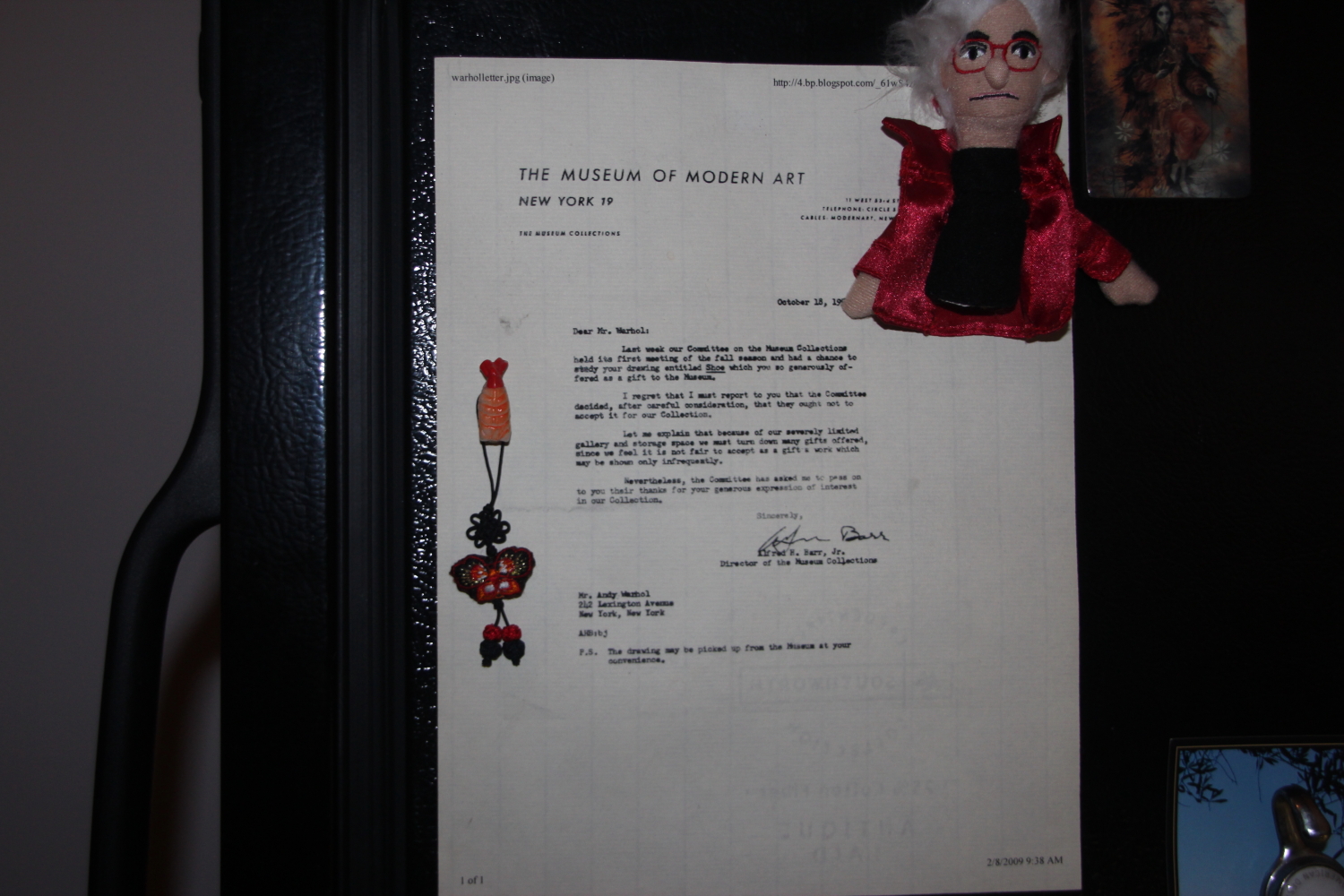
Letter from MoMA to Andy Warhol
A: I take the long view and try to remember that rejection is an occupational hazard that has plagued every artist throughout history. Even one of the most famous – Andy Warhol – had to endure innumerable rejections before his work was finally appreciated. So why should it be any different for my peers and me? Tacked to my refrigerator is a copy of a now classic letter, dated October 18, 1956. It reads:
Dear Mr. Warhol,
Last week our Committee on the Museum Collections held its first meeting of the fall session and had a chance to study your drawing entitled “Shoe,” which you so generously offered as a gift to the Museum.
I regret that I must report to you that the Committee decided, after careful consideration, that they ought not to accept it for our Collections.
Let me explain that because of our severely limited gallery and storage space we must turn down many gifts offered, since we feel it is not fair to accept as a gift a work which may be shown only infrequently.
Nevertheless, the Committee has asked me to pass on to you their thanks for your generous expression in our Collection.
Sincerely,
Alfred H. Barr, Jr.
Director of the Museum Collections
P.S. The drawing may be picked up from the Museum at your convenience.
I especially chuckle at the P.S. as, surely, here we have one of the biggest blunders by a museum professional in history!
Comments are welcome!
Pearls from artists* # 574

Barbara’s Studio
*an ongoing series of quotations – mostly from artists, to artists – that offers wisdom, inspiration, and advice for the sometimes lonely road we are on.
A creative life is risky business. To follow your own course, not patterned on parents, peers, or institutions, involves a delicate balance of tradition and personal freedom, a delicate balance of sticking to your guns and remaining open to change. While on some dimensions living a normal life, you are nevertheless a pioneer, breaking away from the molds and models that inhibit the heart’s desire, creating life as it goes. Being, acting, creating in the moment without props and supports, without security, can be supreme play, and it can also be frightening, the very opposite of play. Stepping into the unknown can lead to delight, poetry, invention, humor, lifetime friendships, self-realization, and occasionally a great creative breakthrough. Stepping into the unknown can also lead to failure, disappointment, rejection, sickness, or death.
Stephen Nachmanovitch in Free Play: Improvisation in Life and Art
Comments are welcome!


 barbararachkoscoloreddust.com