Blog Archives
Pearls from artists* # 551

Barbara’s Studio
*an ongoing series of quotations – mostly from artists, to artists – that offers wisdom, inspiration, and advice for the sometimes lonely road we are on.
A creative process is a philosophical search, shaped by matters of practice and procedure that extend from the first touch of the artist’s pencil, brush, or chisel to the final decisions about what constitutes completeness.
Stylistic particularism – the decision as to what kind of abstract or representational artist you’re going to be – shapes, deepens, and extends the artist’s imaginative powers. Most artists who work for many years see their style evolve, sometimes dramatically. In the 1930s and 1940s Giacometti, who had first been admired for Surrealist sculptures in which representational elements are set in essentially abstract structures, found himself increasingly focused on the direct observation of the human figure. What by the mid-1940s could look like a wholesale transformation of his artistic language was the result of individual decisions all of which, during Giacometti’s career of nearly five decades, interlocked. They reinforced one another. They added up.
Between Abstraction and Representation by Jed Perl in The New York Review of Books, November 24, 2022
Comments are welcome!
Pearls from artists* # 517
*an ongoing series of quotations – mostly from artists, to artists – that offers wisdom, inspiration, and advice for the sometimes lonely road we are on
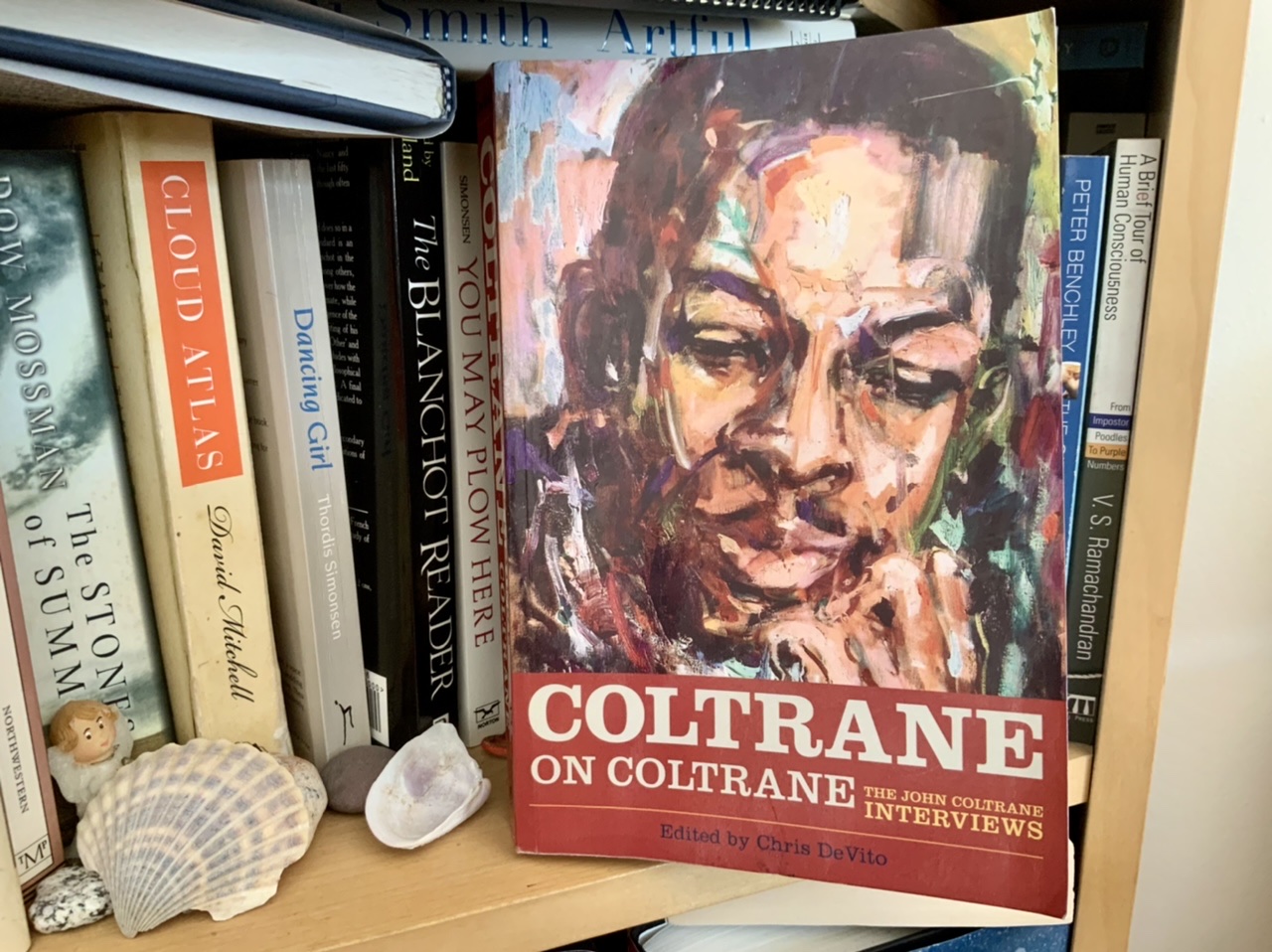
You know. Don, I was reading a book on the life of Van Gogh today. and I had to pause and think of that wonderful and persistent force – the creative urge. The creative urge was in this man who found himself so at odds with the world he lived in, and in spite of all the adversity, frustrations, rejections, and so forth – beautiful and living art came forth abundantly… If only he could be here today. Truth is indestructible. It seems history shows (and it’s the same way today) that the innovator is more often than not met with some degree of condemnation; usually according to the degree of his departure from the prevailing modes of expression or what have you. Change is always so hard to accept. We also see that these innovators always seek to revitalize, extend and reconstruct the status quo in their given fields, wherever it is needed. Quite often they are the rejects, outcasts, sub-citizens, etc. of the very societies to which they bring so much sustenance. Often they are people who endure great personal tragedy in their lives. Whatever the case, whether accepted or rejected, rich or poor, they are forever guided by that great and eternal constant – the creative urge. Let us cherish it and give all praise to God.
John Coltrane in Coltrane on Coltrane: The John Coltrane Interviews
Comments are welcome!
Pearls from artists* # 29
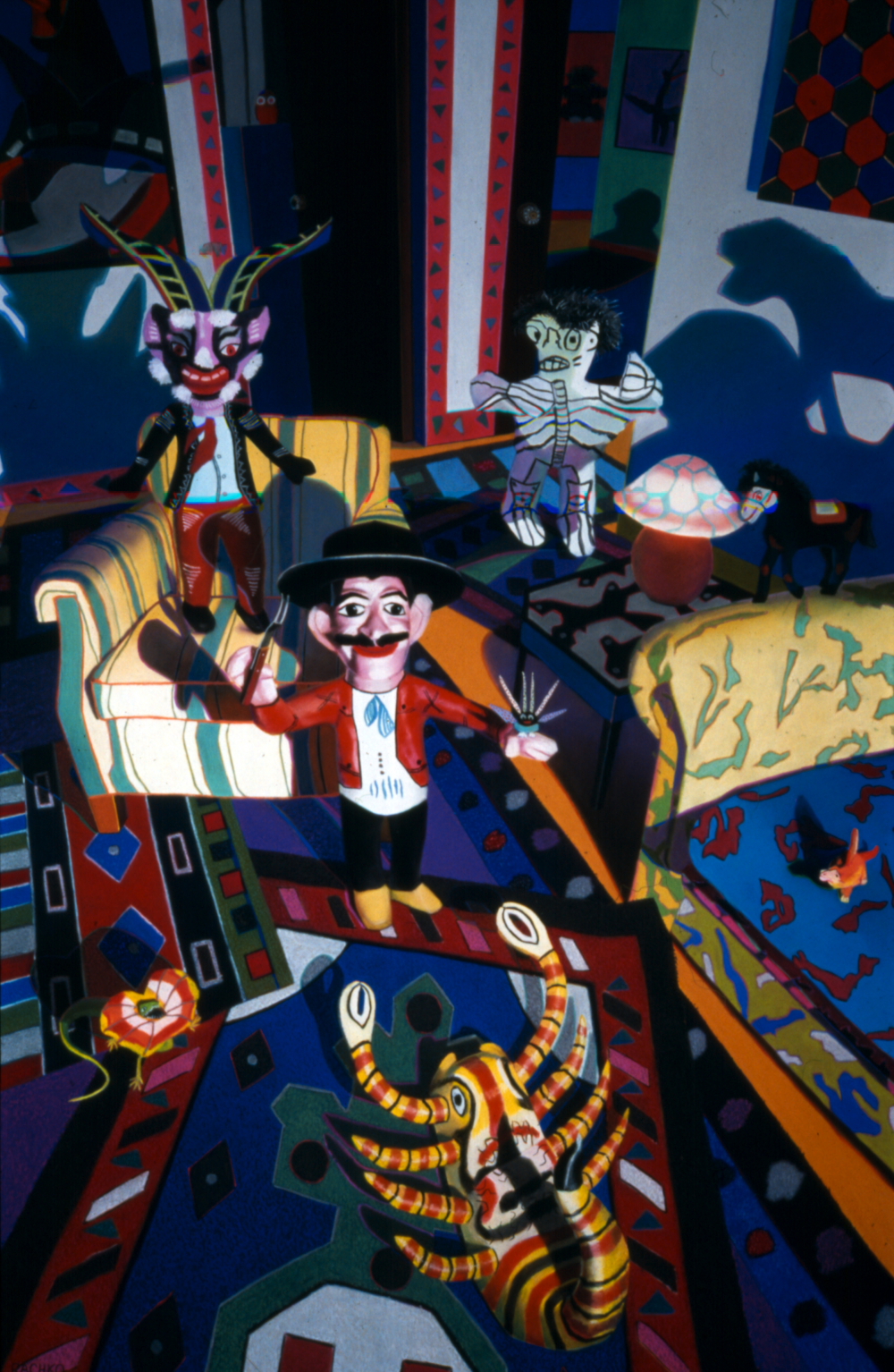
“He Just Stood There Grinning,” soft pastel on sandpaper, 58″ x 38″
* an ongoing series of quotations – mostly from artists, to artists – that offers wisdom, inspiration, and advice for the sometimes lonely road we are on.
And all the spaces of our past moments of solitude, the spaces in which we have suffered from our solitude, enjoyed, desired, and compromised solitude, remain indelible within us, and precisely because the human being wants them to remain so. He knows instinctively that this space identified with his solitude is creative; that even when it is forever expunged with the present, when, henceforth, it is alien to all the promises of the future, even when we no longer have a garret, when the attic is lost and gone, there remains the fact that we once loved a garret, once lived in an attic. We return to them in our night dreams. These retreats have the value of a shell. And when we reach the very end, the labyrinths of sleep, when we attain to the regions of deep slumber, we may perhaps experience a type of repose that is pre-human; pre-human, in this case, approaching the immemorial. But in the daydream itself, the recollection of moments of confined, simple, shut-in space are experiences of heartwarming space, of a space that does not seek to become extended, but would like above all to be possessed. In the past, the attic may have seemed too small, it may have seemed cold in winter and hot in summer. Now, however, in memory recaptured through daydreams, it is hard to say through what syncretism the attic is at once small and large, warm and cool, always comforting.
Gaston Bachelard in The Poetics of Space
Comments are welcome!


 barbararachkoscoloreddust.com