Blog Archives
Q: Over your 40-year career as an artist, you have managed to keep presentation, technical, subject matter, conceptual consistencies in your art practice and work. How do you manage to filter out inspirations that might be luring at that moment but do not support your art practice? For example, you master pastel works. There must have been moments when you might have been inspired to make oil works. How do you keep such inspirations aside. (Question from Vedica Art Studios and Gallery)

A: About thirty-five years ago, when my pastel paintings were becoming larger—around 60” x 40”—I had to choose between transitioning to oil on canvas or continuing with pastel. Framing was the main concern. I wasn’t certain large pastels could be framed, and even if they could, the cost might be prohibitive. However, I had already fallen in love with pastel and knew no other medium could offer such vibrant colors or velvety textures. Determined, I resolved the framing issue (art-making is fundamentally problem-solving), committed myself fully to soft pastel, and have continued inventing and refining techniques ever since.
My goal from the beginning has always been improvement as an artist. If an activity doesn’t contribute to my growth—as a person or as an artist—I typically don’t pursue it. Time and energy are finite resources, so I try to use them wisely.
Comments are welcome!
Pearls from artists* # 323
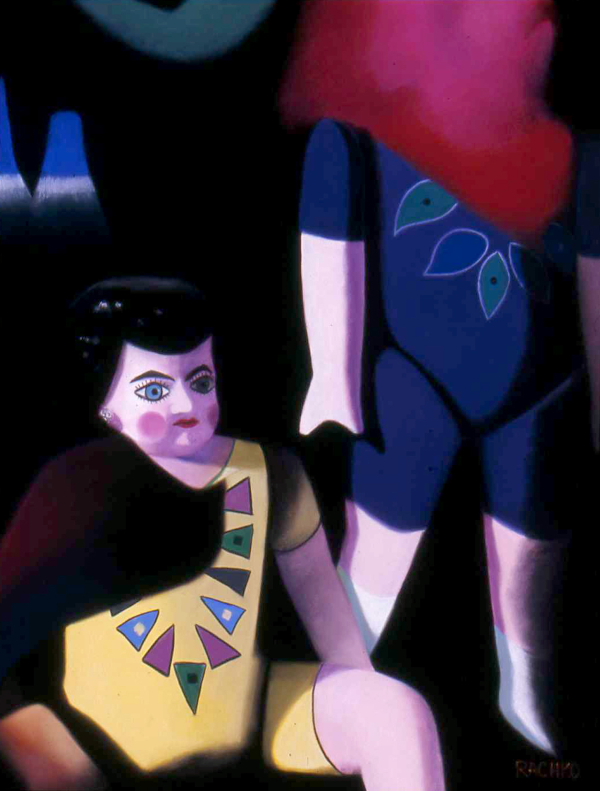
“The Absence,” soft pastel on sandpaper, 26″ x 20″
*an ongoing series of quotations – mostly from artists, to artists – that offers wisdom, inspiration, and advice for the sometimes lonely road we are on.
Art cannot play to the demand because it inheres precisely in bringing forth the unexpected, the New. It unearths what normality buries away. No wonder so many people are afraid of it.
All authentic art, then, is “challenging,” not just the avant-garde. We cannot omit the fact that some great art has an outer layer that makes it more agreeable to popular taste at a particular moment. For example, the work of Vincent van Gogh, one of modernisms prime instigators in the visual arts, seems to be everywhere today even though no one saw much to like in it while he was alive. But while it may be true that on the surface van Gogh’s work is all pretty colors and neat swirls, its immediate appeal is a siren’s song luring us to the depths. There is a chaos lurking in every print of Starry Night (1889) that livens up a suburban bathroom. This chaos isn’t something that van Gogh injected into his painting of an otherwise benign night sky. It is the essence of the starry sky when seen for what it is, that is, when captured outside all comforting clichés that might shield us from its compelling monstrosity.
J.F. Martel in Reclaiming Art in the Age of Artifice: A Treatise, Critique, and Call to Action
Comments are welcome!


 barbararachkoscoloreddust.com