Blog Archives
Pearls from artists* # 633

The Studio
*an ongoing series of quotations – mostly from artists, to artists – that offers wisdom, inspiration, and advice for the sometimes lonely road we are on.
… as he makes clear repeatedly throughout the text, there can be no such thing as a revolution in art. The “plastic process” as he [Mark Rothko] labels, it – the development of art – is inherently evolutionary. An artist can react against it, but there is no way to be outside it; it is the fabric with which he or she weaves. Technique, ways of seeing, representing, and balancing, are all in a common pool from which the artist draws.
Christopher Rothko in The Artist’s Reality: Philosophies of Art by Mark Rothko
Comments are welcome!
Pearls from artists* # 628

*an ongoing series of quotations – mostly from artists, to artists – that offers wisdom, inspiration, and advice for the sometimes lonely road we are on.
Down the rabbit hole of my research, I’d stumbled into an odd conundrum: Even though art experts can’t agree on what art is, a large number of them are convinced that making and experiencing art is an innate human impulse. It’s not a learned pastime we dreamt up once we got bored of staring at blank walls or figured out how to live past age twenty, but a biological predisposition that has helped our species survive. (One we may share with songbirds, parrots, whales, and other animals that have their own “aesthetic culture,” writes evolutionary biologist Richard O. Prom.) One survival-of-the-most-artistic hypothesis contends that art is our version of peacock feathers: An extravagant, frivolous display by which Paleolithic humans showed potential mates that they were fit enough to hunt and gather and have time left-over to paint warty pigs. Another theory is that our art-inclined ancestors survived, thrived, and reproduced because making art offered a dress rehearsal for grappling with hostile conditions. (Nine-thousand-year-old Libyan rock paintings of spear-wielding figures sprinting after horned beasts come to mind.) The scholar Ellen Dissanayake, who’s dabbled in anthropology, archaeology, psychology, and art history, argues that art is a social glue that binds communities together and thus increases its members’ odds of survival. Also, she thinks the concept of “fine art” is a travesty that’s made us forget that “engaging with the arts is as universal, normal, and obvious in human behavior as sex or parenting.”
Bianca Bosker in Get the Picture: A Mind-Bending Journey Among the Inspired Artists and Obsessive Art Fiends Who Taught Me How to See
Comments are welcome!
Pearls from artists* # 360
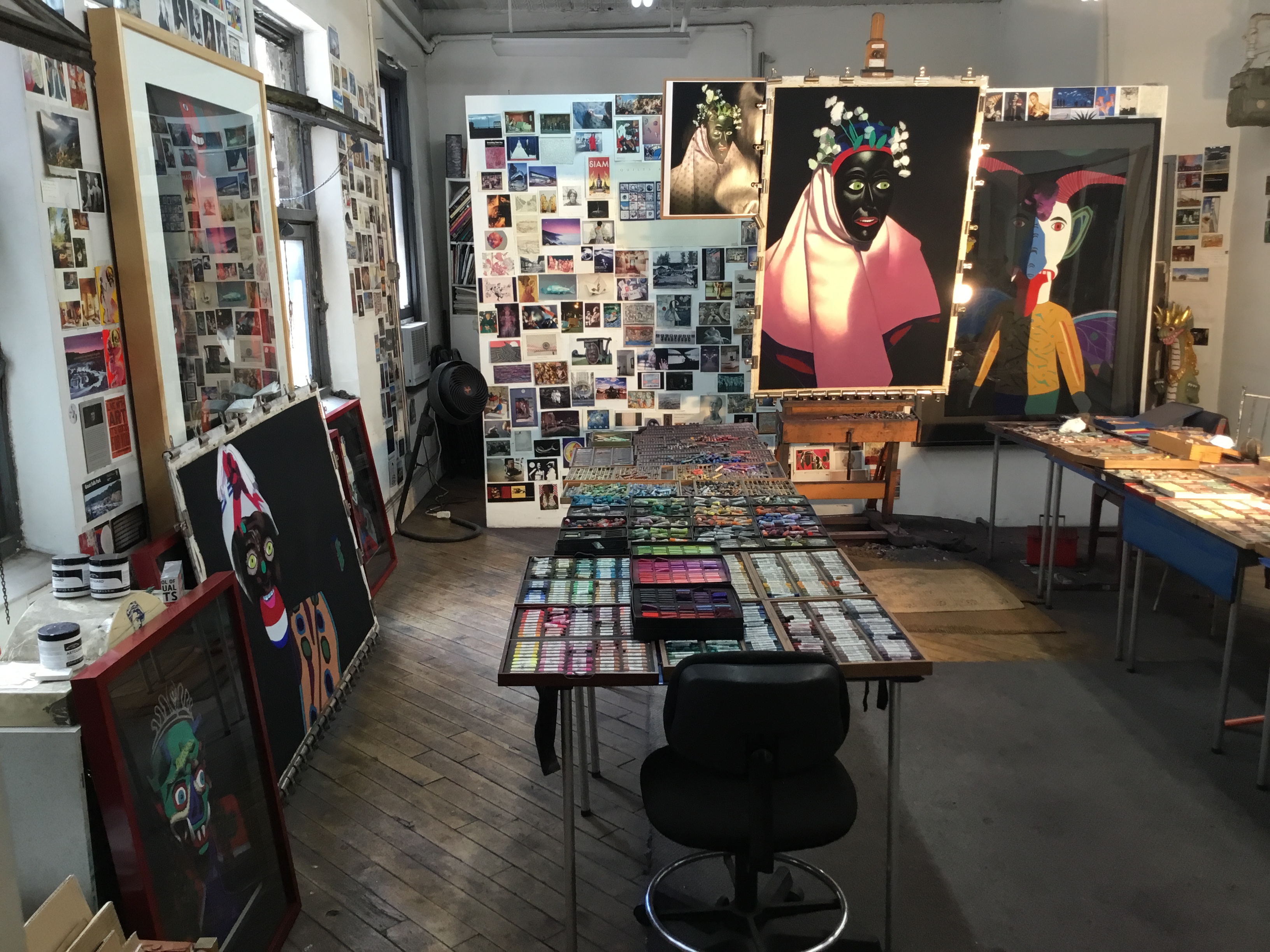
Barbara’s studio
*an ongoing series of quotations – mostly from artists, to artists – that offers wisdom, inspiration, and advice for the sometimes lonely road we are on.
Human beings have been creative beings for a really long time – long enough and consistently enough that it appears to be a totally natural impulse. To put the story in perspective, consider this fact: the earliest evidence of recognizable human art is forty thousand years old. The earliest evidence of human agriculture, by contrast is only ten thousand years old. Which means that somewhere in our collective evolutionary story, we decided it was way more important to make attractive, superfluous items than it was to learn how to regularly feed ourselves.
Elizabeth Gilbert in Big Magic: Creative Living Beyond Fear
Comments are welcome!


 barbararachkoscoloreddust.com