Category Archives: Pastel Painting
Q: If your “actors” could talk, what might they say about you as a director?

“He Was So in Need of Botany,” soft pastel on sandpaper
A: I hope they would say that I am very focused, devoted to doing the best work possible, that I know exactly what I am after, and that I use all the skills and knowledge I have acquired over many years as a painter and a photographer to make art that is worthwhile and meaningful.
Q: Your paintings are full-blown productions. You take great care to not only cast them, but to choose the right sets and lighting for them. Would you consider making films?
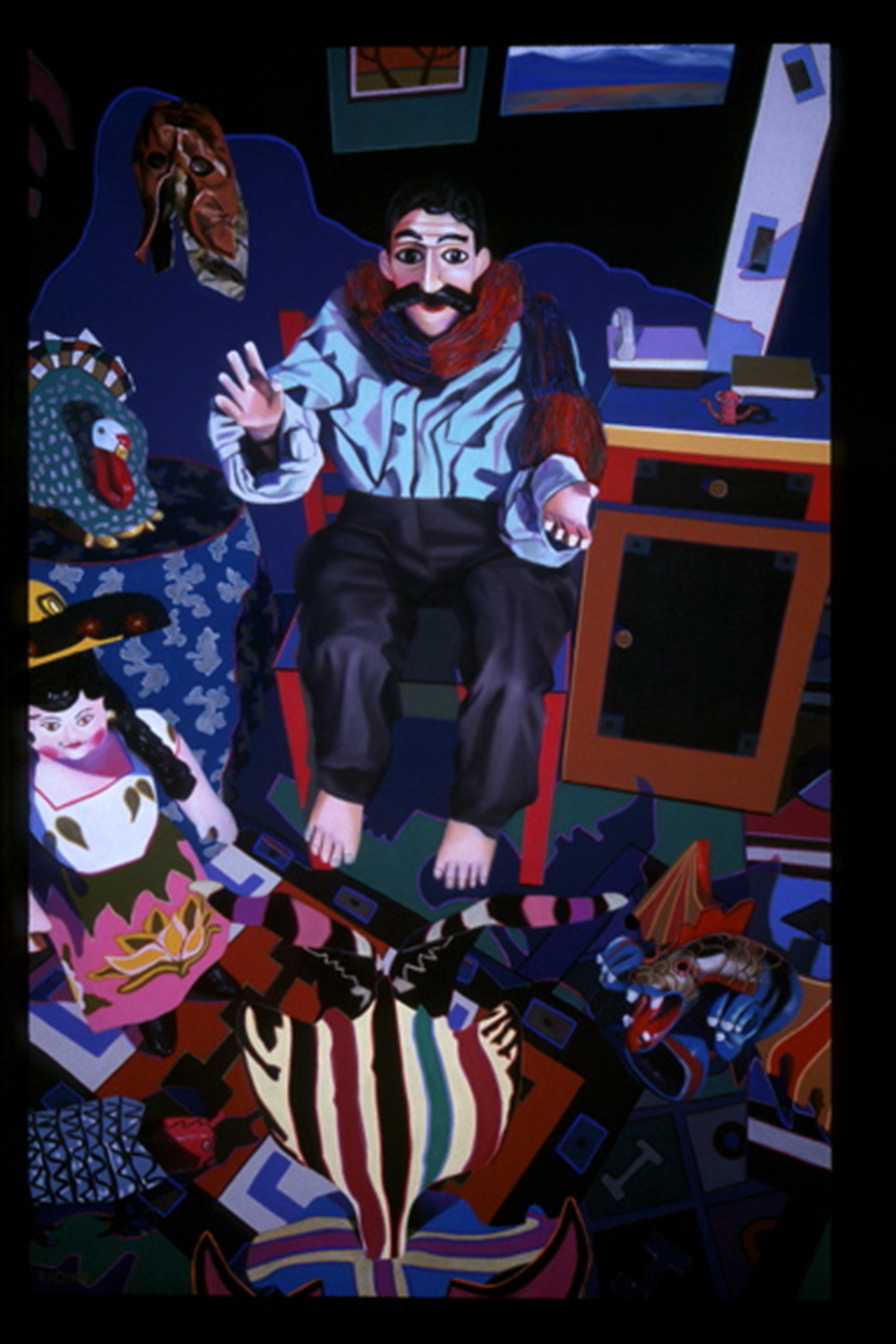
“Truth Betrayed by Innocence,” soft pastel on sandpaper
A: In the late 1990s I seriously considered it – I studied film at the New School and at New York University – but ultimately I decided to stay with painting. A well-made film will be seen by more people than a painting ever will, but the finances of making it are daunting. Historically visual artists have achieved mixed results when they have turned to filmmaking. Cindy Sherman was not very good at it, but Shirin Neshat’s feature film was very good. Julian Schnabel is arguably a much better filmmaker than he ever was a painter. Most importantly for me, filmmaking is a very complex collaboration. I love the time I spend alone in my studio and prefer having control over and being fully responsible for the results. It would be difficult to give this up.
Q: There is plenty of joyful and vibrant color in your work, but shadows are also ever-present. I would almost go as far as calling them the supporting players of your compositions. Can you elaborate on their importance and significance?

“She Embraced It and Grew Stronger,” soft pastel on sandpaper
A: When I arrange the setups, I spend a lot of time lighting them, mainly in a search for intriguing cast shadows. At one point in the “Domestic Threats” series the shadows became so important that I thought of them as physical objects in their own right. So I made them very prominent, outlined them, and otherwise gave them added emphasis. Often they had no relation to the actual objects as I created any shadow shapes that looked interesting in the painting. When I go to art galleries and museums, I always look at the shadows surrounding well-lit three dimensional objects. I find shadows quite fascinating. How less visually satisfying Calder’s mobiles and stabiles would be without the cast shadows!
Q: In your paintings, we occasionally catch a glimpse of a blond-haired female whom I assume is you. Are you also playing a character or do you appear as yourself?

“No Cure for Insomnia,” soft pastel on sandpaper
A: I am playing myself. I like to include myself in a painting now and then. I used to be a portrait artist and this is one way to keep up my technical skills. Beyond that when I’m in the painting it gives another level of reality to the scene depicted. I painted “No Cure for Insomnia” (above) at a time when I was having trouble sleeping. In it I imagined what people who didn’t know me personally, but who only knew my work, might think was keeping me up at night!
Q: Do the figures go on to play different roles in different paintings or are their characters recurring?
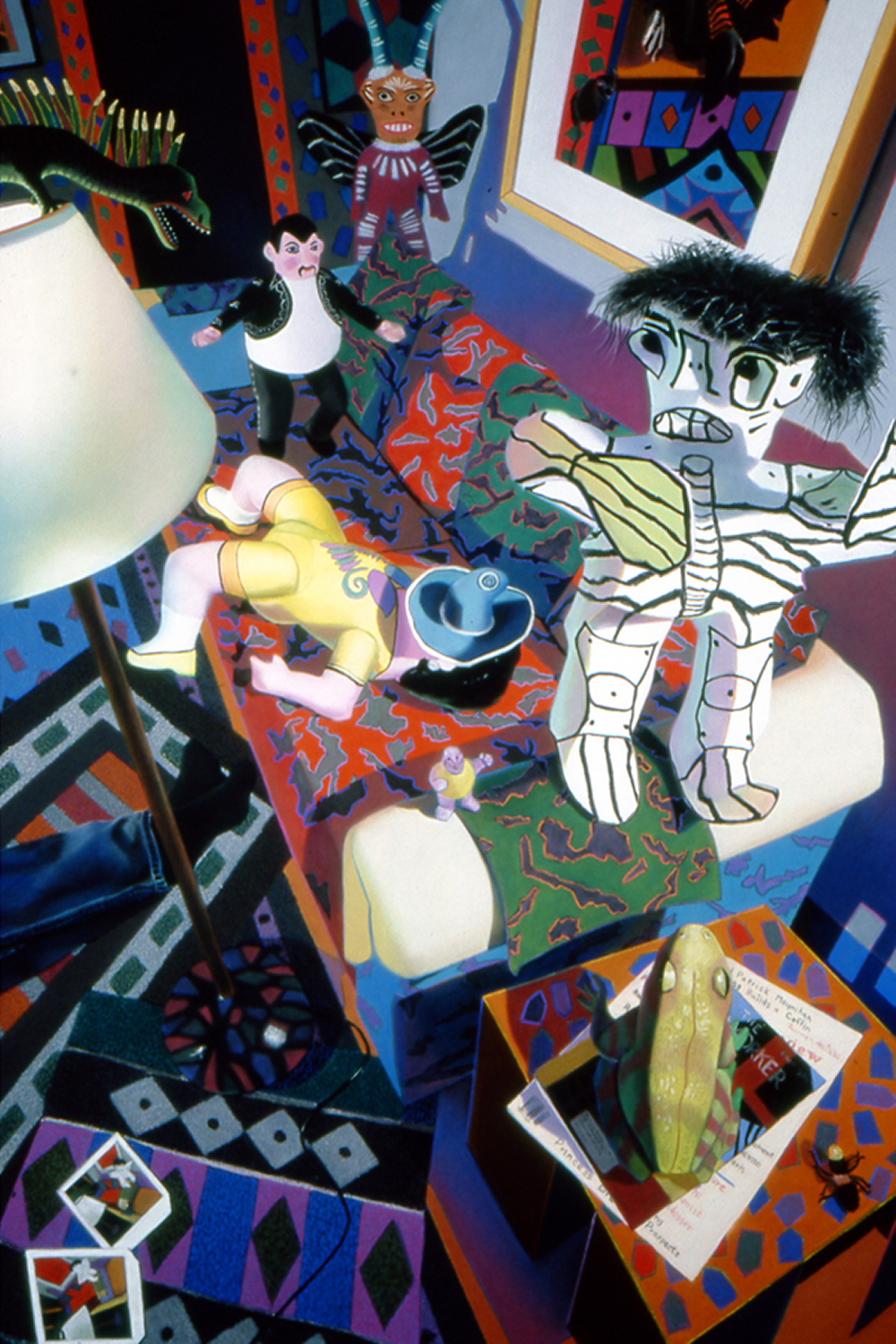
“His Mortal Enemy Was Poised Ready to Strike,” soft pastel on sandpaper
A: The dolls and other objects play different roles in each painting and I paint them differently to reflect this. If you take one figure and follow it through the series, you’ll notice that it evolves quite a bit. I continue to think of each figure as an actor in a repertory company.
Q: There is a voyeuristic quality to your paintings in the “Domestic Threats” series. Perhaps it is because we are seeing objects most would consider inanimate acting out these complex scenes you’ve created for them. Where do the stories come from?
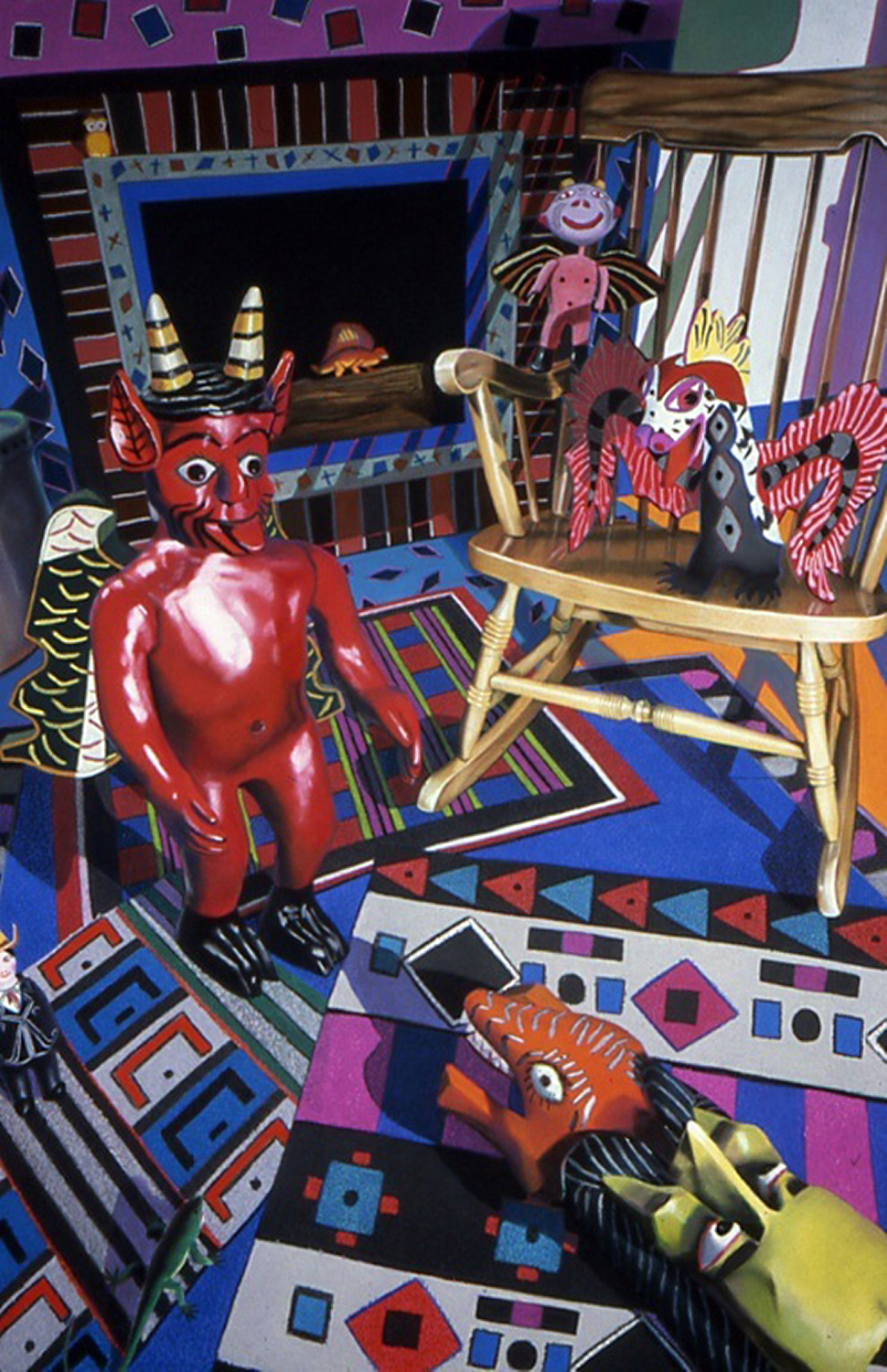
“He Didn’t Take Seriously the Threat From Below,” soft pastel on sandpaper
A: When I set up the figures to photograph, I make up stories about what is happening. Being an artist has lots of negatives, but one of the fun parts is that sometimes we get to act like big kids. Some of the stories come from movies, mythology, folk tales, or dreams. I read a lot and I love stories. I try to be open to all sorts of influences because you never know what will work its way in to enrich your art.
Q: Can you elaborate on the series title, “Domestic Threats?”
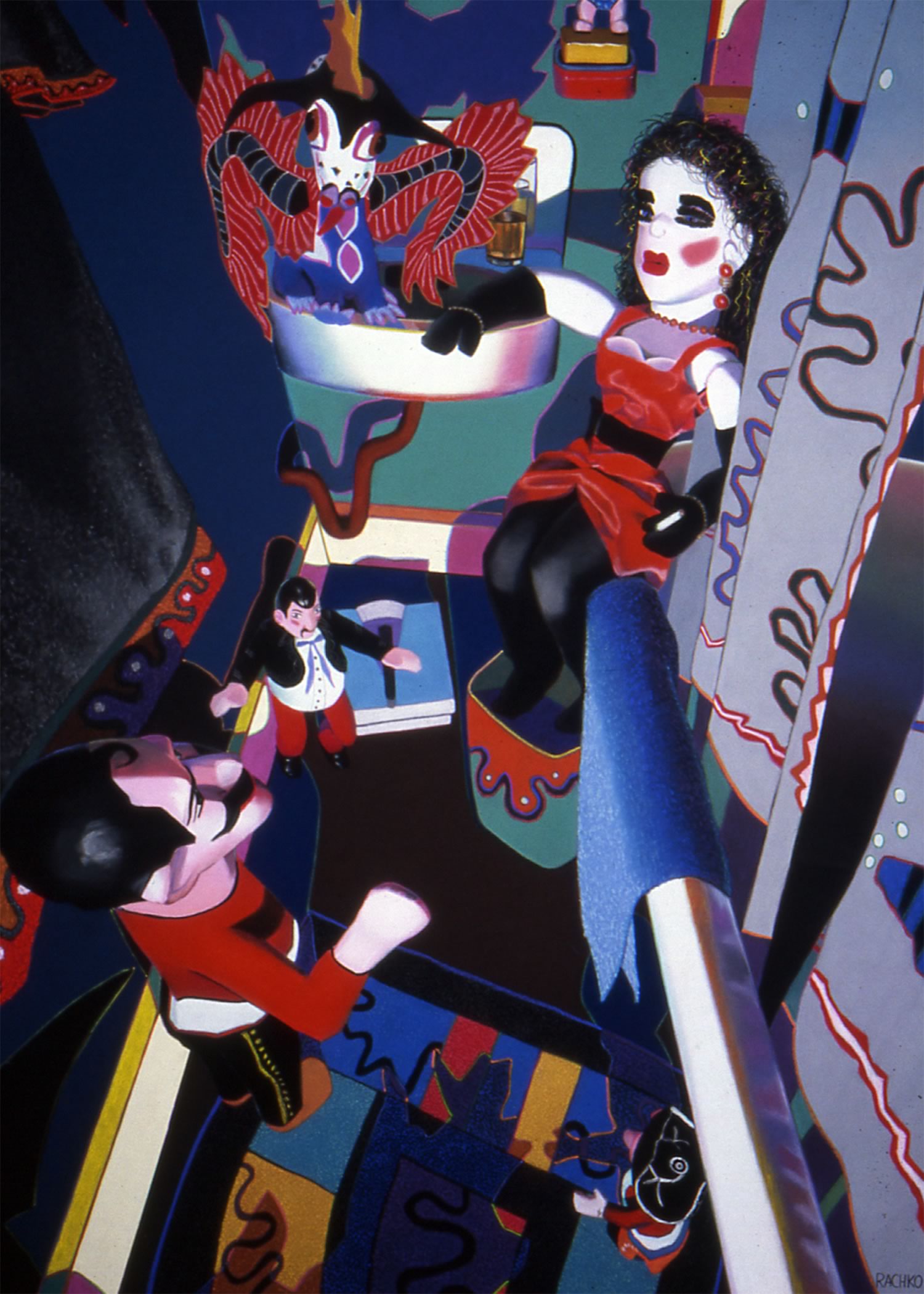
“He Urged Her To Abdicate,” soft pastel on sandpaper
A: All of the paintings in this series are set in places where I reside or used to live, either a Virginia house or New York apartments, i.e., domestic environments. Each painting typically contains a conflict of some sort, at least one figure who is being menaced or threatened by a group of figures. So I named the series “Domestic Threats.” Depending on what is going on in the country at a particular moment in time, however, people have seen political associations in my work. Since my husband was killed on 9/11, many people thought the title, “Domestic Threats,” was prescient. They have ascribed all kinds of domestic terrorism associations to it, but that is not really what I had in mind. For a time some thought I was hinting at scenes of domestic violence, but that also is not what I had intended. “Domestic Threats” seems to be fraught with associations that I never considered, but it’s an apt title for this work.
Q: Are there any other memorable quotes from collectors that you’d like to share?

“He Urged Her to Abdicate,” at John and Lynn’s house; photo by John
A: Here’s one from my good friend John, who with his wife Lynn, owns four pastel paintings. I believe they discovered my paintings in 2000 at a gallery in Marin County (CA). John is talking about work from a previous series called, “Domestic Threats.”
The first time that I saw Barbara’s work in a gallery window I was instantly drawn to it… the intensity of color… examining the figures… my love of folk art… the furniture and other objects. Somewhere in the middle of all this the skewed perspective hit me. I was hooked.
What would visual artists do without appreciative collectors!
Q: What do your collectors say about your work?
“False Friends,” one of Cheryll and John’s pastel paintings
A: Here’s a quote from Cheryll Chew and John Frye, who own four of my pastel paintings.
We walked into her studio in 1994 and saw “In Reality the Frogs Were Men.” That instant on that day, my consuming passion with Barbara Rachko’s work began. We had absolutely no resources to buy “In Reality . . .” I did, however, know without a doubt that one day we would have her work, no matter what it took to get it.
We, years later, have “Scene Eleven: Bedroom,” “Scene Nine: Living Room,” “Scene Five: Kitchen,” and “False Friends.”
We have unorthodox appreciations and every single day, those pieces of art quicken the pulse and bring us pure pleasure.
Her pieces make us want to dance wildly around the room and wave our arms in the air. We are deeply grateful that her work is in our home. Her art balances the everyday domestic with the unthinkably rare, lovely, and maniacal. That is an edgy state of being that we thrive in.
Not long ago, we read an article about Nan Goldin. In the article was a phrase that says precisely what Barbara Rachko’s work does for us . . .
all of the pleasure circuits are deeply fulfilled by looking. . .
Nan Goldin The Look of Love: Matchmaking at the Louvre
NY Times,10.27.2011
Q: What gives you the most personal pleasure as an artist?
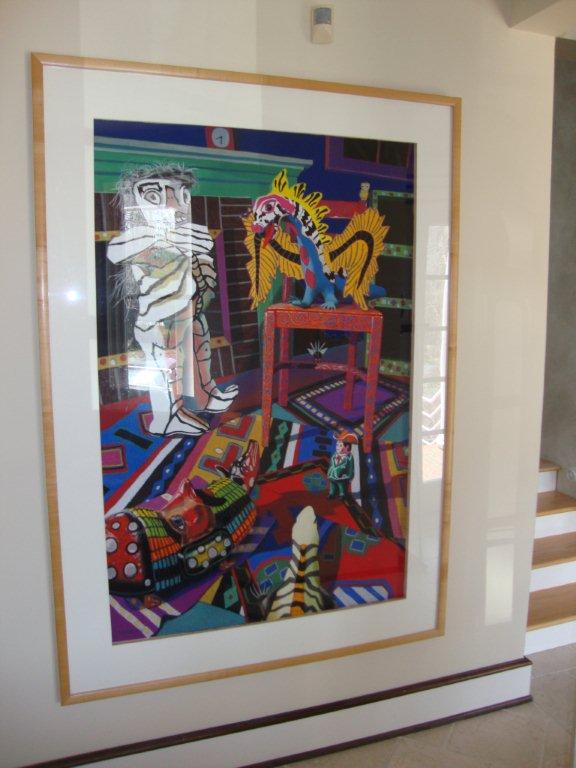
“The Older One Pulled His Punches,” at Beth and Larry’s house; photo by Larry Rubin
A: I’d have to say that it’s my relationships with my collectors. I love to see my pastel paintings and photographs hanging on collectors’ walls, especially when the work is first installed and they tell me how happy they are to own them. People’s relationship to work that they own evolves over time. It’s always gratifying to hear that they love my paintings and photographs more after living with them. Then I know that my work has found the right home. An artist’s works are her children, after all, so we hope they are “adopted” by the right people. Collectors invariably become good friends so now I have a network of art-loving friends around the country.


 barbararachkoscoloreddust.com