Category Archives: Inspiration
Pearls from artists* # 12

Grand Falls, AZ
* an ongoing series of quotations – mostly from artists, to artists – that offers wisdom, inspiration, and advice for the sometimes lonely road we are on.
People who set their sails into art tend to work very hard. They train themselves in school; they practice and they read and they think and they talk. But for most of them there seems to be a more or less conscious cutoff point. It can be a point in time: “I will work until I am twenty-one (twenty-five, thirty, or forty).” Or a point in effort: “I will work three hours a day (or eight or ten).” Or a point in pleasure: “I will work unless…” and here the “enemies of promise” harry the result. These are personal decisions, more or less of individual will. They depend on the scale of values according to which artists organize their lives. Artists have a modicum of control. Their development is open-ended. As the pressure of their work demands more and more of them. they can stretch to meet it. They can be open to themselves, and as brave as they can be to see who they are, what their work is teaching them. This is never easy. Every step forward is a clearing through a thicket of reluctance and habit and natural indolence. And all the while they are at the mercy of events. They may have a crippling accident, or may find themselves yanked into a lifelong responsibility such as the necessity to support themselves and their families. Or a war may wipe out the cultural context on which they depend. Even the most fortunate have to adjust the demands of a personal obsession to the demands of daily life.
Anne Truitt, Daybook: The Journal of an Artist
Comments are welcome.
Pearls from artists* # 11

Great Salt Lake
* an ongoing series of quotations – mostly from artists, to artists – that offers wisdom, inspiration, and advice for the sometimes lonely road we are on.
Virtually all artists spend some of their time (and some artists spend all of their time) producing work that no one else much cares about. It just seems to come with the territory. But for some reason – self defense, perhaps – artists find it tempting to romanticize this lack of response, often by (heroically) picturing themselves peering deeply into the underlying nature of things long before anyone else has eyes to follow.
Romantic, but wrong. The sobering truth is that the disinterest of others hardly ever reflects a gulf in vision.In fact there’s generally no good reason why others should care about most of any one artist’s work. The function of the overwhelming majority of your artwork is simply to teach you how to make the small fraction of your artwork that soars. One of the basic and difficult lessons every artist must learn is that even the failed pieces are essential. X-rays of famous paintings reveal that even master artists sometimes made basic mid-course corrections (or deleted really dumb mistakes) by over-painting the still wet canvas. The point is that you learn how to make your work by making your work, and a great many pieces you make along the way will never stand out as finished art. The best you can do is make art you care about – and lots of it!
The rest is largely a matter of perseverance. Of course once you’re famous, collectors and academics will circle back in droves to claim credit for spotting evidence of genius in every early piece. But until your ship comes in, the only people who will really care about your work are those who care about you personally. Those close to you know that making the work is essential to your well being. They will always care about your work, if not because it is great, then because it is yours – and this is something to be genuinely thankful for. Yet however much they love you, it still remains as true for them as for the rest of the world: learning to make your work is not their problem.
David Bayles and Ted Orland, Art & Fear
Comments are welcome.
Pearls from artists* # 10

West 28th Street
* an ongoing series of quotations – mostly from artists, to artists – that offers wisdom, inspiration, and advice for the sometimes lonely road we are on.
That art that matters to us – which moves the heart, or revives the soul,or delights the senses, or offers courage for living, however we choose to describe the experience – that work is received by us as a gift is received. Even if we are touched by a work of art something comes to us which has nothing to do with the piece. I went to see a landscape painter’s works, and that evening, walking among pine trees near my home, I could see the shapes and colors I had not seen the day before. The spirit of an artist’s gifts can wake our own. The work appeals, as Joseph Conrad says, to a part of our being which is itself a gift and not an acquisition. Our sense of harmony can hear the harmonies that Mozart heard. We may not have the power to profess our gifts as the artist does,and yet we come to recognize, and in a sense to receive, the endowments of our being through the agency of his creation. We feel fortunate, even redeemed. The daily commerce of our lives – “sugar for sugar and salt for salt,” as the blues singers say – proceeds at its own constant level, but a gift revives the soul. When we are moved by art we are grateful that the artist lived, grateful that he labored in the service of his gift.
If a work of art is the emanation of its maker’s gift and if it is received by its audience as a gift, then is it, too, a gift? I have framed the question to imply an affirmative answer, but I doubt we can be so categorical. Any object, any item of commerce, becomes one kind of property or another depending on how we use it. Even if a work of art contains the spirit of the artist’s gift, it does not follow that the work itself is a gift. It is what we make of it.
And yet, that said, it must be added that the way we treat a thing can sometimes change its nature. For example, religions often prohibit the sale of sacred objects, the implication being that their sanctity is lost if they are bought and sold. A work of art seems to be a hardier breed; it can be sold in the market and still emerge a work of art. But if it is true that in the essential commerce of art a gift is carried by the work from the artist to his audience, if I am right to say that where there is no gift there is no art, then it is possible to destroy a work of art by converting it into a commodity. Such, at any rate, is my position. I do not maintain that art cannot be bought and sold; I do maintain that the gift portion of the work places a constraint upon our merchandising.
Lewis Hyde, The Gift
Comments are welcome.
Pearls from artists* # 9

Lower Manhattan
* an ongoing series of quotations – mostly from artists, to artists – that offers wisdom, inspiration, and advice for the sometimes lonely road we are on.
ART when really understood is the province of every human being. It is simply a question of doing things, anything, well. It is not an outside, extra thing.
When the artist is alive in any person, whatever his kind of work may be, he becomes an inventive, searching, daring, self-expressing creature. He disturbs, upsets, enlightens, and he opens ways for a better understanding. Where those who are not artists are trying to close the book, he opens it, shows there are still more pages possible.
The world would stagnate without him, and the world would be beautiful with him; for he is interesting to himself and he is interesting to others. He does not have to be a painter or sculptor to be an artist. He can work in any medium. He simply has to find the gain in the work itself, not outside it.
Museums of art will not make a country an art country. But where there is the art spirit there will be precious works to fill museums. Better still, there will be the happiness that is in the making. Art tends toward balance, order, judgment or relative values, the laws of growth, the economy of living – very good things for anyone to be interested in.
Robert Henri, The Art Spirit
Comments are welcome.
Pearls from artists* # 8
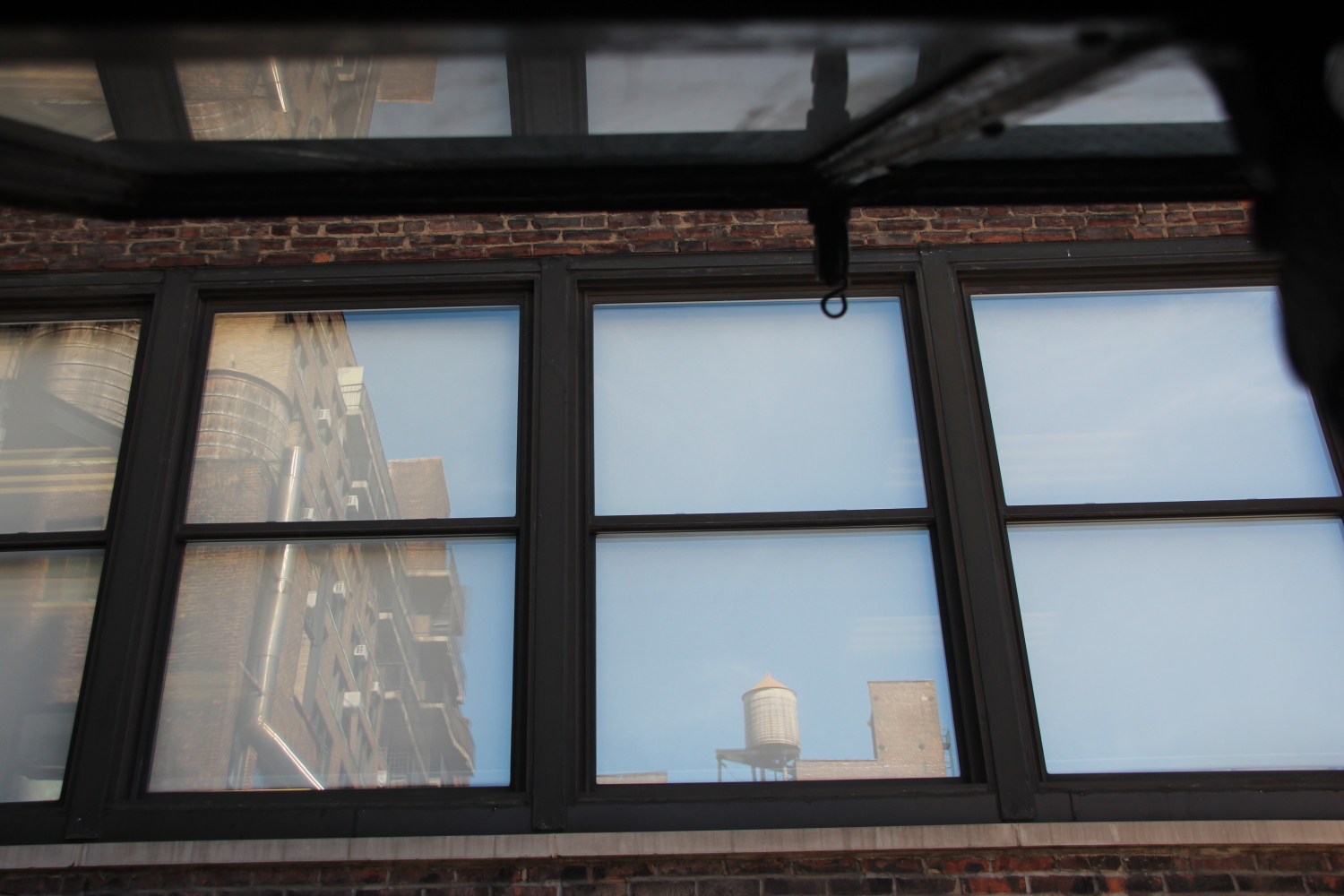
A view from the studio
* an ongoing series of quotations – mostly from artists, to artists – that offers wisdom, inspiration, and advice for the sometimes lonely road we are on.
Here is a fairly sober version of what happens in the small room between the writer and the work itself. It is similar to what happens between a painter and the canvas.
First you shape the vision of what the projected work of art will be. The vision, I stress, is no marvelous thing: it is he work’s intellectual structure and aesthetic surface. It is a chip of mind, a pleasing intellectual object. It is a vision of the work, not of the world. It is a glowing thing, a blurred thing of beauty. Its structure is at once luminous and translucent; you can see the world through it. After you receive the initial charge of this imaginary object, you add to it at once several aspects, and incubate it most gingerly as it grows into itself.
Many aspects of the work are still uncertain, of course; you know that. You know that if you proceed you will change things and learn things, that the form will grow under your hands and develop new and richer lights. But that change will not alter the vision or its deep structures; it will only enrich it. You know that and you are right.
But you are wrong if you think that in the actual writing or in the actual painting, you are filling in the vision. You cannot fill in the vision. You cannot even bring the vision to light. You are wrong if you think that you can in any way take the vision and tame it to the page. The page is jealous and tyrannical; the page is made of time and matter; the page always wins. The vision is not so much destroyed, exactly, as it is, by the time you have finished, forgotten. It has been replaced by this changeling, this bastard, this opaque lightless chunky ruinous work.
Here is how it happens. The vision is, sub specie aeternitatis, a set of mental relationships, a coherent series of formal possibilities. In the actual rooms of time, however, it is a page or two of legal paper filled with words and questions; it is a terrible diagram, a few books’ names in a margin, an ambiguous doodle, a corner folded down in a library book. There are memos from the thinking brain to witless hope.
Nevertheless, ignoring the provisional and pathetic nature of these scraps, and bearing the vision itself in mind – having it before your sights like the very Grail – you begin to scratch out the first faint marks on the canvas, on the page. You begin the work proper. Now you have gone and done it. Now the thing is no longer a vision: it is paper.
Words lad to other words and down the garden path. You adjust the paints’ values and hues not to the world, not to the vision, but to the rest of the paint. The materials are stubborn and rigid; push is always coming to shove. You can fly – you can fly higher than you thought possible – but you can never get off the page. After every passage another passage follows, more sentences, more everything on drearily down. Time and materials hound the work; the vision recedes ever farther into the dim realms.
And so you continue the work, and finish it. Probably by now you have been forced to toss the most essential part of the vision. But this is a concern for mere nostalgia now: for before your eyes, and stealing your heart, is this fighting and frail finished product, entirely opaque. You can see nothing through it. It is only itself, a series of well-known passages, some colored paint. Its relationship to the vision that impelled it is the relationship between any energy and any work, anything unchanging to anything temporal.
The work is not the vision itself, certainly. It is not the vision filled in, as if it had been a coloring book. It is not the vision reproduced in time; that were impossible. It is rather a simulacrum and a replacement. It is a golem. You try – you try every time – to reproduce the vision, to let your light so shine before men. But you can only come along with your bushel and hide it.
Annie Dillard, The Writing Life
Comments are welcome.
Q: Can you speak more about how your studio practice has evolved over the years?

At White Sands, NM; photo by Donna Tang
A: I have spoken at length about how my work and studio practice have evolved since the mid-80s. Please see my interview with Daniel Rothbart at http://www.arterynyc.com/2011/12/a-conversation-with-barbara-rachko/ or click the Blogroll link at right.
Pearls from artists* # 7
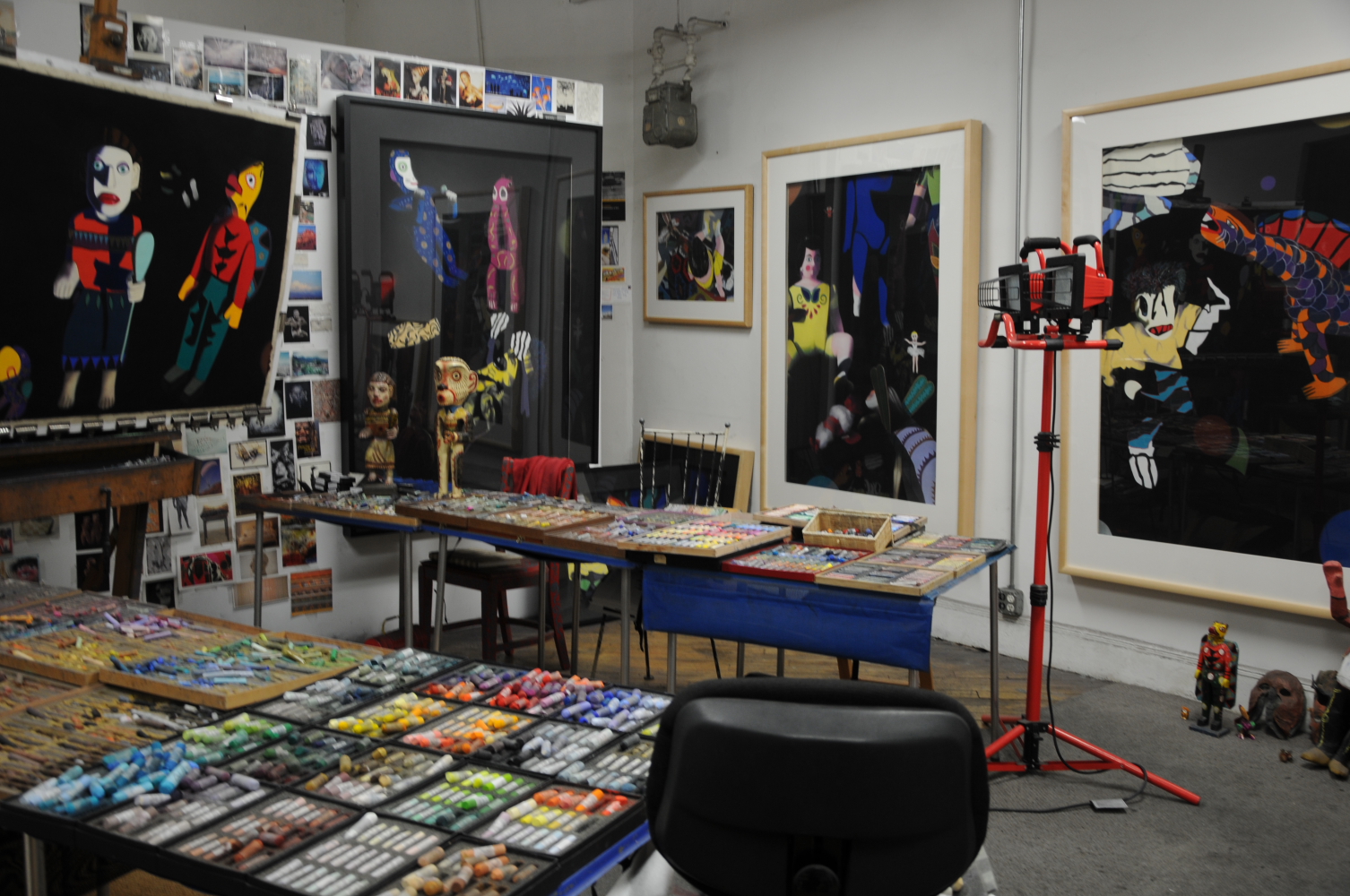
Barbara’s studio
* an ongoing series of quotations – mostly from artists, to artists – that offers wisdom, inspiration, and advice for the sometimes lonely road we are on.
It’s painful to think of the number of paintings that don’t work, not only my own, but also what I see in galleries and museums. Such failures may be adequately painted but they don’t sing. They left the studio but they aren’t happy about it. It’s simple and inevitable: there’s work we artists do that doesn’t come together. And for each of us there’s only one solution to this problem. You just continue to make paintings, and you make more paintings, and then for no particular reason all of a sudden you start to click and all the pieces that you’ve been working with, the direction you’ve been perceiving “as if through a glass darkly” is now open and clear, in all its glory. We paint and everything falls into place. That expression of “being in the zone” expresses the experience perfectly. There is a momentum you’ve built up which was essential to this work. If you had been waiting for inspiration, waiting for that flow to begin, it would have caught you too flat-footed to notice. It arrived out of the readiness that all the previous work created in you. Regardless of how sluggish that process may have seemed at the time, things were lining up in preparation, ideas were formulating.
Ian Roberts, Creative Authenticity: 16 Principles to Deepen Your Artistic Vision
Comments are welcome.
Q: You seem very disciplined. Do you ever have a day when you just can’t get excited about working?
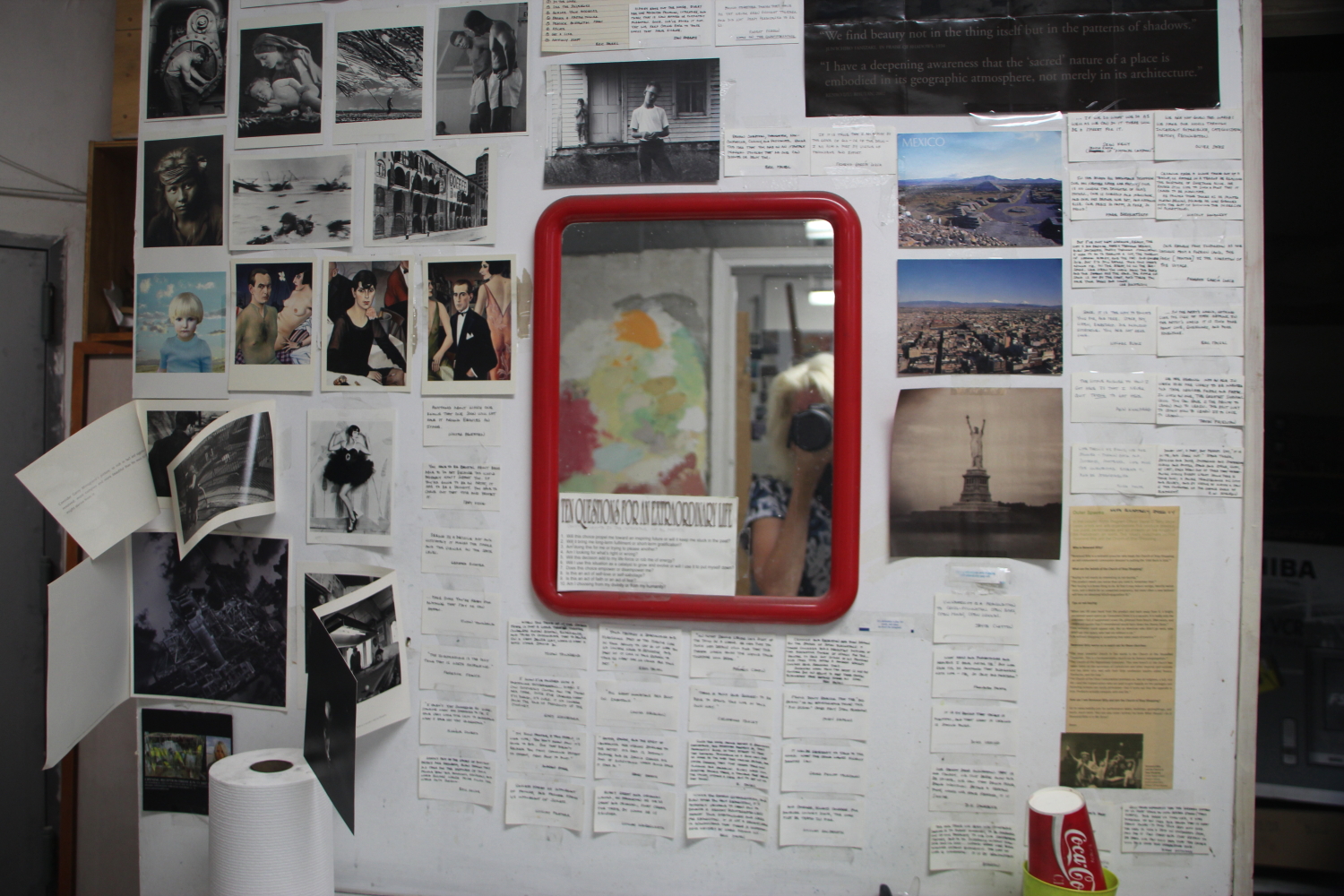
Studio wall with self-portrait
A: That happens occassionaly, but I still go to the studio to work. You know the expression, “99% of life is just showing up”? Well, of course I have to show up at my studio to accomplish anything so I keep fairly regular studio hours – 7 to 8 hours a day, 4 or 5 days a week. In the evening I spend another hour or two answering email, sending out applications, organizing jpegs, etc. When you are an artist there is always work to do and for some of it, no one else can do it. That’s because no one else knows the work from the inside the way the maker does. I like what Twyla Tharp says in her book, “The Creative Habit.” In order to progress an artist needs good work habits that become a daily routine. And Chuck Close likes to say, “Inspiration is for amateurs,” meaning a professional works whether she’s in the mood or not. I completely agree so I keep working and slowly moving ahead.
As Tchaikovsky wrote in a letter to a friend:
We must always work, and a self-respecting artist must not fold his hands on the pretext that he is not in the mood. If we wait for the mood, without endeavoring to meet it halfway, we easily become indolent and apathetic. We must be patient, and believe that inspiration will come to those who can master their disinclination. A few days ago I told you I was working every day without any real inspiration. Had I given way to my disinclination, undoubtedly I should have drifted into a long period of idleness. But my patience and faith did not fail me, and today I felt that inexplicable glow of inspiration of which I told you; thanks to which I know beforehand that whatever I write today will have power to make an impression, and to touch the hearts of those who hear it.
Quoted in Eric Maisel’s A Life in the Arts.
Comments are welcome.
Pearls from artists* # 5
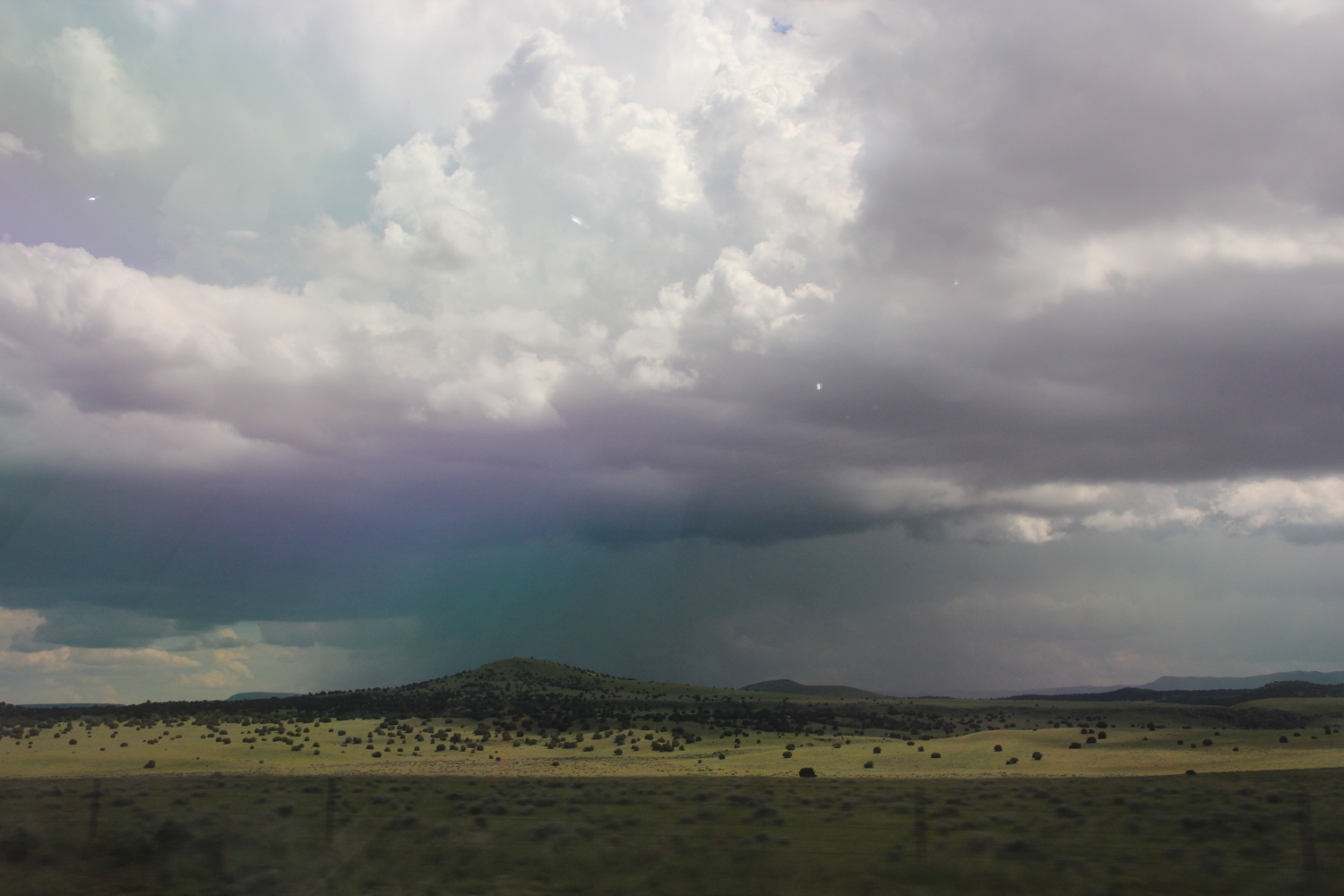
Arizona storm
* an ongoing series of quotations – mostly from artists, to artists – that offers wisdom, inspiration, and advice for the sometimes lonely road we are on.
Flying over the desert yesterday, I found myself lifted out of my preoccupations by noticing suddenly that everything was curved. Seen whole from the air, circumscribed by its global horizon, the earth confronted me bluntly as a context all its own, echoing that grand sweep. I had the startling impression that I was looking at something intelligent. Every delicate pulsation of color was met, matched, challenged, repulsed, embraced by another, none out of proportion, each at its own unique and proper part of the whole. The straight lines with which human beings have marked the land are impositions of a different intelligence, abstract in this area of the natural. Looking down at these facts, I began to see my life as somewhere between these two orders of the natural and the abstract, belonging entirely neither to one nor to the other.
In my work as an artist I m accustomed to sustaining such tensions: A familiar position between my senses, which are natural, and my intuition of an order they both mask and illuminate. When I draw a straight line or conceive of an arrangement of tangible elements all my own, I inevitably impose my own order on matter. I actualize this order, rendering it accessible to my senses. It is not so accessible until actualized.
An eye for this order is crucial for an artist. I notice that as I live from day to day, observing and feeling what goes on both inside and outside myself, certain aspects of what is happening adhere to me, as if magnetized by a center of psychic gravity. I have learned to trust this center, to rely on its acuity and to go along with its choices although the center itself remains mysterious to me. I sometimes feel as if I recognize my own experience. It is a feeling akin to that of unexpectedly meeting a friend in a strange place, of being at once startled and satisfied – startled to find outside myself what feels native to me, satisfied to be so met. It is exhilarating.
I have found that this process of selection, over which I have virtually no control, isolates those aspects of my experience that are most essential to me in my work because they echo my own attunement to what life presents me. It is as if there are external equivalents for truths which I already in some mysterious way know. In order to catch these equivalents, I have to stay “turned on” all the time, to keep my receptivity to what is around me totally open. Preconception is fatal to this process. Vulnerability is implicit in it; pain, inevitable.
Anne Truitt, Daybook: The Journal of an Artist
Comments are welcome.
Q: Do you have any rituals or a spiritual practice that you do before beginning your work in the studio?
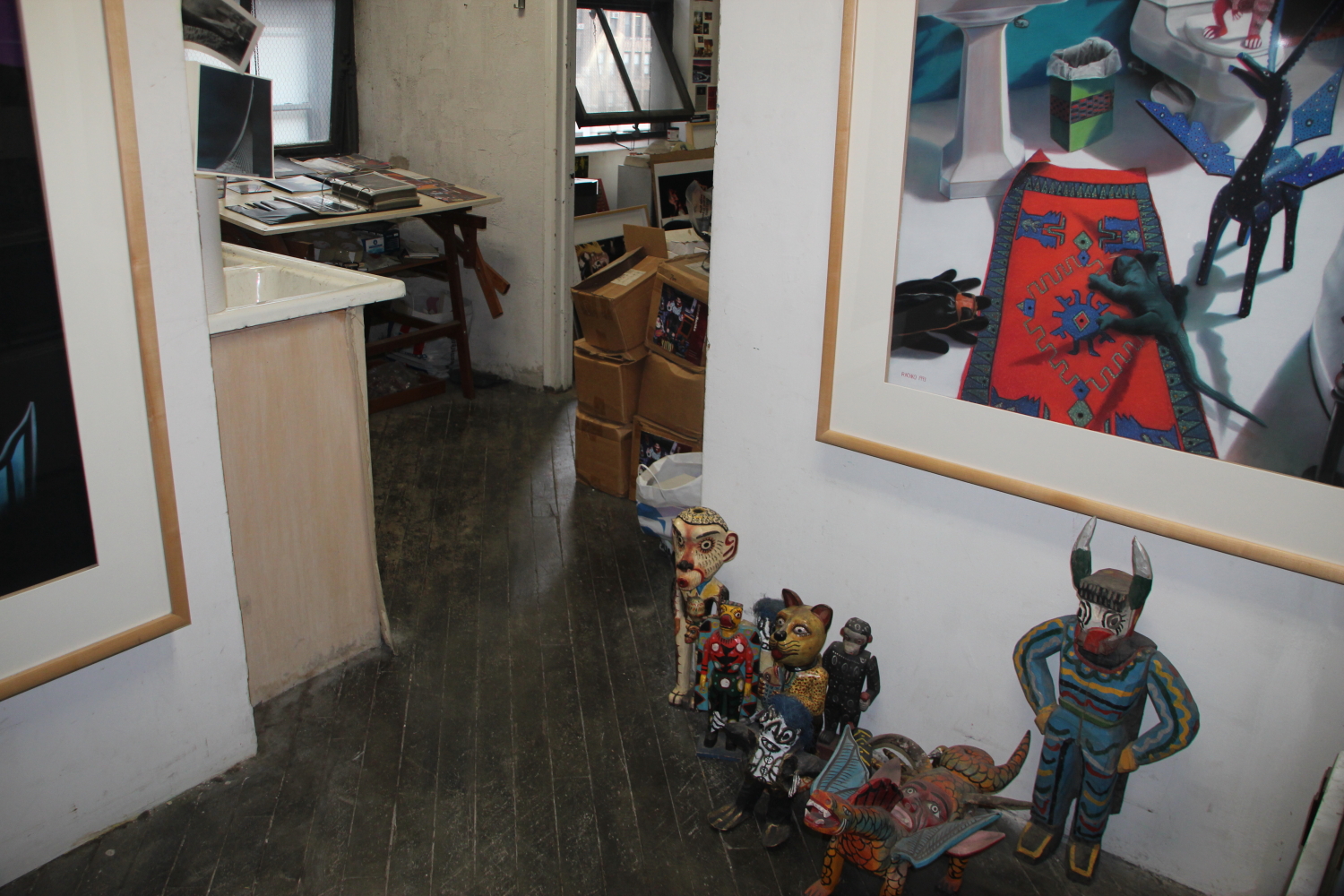
Studio entrance
A: When I arrive at the studio in the morning it’s rare for me to immediately start working. Usually I read something art-related – magazines like Art in America, ARTnews, Tribal Arts, or exhibition catalogues from shows I’ve seen, books on art, on creativity, etc. At the moment I’m re-reading The Gift, by Lewis Hyde. As usual I am struggling to understand aspects of the art business and figure out what I need to do next to get my work seen by a wider audience. The Gift reminds why I decided to make art in the first place. It helps reconnect with forgotten parts of myself and is a much-needed reminder of what I love about being an artist, especially in light of the business stuff that is becoming so complex and demanding of attention now. Balancing the creative and business aspects of being an artist is a continual struggle. Both are so important. An artist needs an appreciative audience – very few artists devote their lives to art-making so that the work will remain in a closet – but I also believe this (from a note hand-written years ago and tacked to the studio wall): “Just make the work. None of the rest matters.”
Comments are welcome.



