Blog Archives
Pearls from artists* # 420

‘Science in Surrealism,” published by Gallery Wendy Norris
*an ongoing series of quotations – mostly from artists, to artists – that offers wisdom, inspiration, and advice for the sometimes lonely road we are on.
During the early period of Einstein’s great fame, which began in 1919, Breton wrote an essay for the first one-man show in Paris of Max Ernst. There, for the first time, he expressed what would become the central mechanism of Surrealism’s theory of poetry: the experience of ‘disorientation,’ engendered by what Breton called ‘the marvelous ability to reach out, without leaving the field of our experience, to two distinct realities and bring them together to create a spark.’ Perhaps in search of authorization, Breton gave this definition in the context of the ‘separate systems of reference’ posited by Einstein’s Relativity. This, Breton argued, helped make sense of weird juxtapositions to be found in Ernst’s collages of the time, shown in Paris in the same year that the German to French translations of both Einstein’s Relativity: The Special Theory and the General Theory and [Sir Arthur] Eddington’s, Space, Time, and Gravitation were published. This in turn gave Breton and his friends a glimpse of the ‘real’ world ushered in by the new physics.
“Sibylline Strangeness: Surrealism and Modern Physics,” by Gavin Parkinson in Science in Surrealism, published by Gallery Wendy Norris
Comments are welcome!
Pearls from artists* # 418
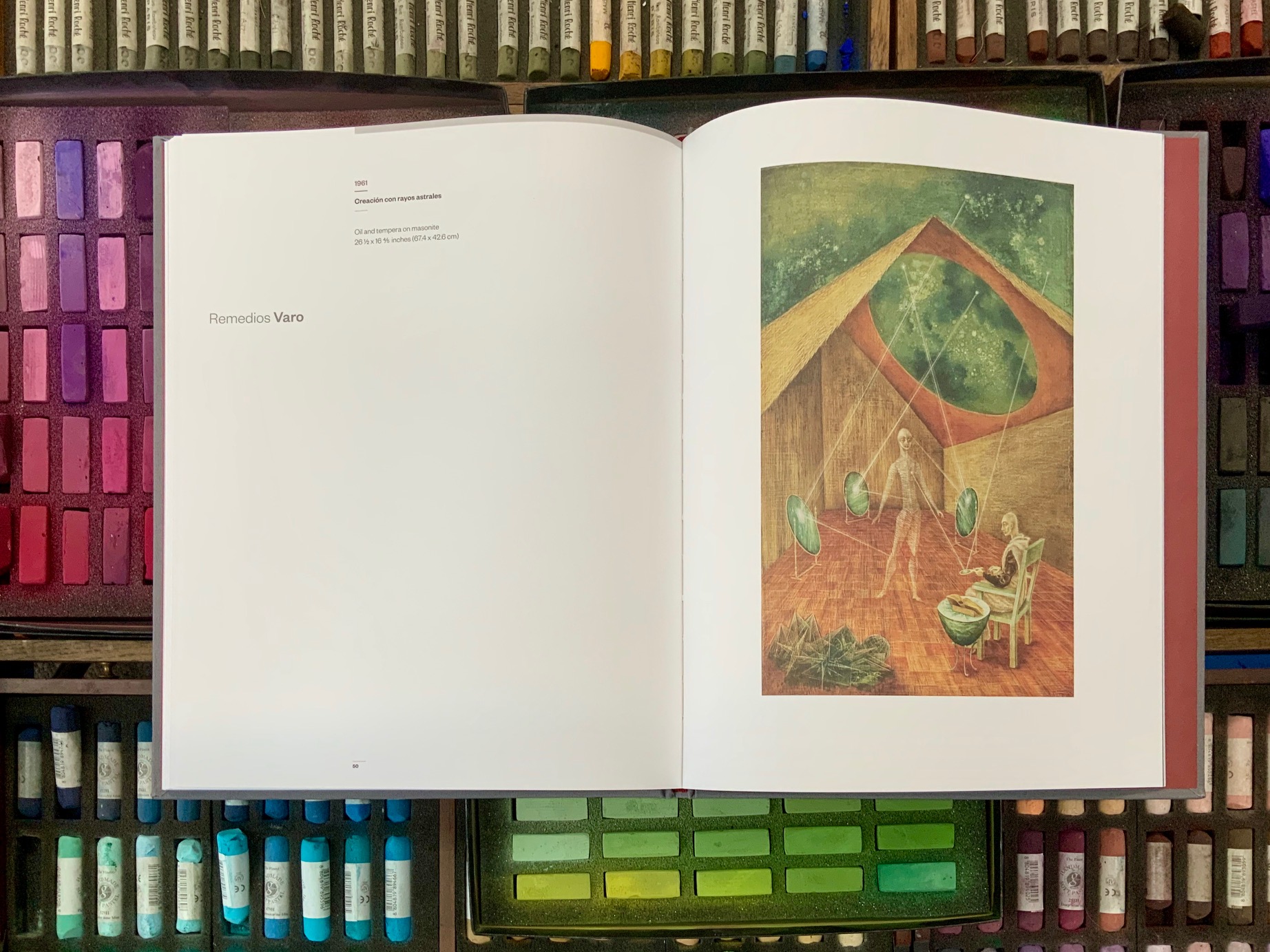
A Remedios Varo Plate from “Science and Surrealism”
*an ongoing series of quotations – mostly from artists, to artists – that offers wisdom, inspiration, and advice for the sometimes lonely road we are on.
… both Surrealism’s birth and infancy coincided with probably the most momentous period in the history of physics. The first Surrealist text, written by Andre Breton and Philippe Soupault and titled Magnetic Fields, deployed the spontaneous technique of ‘automatic writing,’ which supposedly allowed direct access to unconscious material. It appeared in 1920 but was written in the previous year, coinciding with the expedition led by the English astrophysicist, Arthur Eddington, to observe the solar eclipse from the island of Principe off the west coast of Africa. It was this journey that proved predictions set out in Einstein’s General Theory of Relativity (1916) about the gravitational deflection of light by the sun. Eddington’s experiment led not only to Einstein’s instant, mythic status as the ‘new Copernicus’ and the swift popularization of Relativity, but more specifically its appearance in the early theoretical writings of Surrealism’s principle spokesman, Breton, which helped lay the foundations of the movement. Breton’s subsequent manifesto texts of 1924 and 1929, extending his discussion of what he deemed the narrow, restrictive logic of Western though, can be situated within the same historical context that bore the revolutionary discoveries of quantum mechanics, culminating in 1927.
“Sibylline Strangeness: Surrealism and Modern Physics,” by Gavin Parkinson in Science in Surrealism, published by Gallery Wendy Norris
Comments are welcome!
Pearls from artists* # 259
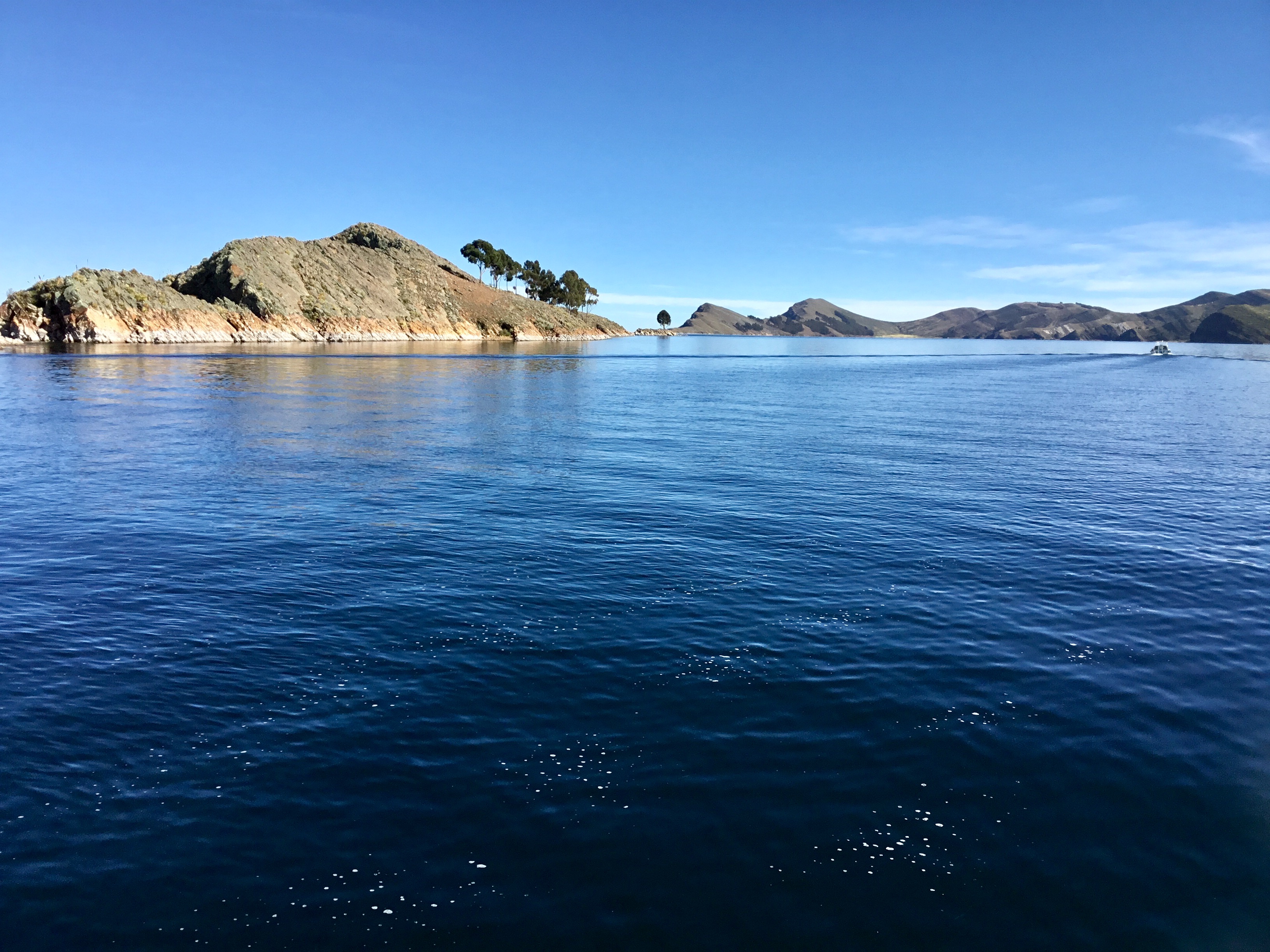
In Bolivia on Lake Titicaca
* an ongoing series of quotations – mostly from artists, to artists – that offers wisdom, inspiration, and advice for the sometimes lonely road we are on.
In college, I made two important decisions about my career.
First, I would put my writing on the back burner until I became well established in science. I know of a few scientists who later became writers, like C.P. Snow, Rachel Carson, but no writers who later became scientists. For some reason, science – at least the creative, research side of science – is a young person’s game. In my own field, physics, I found that the average age at which Nobel Prize winners did their prize-winning work was only thirty-six. Perhaps it has something to do with the focus on and isolation of the subject. A handiness for visualizing in six dimensions or for abstracting the motion of a pendulum favors an agility of mind but apparently requires little knowledge of the human world. By contrast, the arts and humanities require experience with life and the awkward contradictions of people, experience that accumulates and deepens with age.
Alan Lightman in A Sense of the Mysterious: Science and the Human Spirit
Comments are welcome!


 barbararachkoscoloreddust.com