Blog Archives

Q: Does your work look different to you on days when you are sad, happy, etc.?
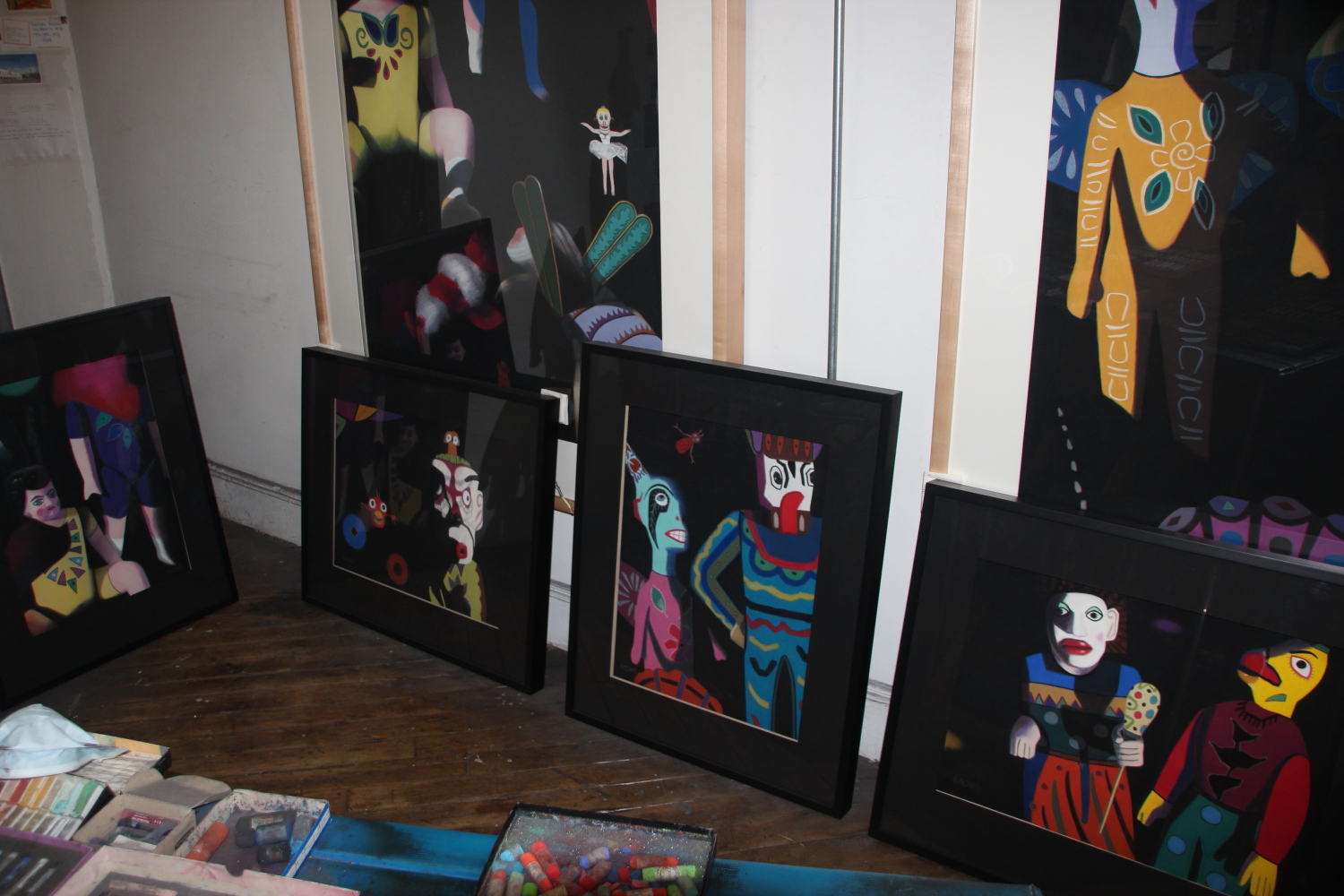
Recent work
A: I’m more critical on days when I am sad so that the faults, imperfections, and things I wish I had done better stand out. Fortunately, all of my work is framed behind plexiglas so I can’t easily go back in to touch up newly-perceived faults. It reminds me of the expression, “Always strive to improve, whenever possible. It is ALWAYS possible!” However, I’ve learned that re-working a painting is a bad idea. You are no longer deeply involved in making it and the zeitgeist has changed. The things you were concerned with are gone: some are forgotten, others are less urgent. For most artists the work is autobiography. Everything is personal. When I look at a completed pastel painting, I usually remember exactly what was happening in my life as I worked on it. Each piece is a snapshot – maybe even a time capsule, if anyone could decode it – that reflects and records a particular moment. When I finally pronounce a piece finished and sign it, that’s it, THE END. It’s as good as I can make it at that point in time. I’ve incorporated everything I was thinking about, what I was reading, how I was feeling, what I valued, art exhibitions I visited, programs that I heard on the radio or watched on television, music that I listened to, what was going on in New york, in the country, in the world, and so on. It is still a mystery how this heady mix finds its way into the work. During the time that I spend on it, each particular painting teaches me everything it has to teach. A painting requires months of looking, reacting, correcting, searching, thinking, re-thinking, revising. Each choice is made for a reason and as an aggregate these decisions dictate what the final piece looks like. On days when I’m sad I tend to forget that. On happier days I remember that the framed pastel paintings that you see have an inevitability to them. If all art is the result of one’s having gone through an experience to the end, as I believe it is, then the paintings could not, and should not, look any differently.
Comments are welcome.
Pearls from artists* # 14

“Myth Meets Dream,” soft pastel on sandpaper
* an ongoing series of quotations – mostly from artists, to artists – that offers wisdom, inspiration, and advice for the sometimes lonely road we are on.
The tendency to complete a Gestalt is so strong that it is surprising so many people have trouble finishing tasks. It just shows the inherent difficulty of getting anything physical accomplished. Matter is stubborn. Only dogged effort brings a concept into an arena in which it can demand the serious attention we give a challenge to our own physical selves. It is here that “conceptual art” tends to be, using Alexandra’s (Truitt’s daughter) adjective, “lame.” The concept, remaining merely conceptual, falls short of the bite of physical presence. Just one step away is the debilitating idea that a concept is as forceful in its conception as in its realization.
I see that this might be considered an intelligent move. The world is cluttered with objects anyway. The ideas in my head are invariably more radiant than what is under my hand. But something puritanical and tough in me won’t take that fence. The poem has to be written, the painting painted, the sculpture wrought. The beds have to be made, the food cooked, the dishes done, the clothes washed and ironed. Life just seems to me irremediably about coping with the physical.
Ann Truitt, Daybook: The Journal of an Artist
Comments are welcome.


 barbararachkoscoloreddust.com