Blog Archives
Q: Would you talk about some of your early experiences with art?
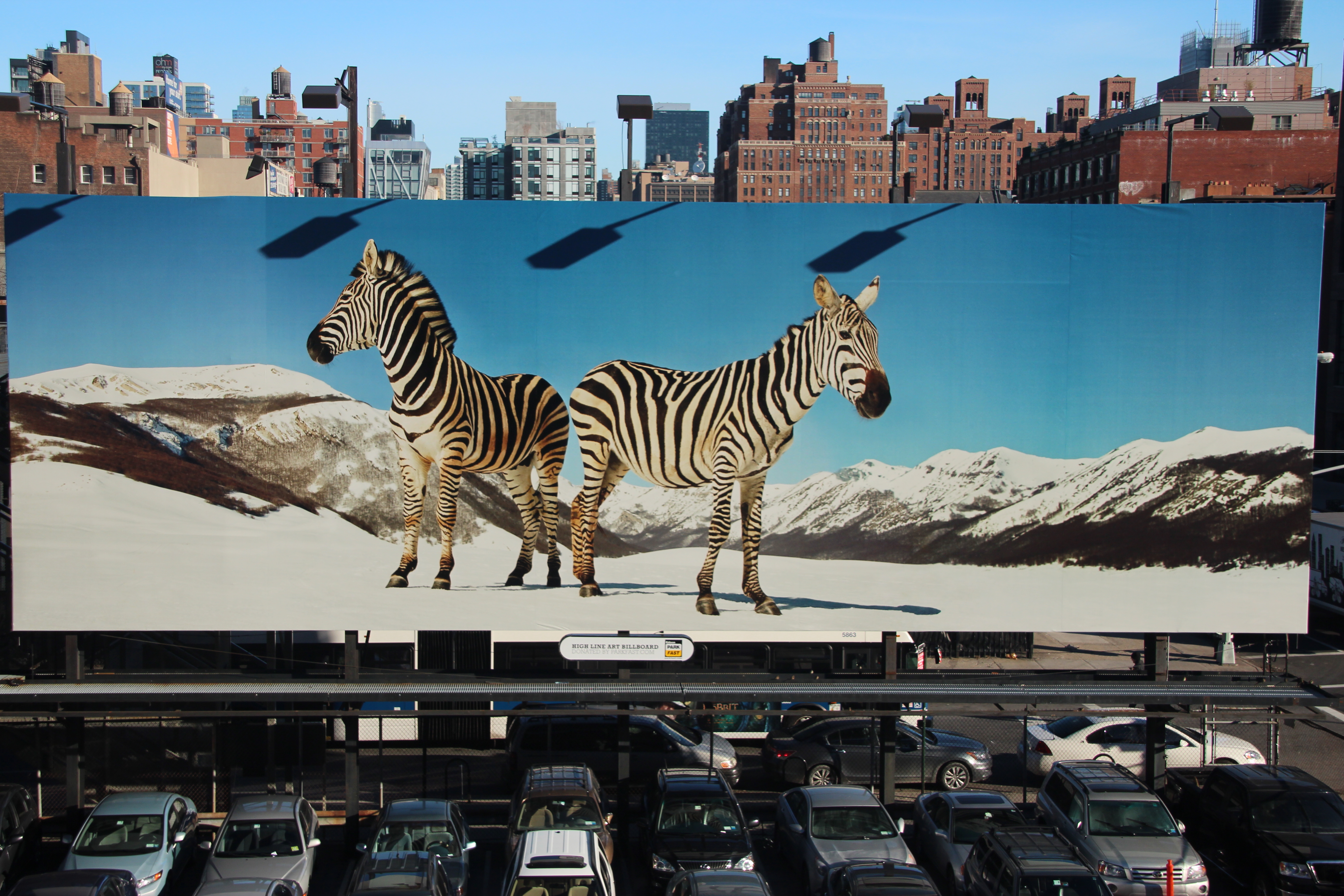
Zebras in Chelsea
A: I grew up in a blue collar family in suburban New Jersey. My father was a television repairman for RCA. For awhile my mother worked as a sewing machine operator in a factory that made women’s undergarments, but mostly she stayed home to raise my sister and me (at the time I had only one sister, Denise; Michele was born much later). My parents were both first-generation Americans and in those days no one in my extended family had gone to college. I was a smart kid and showed some artistic talent in kindergarten or earlier. I have always been able to draw anything, as long as I can see it (i.e., I require a visual reference as opposed to drawing from memory). I remember copying the Sunday comics, which in those days appeared in all the newspapers. At the age of 6 my mother enrolled Denise and me in Saturday morning painting classes at the studio of an artist named Frances Hulmes in Rutherford, NJ. I continued the classes for about 8 years and became a fairly adept oil painter. Living just 12 miles from New York City in Clifton, New jersey, my mother often took us to museums, particularly the Museum of Modern Art, the Metropolitan Museum of Art, and the Museum of Natural History. I remember falling in love with Rousseau’s “The Sleeping Gypsy” and being astonished by the violence and scale of Picasso’s “Guernica,” when it was on long-term loan to MoMA. I have fond memories of studying the dioramas at the Museum of Natural History. They are still my favorite part of the museum. I suppose it goes without saying that there were not any artists in my family so I had no role models. At the age of 15 my father decided that art was not a serious pursuit – he said it was a hobby, not a profession – so he abruptly stopped paying for my Saturday morning lessons. With no financial or moral support to pursue art, I turned my attention to other interests (ex. I learned to fly airplanes, becoming a commercial pilot and Boeing 727 flight engineer) and let my artistic abilities lie dormant.
Comments are welcome!
Pearls from artists* # 9

Lower Manhattan
* an ongoing series of quotations – mostly from artists, to artists – that offers wisdom, inspiration, and advice for the sometimes lonely road we are on.
ART when really understood is the province of every human being. It is simply a question of doing things, anything, well. It is not an outside, extra thing.
When the artist is alive in any person, whatever his kind of work may be, he becomes an inventive, searching, daring, self-expressing creature. He disturbs, upsets, enlightens, and he opens ways for a better understanding. Where those who are not artists are trying to close the book, he opens it, shows there are still more pages possible.
The world would stagnate without him, and the world would be beautiful with him; for he is interesting to himself and he is interesting to others. He does not have to be a painter or sculptor to be an artist. He can work in any medium. He simply has to find the gain in the work itself, not outside it.
Museums of art will not make a country an art country. But where there is the art spirit there will be precious works to fill museums. Better still, there will be the happiness that is in the making. Art tends toward balance, order, judgment or relative values, the laws of growth, the economy of living – very good things for anyone to be interested in.
Robert Henri, The Art Spirit
Comments are welcome.
Pearls from artists* # 7
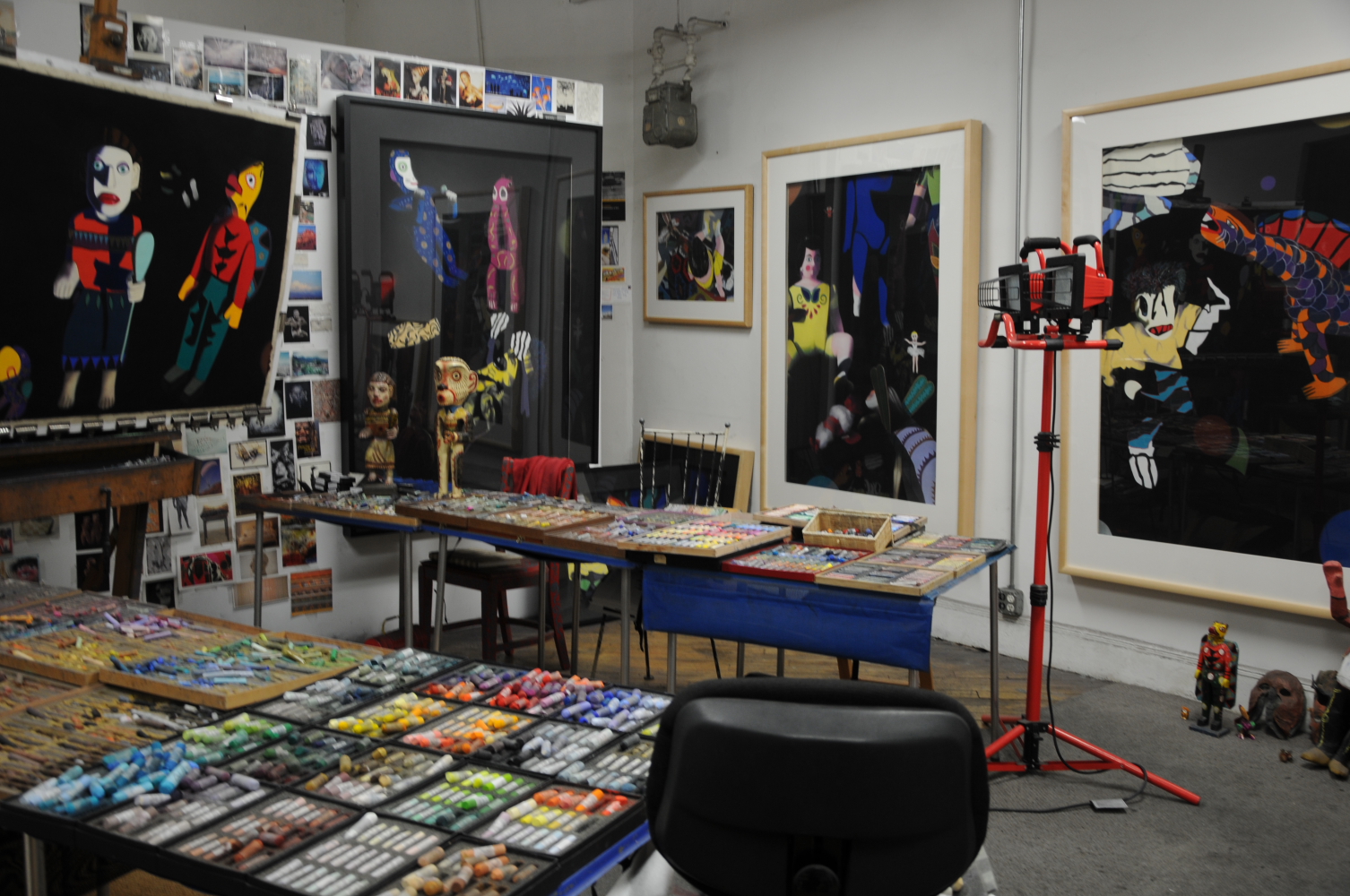
Barbara’s studio
* an ongoing series of quotations – mostly from artists, to artists – that offers wisdom, inspiration, and advice for the sometimes lonely road we are on.
It’s painful to think of the number of paintings that don’t work, not only my own, but also what I see in galleries and museums. Such failures may be adequately painted but they don’t sing. They left the studio but they aren’t happy about it. It’s simple and inevitable: there’s work we artists do that doesn’t come together. And for each of us there’s only one solution to this problem. You just continue to make paintings, and you make more paintings, and then for no particular reason all of a sudden you start to click and all the pieces that you’ve been working with, the direction you’ve been perceiving “as if through a glass darkly” is now open and clear, in all its glory. We paint and everything falls into place. That expression of “being in the zone” expresses the experience perfectly. There is a momentum you’ve built up which was essential to this work. If you had been waiting for inspiration, waiting for that flow to begin, it would have caught you too flat-footed to notice. It arrived out of the readiness that all the previous work created in you. Regardless of how sluggish that process may have seemed at the time, things were lining up in preparation, ideas were formulating.
Ian Roberts, Creative Authenticity: 16 Principles to Deepen Your Artistic Vision
Comments are welcome.
Q: There is plenty of joyful and vibrant color in your work, but shadows are also ever-present. I would almost go as far as calling them the supporting players of your compositions. Can you elaborate on their importance and significance?

“She Embraced It and Grew Stronger,” soft pastel on sandpaper
A: When I arrange the setups, I spend a lot of time lighting them, mainly in a search for intriguing cast shadows. At one point in the “Domestic Threats” series the shadows became so important that I thought of them as physical objects in their own right. So I made them very prominent, outlined them, and otherwise gave them added emphasis. Often they had no relation to the actual objects as I created any shadow shapes that looked interesting in the painting. When I go to art galleries and museums, I always look at the shadows surrounding well-lit three dimensional objects. I find shadows quite fascinating. How less visually satisfying Calder’s mobiles and stabiles would be without the cast shadows!


 barbararachkoscoloreddust.com