Category Archives: Working methods
Q: The imagery used throughout your work evoked glimmers of childhood memories, specifically “Punch and Judy” puppet shows. Would you talk about your use of this kind of slightly sinister iconography?

Barbara and Tomas in Panajachel
A: I don’t really see my iconography as sinister, although I know some people do.
I search the markets and bazaars of Mexico, Guatemala, and elsewhere for folk art objects – masks, carved wooden animals, papier mache figures, children’s toys – to bring back to New York to photograph and paint.
Color is very important – the brighter and the more eye-catching the patterns are on these objects the better – plus they must be unique and have lots of personality. I try not to buy anything mass-produced or obviously made for the tourist trade. The objects must have been used or otherwise look like they’ve had a life (i.e., been part of religious festivities) to draw my attention. How and where each one comes into my possession is an important part of the creative process. Making this work is a long, complex undertaking with many facets. Finished paintings are always an idiosyncratic blend of reality, fantasy, and autobiography.
Finding, buying, and getting the objects back to the U.S. is sometimes circuitous, but that, too, is part of the process, an adventure, and often a good story. Here’s an example.
In 2009 I was in a small town on the shores of Lake Atitlan in Guatemala, called Panajachel. After returning from a boat ride across the lake, my friends and I were walking back to our hotel when we discovered a wonderful mask store. How fortuitous! I spent some time looking around, made my selections, and was ready to buy five exquisitely-made standing wooden figures, when I learned that Tomas, the store owner, did not accept credit cards. I was heart-broken and thought, “Oh, no, I’ll have to leave these Panajachelitos behind.”
However, thanks to my good friend, Donna, whose Spanish was much more fluent than mine, the three of us brain-stormed until finally, Tomas had an idea. I could pay for the figures at a nearby hotel and in a few days when the hotel was paid by the credit card company, the hotel would pay Tomas. Fabulous! Tomas, Donna, and I walked to the hotel, where the transaction was made and the first hurdle was overcome.
Working out the packing and shipping arrangements took another hour or two. This was a small village off the beaten track so boxes and packing materials were scarce. As we figured out the details, Tomas and I realized we liked and trusted each other, became friends, and exchanged telephone numbers. The store did not even have a telephone so he gave me the phone number of the post office next door, saying that when I called, he could easily run next door!
Most wonderfully, the package was waiting for me in New York when I returned home from Guatemala. All of the objects were unbroken and in excellent condition.
As I travel I am drawn to each of these figures because it possesses a powerful presence that resonates with me. It’s a mystery really. I am not sure exactly how or why, but I know each object has lessons to teach as it assumes various roles in yet-to-be-created paintings.
Coming upon a new find I wonder, who made this thing? How? Why? Where? When? I feel connected to each object’s creator and curiosity leads me to become a detective and an archaeologist to find out more about it and to figure out how to most effectively use it in my work.
The best way I can describe it: after three decades of seeking out, collecting, and using these folk art figures as personal symbols in my work, the process has become an enriching personal journey towards greater knowledge and wisdom. They are a vehicle for learning more about the world and and about myself. And what artist doesn’t love to learn?
Comments are welcome!
Start/Finish of “Motley,” 38″ x 58″ image, 50″ x 70″ framed

Beginning

Completed
Comments are welcome!
Q: How has your use of photography changed over the years?
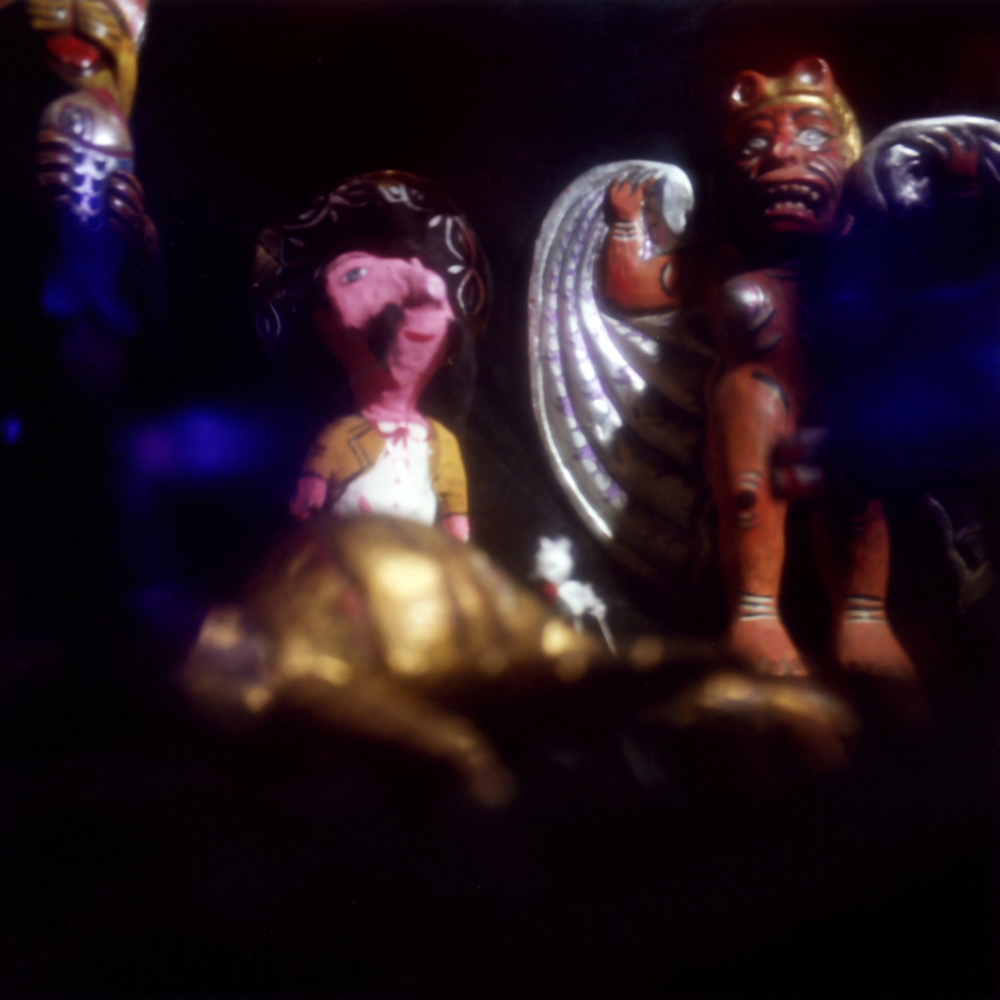
Untitled, 24″ x 24″ c-print
A: When my husband, Bryan, was alive I barely picked up a camera, except to photograph sights encountered during our travels.
Throughout the 1990s and ending in 2007, I worked on my series of pastel-on-sandpaper paintings called, “Domestic Threats.” These were realistic depictions of elaborate scenes that I staged first in our 1932 Sears house in Alexandria, Virginia, next in a New York sixth floor walk-up apartment, and finally in my current New York apartment.
I use Mexican masks, carved wooden animals, and other folk art figures that I discovered on trips to Mexico. I staged and lit these setups, while Bryan photographed them using his Toyo-Omega 4 x 5 view camera. We had been collaborating this way almost from the beginning (circa 1991). Having been introduced to photography by his father at the age of 6, Bryan was a terrific amateur photographer.
Bryan would shoot two pieces of 4 x 5 film at different exposures and I would select one, generally the one that showed the most detail in the shadows, to make into a 20 x 24 photograph. The photograph would be my starting point for making the pastel painting. Although I work from life, too, I could not make a painting without mostly looking at a reference photo.
After Bryan was killed on 9/11, I had no choice but to study photography. I completed a series of photography classes at the International Center of Photography in New York, turned myself into a skilled photographer, and presented my first solo photography exhibition at HP Garcia in New York in 2009.
Comments are welcome!
Start/Finish of “The Storyteller,” 20″ x 26″ image, 28 1/2″ x 35″ framed

Charcoal underdrawing
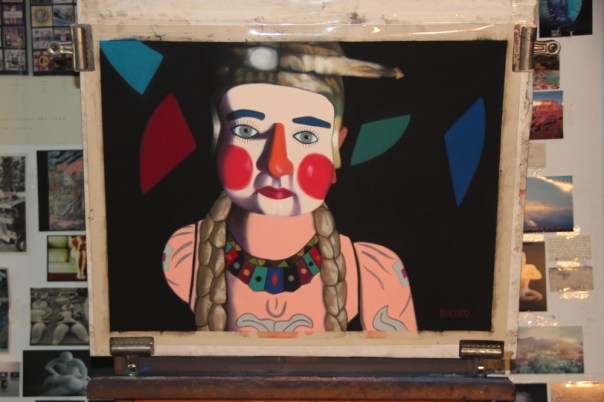
Completed and signed
Comments are welcome!
Q: What’s on the easel today?

Work in progress
A: I am working on a small 20″ x 26″ pastel painting that doesn’t have a title yet.
Comments are welcome!

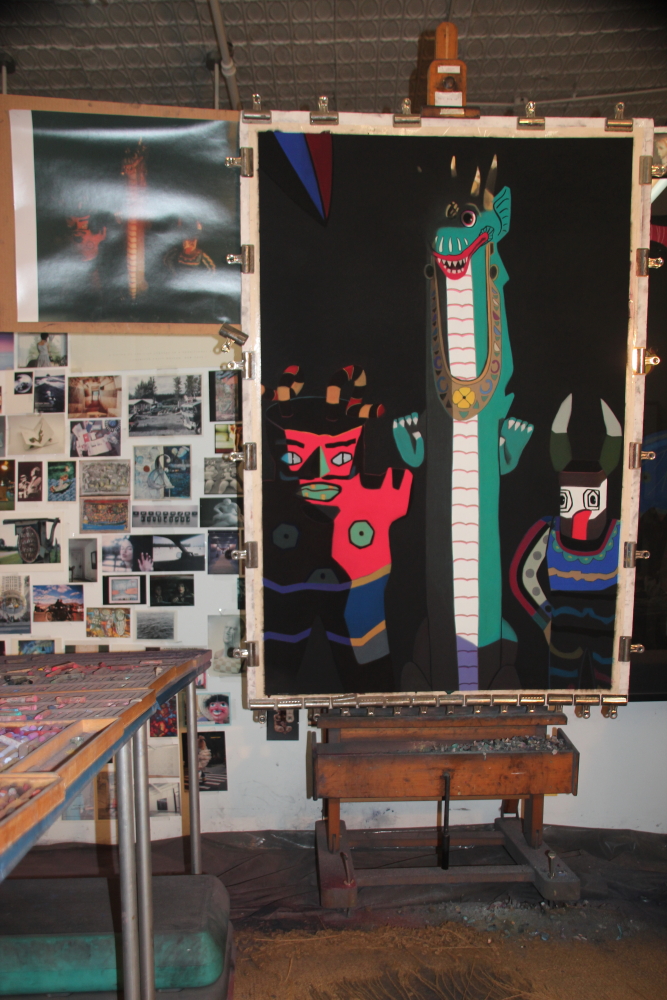
Q: What’s on the easel today?
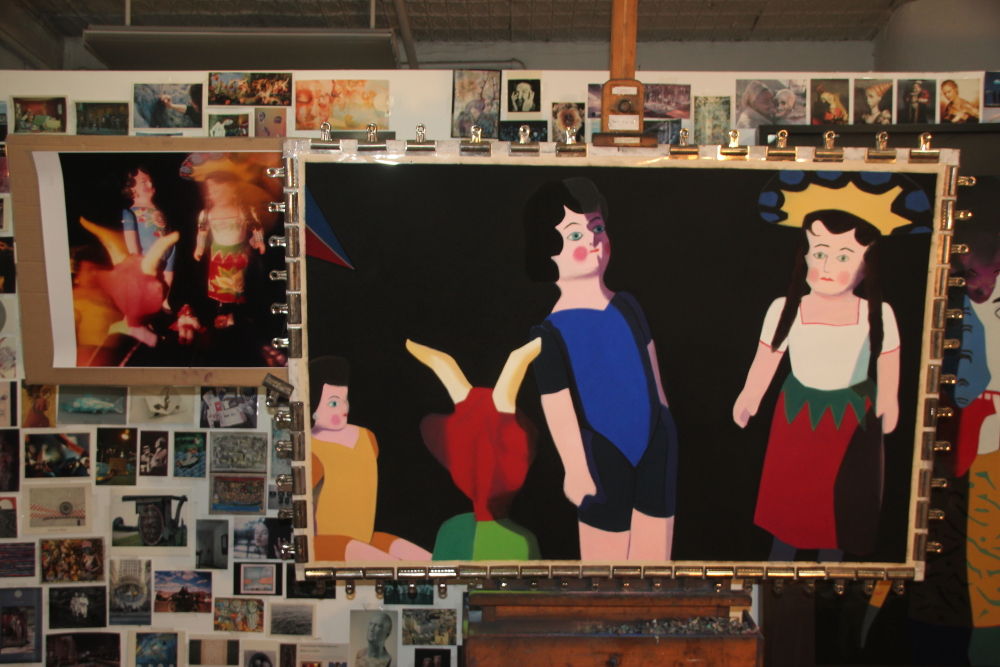
Work in progress
A: I am working on a large 38″ x 58″ pastel painting that depicts figures found years ago in Oaxaca and Mexico City. This painting doesn’t have a title yet.
Comments are welcome!
Q: Would you share your elevator pitch?
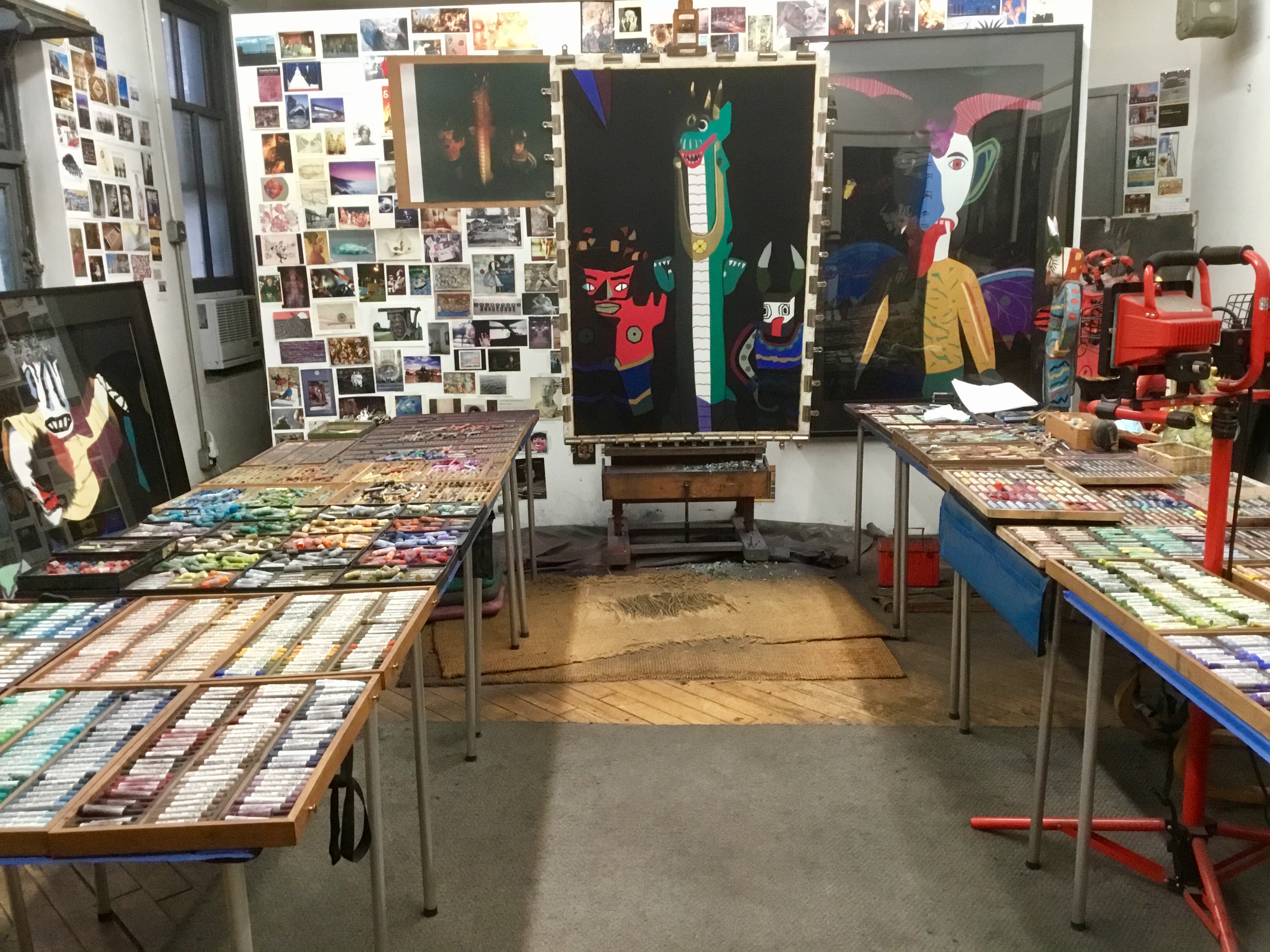
Barbara’s studio
A: Here it is:
I live in New York and have been a working artist for thirty years. I create original pastel paintings that use my large collection of Mexican and Guatemalan folk art – masks, carved wooden animals, papier mache figures, and toys – as subject matter.
Blending with my fingers, I spend months painstakingly applying dozens of layers of soft pastel onto acid-free sandpaper. My self-invented technique achieves extraordinarily rich, vibrant color and results in paintings that uniquely combine reality, fantasy, and autobiography.
My background is extremely unusual for an artist. I am a pilot, a retired Navy Commander, and a 9/11 widow.
Please see the extensive interview (14 pages so page through) at
http://barbararachko.com/images/PDFS/ARTiculAction-July2014.pdf
and see images and more at http://barbararachko.com/en/
Comments are welcome!
Q: What do you dislike most about being an artist?

Barbara’s studio
A: I am not the only artist who would say this, certainly, but the low pay is a continual frustration.
The expenses of doing business continually increase and most other professionals get to pass these on to their clients. But for artists it’s different: it’s just tough to pass along costs to collectors. One of the reasons I spend so much time educating people about the process involved in making my pastel paintings, is to provide some understanding of the serious amounts of time, effort, travel, thought, education, money, etc. that are essential to creating them.
It always surprises me when non-artists don’t appreciate the unswerving devotion and plain hard work that are required of professional artists. It makes me wonder what people imagine artists do all day.
Comments are welcome!
Start/Finish of “Palaver,” soft pastel on sandpaper, 26″ x 20″
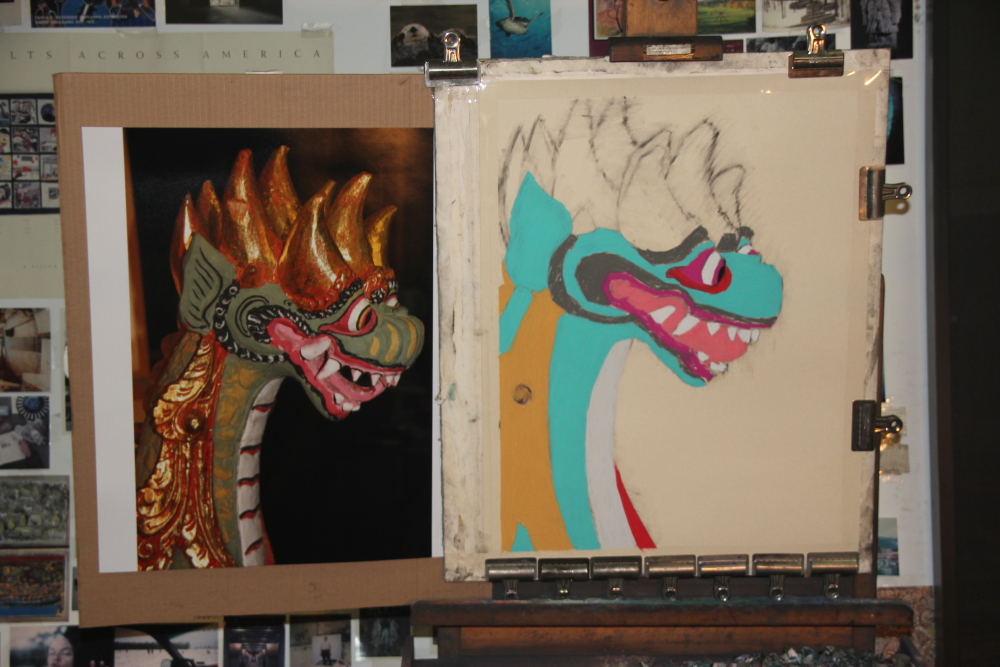
Beginning
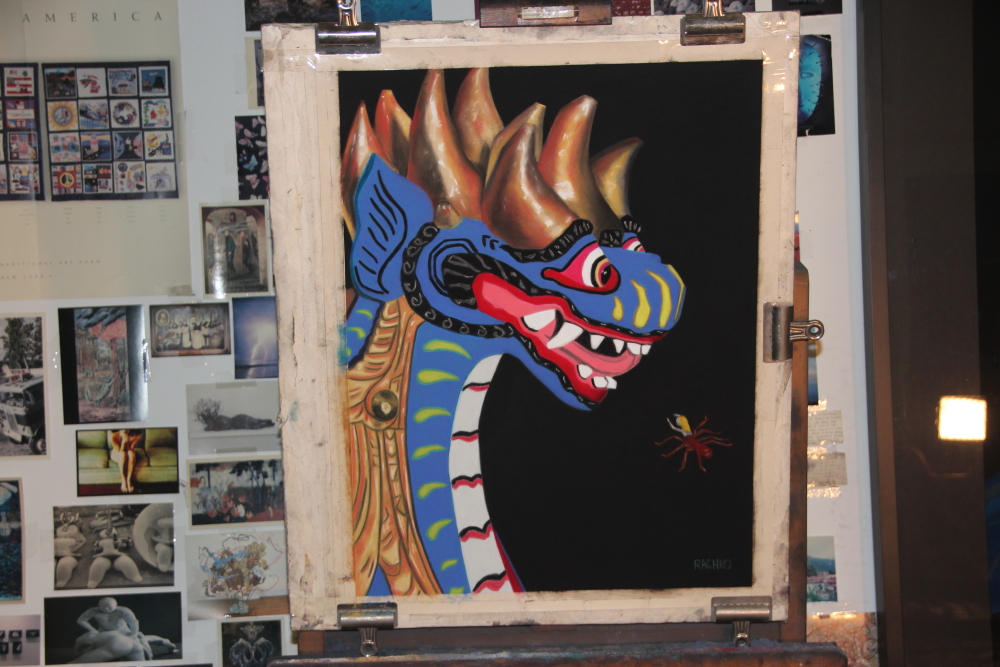
Finished and signed
Comments are welcome!



