Blog Archives

Q: Is there anything you wish you could change about life as a visual artist?

Barbara’s Studio


A: While there is much to admire and maybe even envy about being an artist, it does have some downsides. Among these, for me, is that enormous amounts of solitude are required to create art. I wish this were not the case.

Our work is entirely unique and because it starts as an idea in our heads, we must work solo to bring it into the world. We spend our days pondering, looking, and reacting, rather than speaking to anyone. As typical workdays go, it is rather odd.

I sometimes envy filmmakers who require collaboration with a large team of experts in order to practice their art. They have fellow professionals with whom they can discuss their ideas and they can solicit advice on how to make improvements. Artists rarely have this luxury.

On the other hand, visual artists don’t have to wait for anyone else to do their jobs before we can get to work. We don’t have to deal with personality conflicts or other people’s agendas. Our individual creative process is generally free of obstacles created by others. When you really think about it, the only thing that is required of an artist is to go to the studio and get to work! We are free to make our own rules and our own schedules, and, creatively speaking, are largely responsible for our own advances and setbacks.

Comments are welcome!

Q: Walk us through your “typical day”?

Barbara at work on “Schemer,” Soft Pastel on Sandpaper, 26” x 20”

Barbara at work on “Schemer,” Soft Pastel on Sandpaper, 26” x 20”

A:  I’ll describe a typical day at the studio.  When I first arrive in the morning, I read for 30 minutes. Reading focuses and quiets my mind and gets me ready to begin the day’s work.  While I read, I look at the pastel painting that’s on my easel to see where to begin.  Then I close the book, turn on some music, plug in the Halogen lamps I use while working, apply a barrier cream to my hands, put on a surgical mask (to avoid breathing pastel dust), pick up a pastel, and start.   

I never sit while working.  I enjoy the physicality of art-making and prefer to stand at my easel so I can back up to see how the pastel painting looks from a distance.  I like being on my feet all day and getting some exercise.  I work for a couple of hours, break for lunch, and then work the rest of the afternoon.

I believe artists need to be disciplined.  I work five days a week, taking Wednesdays and Sundays off, and spend seven hours or more per day in the studio.  Daylight is essential so I work more hours in summer, fewer in winter.  I like to think of art-making as independent of time tables, but I tend to work in roughly two-hour blocks before taking a break.  I typically work until 5:00 or so.

Studio hours are sacrosanct and exclusively for creative work.  I do not have WiFi at my studio and prefer to keep my computer and mobile devices elsewhere (they devour time).  Art business activities – answering email, keeping up with social media, sending jpegs, writing blog posts, doing interviews, etc. – are accomplished at home in the mornings, in the evenings, and on days off from the studio.

Comments are welcome!
Pearls from artists* # 25

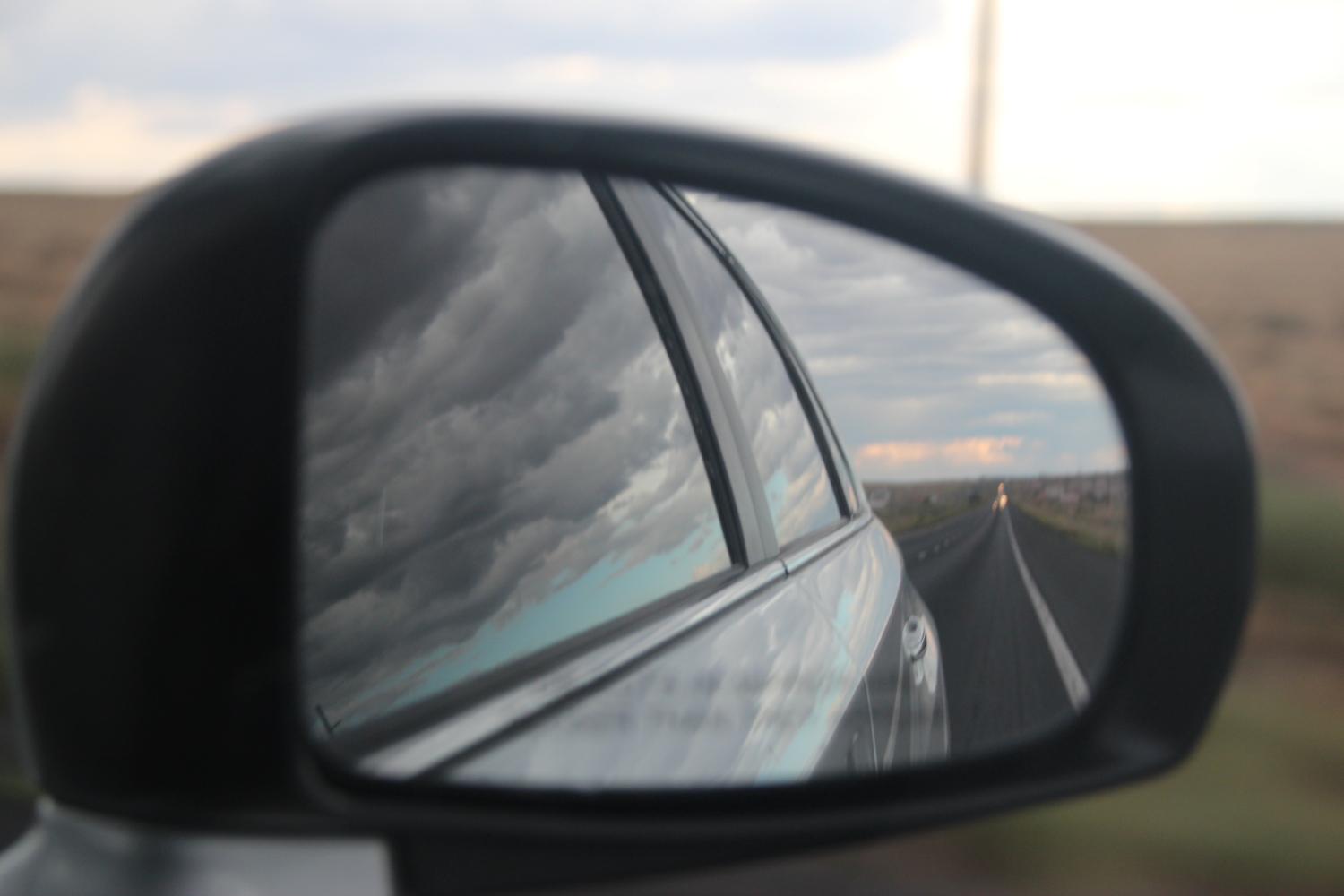
Arizona highway (Donna at the wheel)

Arizona highway (Donna at the wheel)

* an ongoing series of quotations – mostly from artists, to artists – that offers wisdom, inspiration, and advice for the sometimes lonely road we are on.

February 21, 1924.  A hell of a day yesterday.  Bitter disappointment awaits the worker in photography.

After risking my neck to get the 8 x 10 camera on la azotea – flat roof – over Tina’s room, the highest vantage point of Lucerna 12, and after straining my back and stripping my nerves to  capture a sweep of scurrying cloud forms, development revealed fog – ruinous fog – unmistakably from extraneous light – and a beautiful negative it was, or might have been!

The demon fog can play such uncanny tricks – always I am confounded, disconcerted, mystified until the trouble has been located.  All morning I squinted and poked and probed, finally patching with felt the supposed leak due to a warped back, but I lost my negative, as fine a one as any of clouds I have done.

In a blue funk, I was ready to quit, and when Galvan called, accepted his  suggestion that we ride into the country and then walk for a while.

North, and out of el distrito federal, he took us to a barranca – gorge – close by – in fact, hardly twenty minutes drive away, yet, from the desolation of this cactus covered gulch we seemed a hundred miles away from any city street.  Cactus and rock and the tortuous curves of el arroyo seco – the dry gulch – a bleakness to the spot intensified by a lowering sky, black wrathful clouds, angrily unable to spill their burden of rain.  We climbed, we shot, we lay on the dead grass and watched the sunset edge the clouds with rose, and all around stiff cacti in spreading silhouette.  Tea with Galvan, his three old aunts and Don pepe – cajeta de Celaya, te, pasas – jelly from Celaya, tea, raisins, and sweet bread.

I feel better, to hell with photography, art, women and all.

Yet – I wished for my camera today.  Those serrated stalks of the maguey, their bold uncompromising leaves cutting the horizon, they would make a fine jagged base to a typical Mexican sky.

Nancy Newhall, editor, The Daybooks of Edward Weston:  Two Volumes in One:  I. Mexico  II. California

Comments are welcome!
